
Reinvigorating the religion
Participants at the 11th World Zoroastrian Congress propound varying views to reignite the faith
Drawing cultural parallels between the local Perthians and the Zoroastrians, Mubarakai noted, "We take pride in who we are… We wear our hearts on our sleeves… Love the usual yarn — fèkamfèki — over a drink or two.” He appreciated that Zoroastrians are "humanitarian, innovative and entrepreneurial” but was concerned that "today’s leadership lacks youth” and the "children in the globalized world are stuck in front of their screens. If we do not accept that difference, the community will risk further fragmentation.”
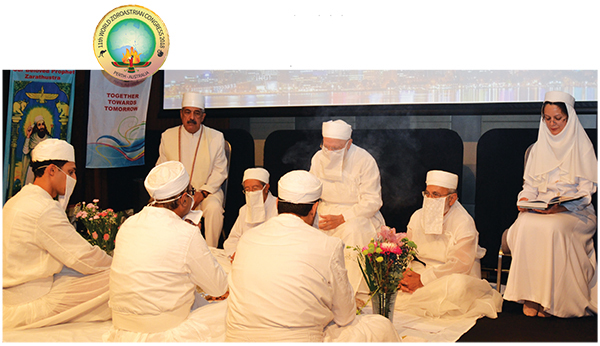
Inaugural jashan at the 11WZC with priests from India, Iran, Australia and North America
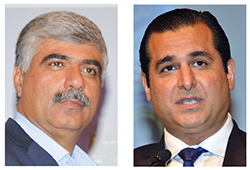
Dr Esfandiyar Ekhtiyari (l) and Yaz Mubarakai
Having progressed from "a very closed upbringing as a farmer’s son in rural India to the Parliament in Perth,” Mubarakai advocated the leaders of tomorrow to "use traditional values like respect for elders in the modern era. To make way for modern governance, leaders should be adaptable and nimble with technological changes.” His greatgrandfather was the founder of the first power house in Dahanu, his grandparents built the fire temple in that town, his father Yezdi started the auction house for chikoos in Dahanu to strengthen the bargaining power of the agriculturists. Observing their "significant contribution to social justice and imbibing their Zoroastrian values,” he mentioned, "I have tried to emulate their hard work. I want to do more for my community.” On his agenda is the creation of a Zoroastrian community center in Perth with the support of local Zoroastrians that is expected to cost AUD 1.5 million. "We have got property, 20 km southwest of the freeway… I am going to get this done,” he stated emphatically.
He referred to countries like Israel and Singapore that have "dedicated leadership programs to engage young minds,” and where young teenagers are "authorized with power to take charge of 200 men on the front lines… allowed to make mistakes.” Mubarakai urged the community that seems to be heading towards "fragmentation and disintegration” to adopt similar programs for the youth, "to invest in them… to change the future. Do you see any 16 to 18-year-olds (in the audience)? Where are we going from here?” he wondered.
"The biggest capital of Zoroastrians is its human resources, especially the youth,” noted Ekhtiyari, recommending, "All should strive for the development and growth of such a valuable asset. Proper instruction based on the teachings of Asho Zarathushtra Spitaman, more appropriate application of our spiritual capital in addition to a better exploitation of the material capital can aid us on this path… Being together, thinking together and, in hardship, keeping together is the key to this strategy.”
Ekhtiyari also read out the message sent by the President of the Islamic Republic of Iran Dr Hassan Rouhani who wrote, "Zoroaster, the messenger of righteousness and truth, always emphasized that we must avoid evils… to attain a life filled with glory and prosperity… Such a teaching… has provided the foundation for Iranian philosophy and thinking… Iranian culture is closely intertwined with Zoroastrian morality and way of thinking.” Dr Ali Larijani, Speaker of the Iranian Parliament, hoped discussions at the Congress would "provide the basis for the constitution of a world intertwined with peace and stability and devoid of tension, with an attitude towards moderation and equality which is the purpose of divine religions… (as also) bring forth valuable breakthrough and increase beneficence for the salvation of future generations.”
Demography on display
In her talk on "Zoroastrian demography through the ages,” Roshan Rivetna who has attended 10 of the 11 World Zoroastrian Congresses gave an overview of the pockets of Zoroastrians, estimating the current strength of Zoroastrians in the world at 1,18,226. "While every effort has been made to seek out reliable sources for each country, this compilation is a ‘magazine survey’, and not an official, statistically correct census,” she clarified.
From the time they numbered in millions in the Achemenian Empire the strength of Zoroastrians has vacillated. Their numbers reduced in the Seleucid Empire, recovered slowly in the Parthian Empire, gained momentum in the Sassanian Empire, declined after the Arab invasion and the subsequent Safavid, Qajar and Afghan dynasties, but recorded an increase during the Pahlavi dynasty. In 2011 they registered 25,271 as per the census data in Iran but according to some sources, the more realistic count of Zoroastrians in Iran would be around 15,000, the majority residing in the cities of Tehran, Yazd and Kerman.
With the numbers in India dropping from 69,601 to 57,264, as per the census data, the decline is 17.75%. In Pakistan the numbers have fallen from 2,121 in 2004 to 1,675 in 2012, showing a drop of 21%. Sri Lanka showed a count of 37 Zoroastrians in 2012, indicating a decline of 44%.
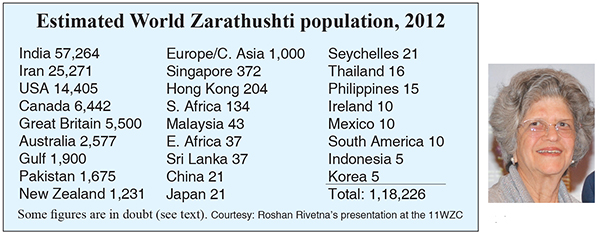
Roshan Rivetna: awesome responsibility
In the Far East, China and Japan each had 21 Zoroastrians in 2012, Malaysia had 43, Hong Kong, 204, Thailand and Vietnam, 16, The Philippines 15, Korea and Indonesia five each, and Singapore 372. Amongst all the countries, Singapore has the largest growth, 130%.
In South Africa, there were 134 Zoroastrians, in East Africa 37, and in Seychelles 21 members of the Temoolji family. In the Gulf areas, the count is estimated at 1,900.
In Great Britain there are 5,500 Zoroastrians (the 2011 Census Office for National Statistics showed the count as 4,105), 10 in Ireland and around 1,000 in Europe and Central Asia.
In the US there were 14,405 and in Canada, 6,442, showing a 24% rise in North America in the last eight years. In Mexico and Central America there are 10 with another 10 in South America.
In Australia, the estimated count is 2,577, with the largest concentration of 1,530 in Sydney, followed by 516 in Melbourne and 277 in Perth. New Zealand recorded 1,231 Zoroastrians.
Whilst acknowledging that "the population may be overcounted and there is a large percentage of intermarrieds,” Rivetna stressed, "Each and every one shares an awesome responsibility. Can we come together and work together? We have the resources, do we have the will?”
Post lunch, there were three speakers offering different perspectives on the Zoroastrian religion. "For more than four decades I have been one of those arguing for a more ‘open door’ approach. However we (Parsis) have now reached an inflection point in the struggle to survive. Preserving our uniqueness is critical. Maintaining our distinct identity is critical. We no longer have the luxury to fight each other. Intelligent conservatism is therefore the need of the hour,” asserted legal counsel and columnist Berjis Desai in his talk on "Intelligent Conservatism can improve Parsi survival prospects.” He further explained intelligent conservatism as "avoiding extreme views on either side of the socioreligious spectrum, capturing the common middle ground… Intelligent conservatism may not always be politically correct or doctrinally pure. It is simply pragmatic. Its sole objective is to increase our numbers without losing our uniqueness.”
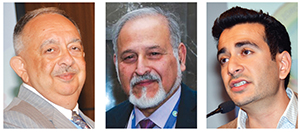
From l: Berjis Desai, Khojeste Mistree, Kobad Bhavnagri
To Desai, a Parsi woman in India who marries a non-Parsi continues to be a Parsi Zoroastrian unless it can be conclusively established that she has undergone conversion to her husband’s faith. He therefore considered the Goolrookh Gupta case currently in the Supreme Court as "damaging and unnecessary.” He conceded though that the Prochy and Sanaya Mehta case in the Calcutta High Court should be "welcomed” for it would help determine whether a navjoted child of a Parsi mother and a non-Parsi father can be regarded as a Parsi. Hoping that the court upholds a liberal view, Desai argued, "Presently too many Parsis are being lost on this account. Unable to bring up their children as Parsis, interfaith married Parsi mothers become indifferent to their religious and community identity. Many young Parsis are also repulsed by what they regard as unjustified discrimination and start disregarding themselves as Parsis. In this battle, we cannot afford to lose a single Parsi.”
The liberal-turned-conservative activist was emphatic, "The Prophet may have ‘enjoined conversion,’… however in the present situation it is suicidal to advocate or encourage outright conversion. The image of marauding hordes annihilating our unique identity is a nightmare which we cannot even contemplate… It follows that Parsis adopting a non-Parsi child cannot make such a child a Parsi… Adoption cannot be used as a device for outright conversion...”
As per Desai’s "balanced approach” it is "gravely offensive to prohibit non-Parsis from viewing the face of our dead. This is neither a religious dictat nor any time sanctified custom…At the same time we ought to banish the thought in some liberal minds which want free entry of non-Parsis into our fire temples… Intelligent conservatism demands that we preserve and cherish the environs of our fire temples… Prayer halls… being open to all is a non-issue.”
Since installing a crematorium or a burial ground in the environs of the Towers of Silence is "not a feasible option” and an aviary for breeding vultures is a "hare brained scheme” he advocated improving the efficiency of solar panels to prevent undisposed remains for a long time. As prayers for crematees are permitted at agiaries after four days, he felt they could be permitted earlier too.
In favor of "harnessing non-Parsi Zoroastrians,” he suggested sustained interaction with them and encouraging youth exchange programs between Parsis and non-Parsi Zoroastrians to understand each other’s cultural ecosystems in the hope that it will result in same faith marriages with a "gradual and slow assimilation through marriages.”
To combat the prevailing indifference in the community he stated, "Each of us has to be convinced that it is worthwhile to preserve and save Parsi culture, as an anthropological rarity if nothing else. We have to stop feeling like a community. We have to start feeling like a nation — develop legitimate pride in our unique value systems, beliefs and way of life. Israel is the best example to emulate… We have to get rid of our labels – orthodox or reformist; traditionalist or modernist, progressive or isolationist. We have to all become conservationists… to forge a consensus on contentious issues.”
"Zoroastrianism is not only the most beautiful but also the most misunderstood religion. Intellectually it has a lot to offer, being so practical and applicable to modern man,” commented Khojeste Mistree, founder of Zoroastrian Studies, founder trustee of the World Alliance of Parsi Irani Zarthoshtis and former trustee of the Bombay Parsi Punchayet in his talk on "The Prayers of Creation and Truth, Yatha and Ashem.”
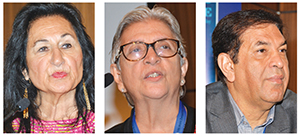
From l: Berjis Desai, Khojeste Mistree, Kobad Bhavnagri
It is not possible for any Zoroastrian ritual to be performed without the recitation of the Ahunavar (Yatha Ahu Vairyo) and Ashem Vohu prayers, stated Mistree. According to him, as the Ahunavar has the power to energize the world with positive energy so as to weaken the powers of evil.
The 21 words of the Ahunavar are limited to the 21 nasks or treatises of the religion. The first seven nasks deal with the religion, the next seven with medicine, and the last seven with philosophy and astrology as linked to religion. Ther three lines of the Ahunavar have three interlinked themes, whether seen horizontally or vertically: the physical world is to be understood through the good mind to increase the power of God; recognition of the spiritual world generates deeds to remove poverty/imbalance; the path of Truth lead to God realization.
To explain how there is a word and line symmetry in the basic manthric prayers he showed on the screen how Ashem’s inherent message of "truth is the best” and "it is happiness around one for the sake of truth” can be seen even when the core words from the three lines of the prayer follow a diagonal path.
"What does your religion teach you? Religion teaches us to be happy…Spread happiness in your environment by upholding truth. Constantly remind yourself to be happy within,” Mistree amplified on the key concept of Ashem Vohu.
"When you generate good thoughts, chances are you will generate good words that will result in good deeds… If you generate wealth, share it. Fasting and celibacy are not spiritual virtues but sins” according to the Zoroastrian religion. "By professing good thoughts, words and deeds one concurrently rejects evil thoughts, words and deeds.” He urged the audience to "reject the forces of evil that cause misery.” The propensity to argue, to fight, to run down traditions are all manifestations of evil, he said.
"Refusing to change will lead our civilization down the path of destruction,” cautioned Kobad Bhavnagri, one of Australia’s leading experts on renewable energy and the energy sector. Head of Australia and Asia-Pacific Economics and Policy at Bloomberg New Energy Finance, an independent research house specializing in the future of energy, in his talk on "Reinventing Fire: The Quest to Reinvigorate Zoroastrianism,” Bhavnagri referred to efforts by world leaders to counter the ill effects of fossil fuels that cause global warming by "reinventing fire,” an expression used by American scientist Amory Lovins.
He further stressed, "Sustainability needs to be the ultimate quest for us as Zarathushtis, not just for the planet but for our religion.” He rhetorically asked, "Have we realized that we are custodians of this religion for future generations?... If the Zoroastrian community was a company, would you invest in it?” The reason why people would not invest is "because they feel it has little to offer them in return… A huge amount of our intellectual and emotional resources are going into divisive, futile and unproductive debates about intermarriage, conversion and corpse disposal. Perhaps an even greater amount of our emotional energy is expended on factionalism, rivalry and petty communal politics… We were the rulers of one of the world’s greatest empires… the city builders of Bombay and the nation builders of India. What is our current contribution to the world, to humanity as a community today?... To protest over a train line running beneath our atash behrams. It is self-obsessed and insular.”
According to him, "Zoroastrian philosophy has the power to enrich human thought, freeing people from fear, from guilt, from submission, from oppression, from the ills of violent, manipulative and exploitative philosophies and ideologies that continue to take root in the modern world.” For a better future he suggested the quality of community leadership be improved with proper standards of governance, transparency and accountability based on a template of best practices. He also recommended other initiatives that are already being considered by the community – robust religious infrastructure to support growing communities in the West, improving the status of the clergy, creating academic chairs for the study of Zoroastrianism, global sponsorships for talented Zoroastrians to study the creative arts, establishment of a venture capital fund to promote entrepreneurship. His last suggestion was to be soldiers for good by creating a World Zoroastrian Charity which seeks to improve the lives of others, regardless of their religion.
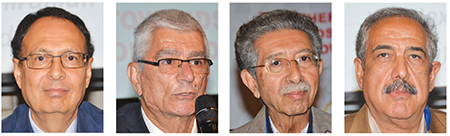
From l: Neville Shroff, Fariborz Rahnamoon, Mobedyar Maneck Bhujwala, Dr Kourosh Niknam
While these speakers were offered a podium in the larger Astral Ballroom at the Crown Hotel, the other speakers on the second day who shared their views in the adjoining Astral Ballroom were Dr Meherevar Marzbani, a psychologist, who spoke on "Gathas Today and Their Relevance;” Dr Mehran Sepehri, faculty member of the University of Technology in Iran whose subject was "1000 Points of Lights,” and Rati Wadia, former principal of Queen Mary School, who gave a slide presentation on "Eminent Parsis.”
Reconciliation through religion
"Zoroastrianism in the 21st Century” was broached once again through a panel discussion when the current rituals, teachings, tenets of the faith were reviewed by the session moderator Neville Shroff, president of the Zoroastrian Charity Funds of Hongkong, Canton and Macao, with the other participants being Dr Kourosh Niknam of France, Fariborz Rahnamoon of Canada and Mobedyar Maneck Bhujwala of California.
Advocating the need for Zoroastrians to inculcate good thoughts, in harmony with nature, Rahnamoon commented that an average individual harbors 70,000 thoughts a day which means that less than one second is spent per thought, tantamounting to waste of brain power. Rahnamoon believed that Yasna 28.5 recommends that the message of wisdom is to be shared. "If you know something good, why not share it? You are not forcing the religion on anyone.”
Niknam noted that the Zoroastrian religion has "the power to spread peace, reconciliation, love and creativity at a time when violence and cruelty take place in so many places in the world. Yet this amazing and precious faith of ours is not given much importance and status.” He mentioned how mobeds living outside Iran continuously invite new followers to the religion in America, Europe, Russia and Central Asia.
Bhujwala stressed that non athornans who undergo priestly training should be respected for taking it up as a calling rather than a career. Knowing that "Zarathushtra advocated rational thinking,” he regretted that community members show "a reluctance to face changes. We have to be proactive with innovative approaches.” Should the Zoroastrian temples open their doors to everyone? According to Bhujwala, different countries face different situations. Since the Zoroastrian religion stresses on purity and the need for a bath before entering the temple, he wondered if the shrines would be desecrated if the homeless beggars living on the streets were to enter the holy places.
Homi Gandhi, president of the Federation of Zoroastrian Associations of North America, reminisced about a trip to Iran when he was asked whether certain tourists were Zoroastrians and should be permitted inside the sanctum of the temple there. His response was "anyone who practices good thoughts, words and deeds is a Zoroastrian.”
Speeches made on the third day of the Congress will be covered in the next issue of Parsiana.