
Seminar
Enriching lives
The role and importance of Corporate Social Responsibility was examined at a seminar in memory of J. R. D. Tata
People say "the responsibility of business is business but I disagree. The responsibility of business is human development,” said Thermax chairperson Anu Aga while initiating a discussion on Corporate Social Responsibility (CSR) at a half-day seminar dedicated to the memory of the late industrialist J. R. D. Tata.
The annual meet held by the Leslie Sawhny Endowment (LSE) at The Taj Mahal Palace and Tower on December 22, 2007 saw a host of prominent industrialists and social activists participate.
CSR "is the mantra of all large companies,” said Endowment chairman Minoo Shroff inaugurating the seminar. "Only companies with empathy for the environment will be around 50 years from now.” He noted the Tatas were "the most outstanding” practitioners of CSR much before the phrase was coined. Tata Iron and Steel, now known at Tata Steel, conducted in 1980 a social audit by a three-man independent committee chaired by former Bombay High Court chief justice S. P. Kotwal.
Shroff spoke of ITC’s efforts at linking urban and rural communities and the Aditya Birla center’s work to improve the lot of 3,700 villages. The Godrej group’s vast industrial set-up at Vikhroli was "a model township,” stated Shroff while Darius Forbes of the Forbes Marshall group "enriched the lives of people around (their industrial) complex.” He termed Aga "an epitome of good corporate citizenship (who) championed human rights issues.”
Aga said the government is "a major player in social work” but a "stifling bureaucracy, waste and corruption” hampered its effectivensss. Government should facilitate and implement rather than be a player, she opined.
She cited a study evaluating the CSR effectiveness of 500 top corporations conducted by a non-governmental body Karmayog.org, a project of the R. O. Somani Charitable Trust. None made it to the highest ranking and 229 were listed as "not doing CSR as per information from their websites and annual reports.” Only four companies — HDFC, Infosys Technologies, Tata Steel and Titan Industries — achieved the second highest ranking.
She commented that companies should have a humanistic basis and see to the well-being of their stakeholders, "not only shareholders but all those who are affected by the corporation.”
While the government was the largest spender on social infrastructure, India still had a greater percent of malnutritioned children than even Sub-Sahara, she noted. "We lead the world in malnutrition,” she averred.
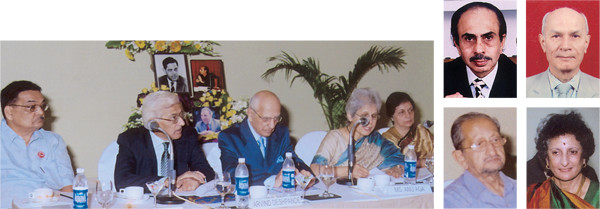
Above (from left): Sharad Joshi, LSE honorory advisor Arvind Deshpande, Minoo Shroff, Anu Aga and Sujata Manohar. Alongside (clockwise from top left): Adi Godrej, Darius Forbes, Nawaz Mody and Aspi Moddie: Good corporate goverance pays
Thermax, the company Aga’s father founded put aside one percent of their profits for social causes, observed Shroff. But when the company "was not doing well,” Aga stated all energies were diverted to survival.
She warned that unless the country did more for the disadvantaged, "the demographic dividend (would become) a demographic disaster… how long can people live with deprivation… business cannot survive in a country that has failed.” She advocated following Mahatma Gandhi’s adage, earn "enough for our needs but not our greeds.”
Writer and social activist Aspi Moddie said he once asked J. R. D. Tata why he did not advise the country’s first Prime Minister Jawaharlal Nehru on economic development and population growth. "You are closer to Nehru than any other” industrialist, Moddie told him. Tata replied, "He wouldn’t listen.” To which Aga retorted that a man’s wife is the closest to him but "how much impact” does she have on him?
"How do you get more and more businesses to follow CSR?” asked Godrej group chairman Adi Godrej. He noted that India, however, ranked third in Asia in terms of corporate governance. "Good corporate governance pays,” he noted. It "attracts talent.” The opposite, "repels talent.”
As regards global warming he noted that the developed world wished to curb the growth of countries like India and China by insisting on lower carbon emissions. The West was told "You bring them down (per person) and we’ll bring them down.” He quoted Gandhi as saying "Poverty is the biggest polluter.” Aga commented that though the carbon emissions from India were low, the country’s affluent families emitted more than westerners.
Forbes modestly attributed his group’s CSR success to being a "small family organization.” The approach was "very personalized.” He said the companies’ 1,000 employees "are involved” with the concern. "In my own neighborhood people greet me with smiles and happiness.”
Madhur Bajaj, executive director of Bajaj Auto, spoke of the need "to spread the (CSR) message.” He felt the concept of trusteeship "scares people.” The better approach would be akin to a gardener who helps things grow.
Former Supreme Court justice Sujata Manohar said, "The ultimate test (of success) is not the amount of wealth (accumulated but whether) human rights are sufficiently protected.” She cited the incidence of child and bonded labor and called for businesses to maintain values and idealism.
Finance and accounting expert Yezdi Malegam said CSR should be "a concern of the organization as a whole,” not just the top management. He called for more disclosures and a "zero tolerance code” regarding corruption.
Noting that today some individuals’ wealth was greater than that of corporates, V. S. Palekar, former head of Johnson and Johnson suggested, "CSR has to be a movement encompassing a larger number of people” than merely corporations.
Economist D. R. Pendse said if J. R. D. Tata were alive today, "he would have just smirked… there was a time when people criticized” the Tatas for their social concerns. "CSR was a way of life. J. R. D. believed what was good for India was good for Tatas.” Pendse spoke of the "Bombay Plan” drawn up in 1944 by Tata, the first such blueprint "prepared by an industrialist.” It was however "completely ignored.”
Reacting to Moddie’s remark that the gathering consisted of the converted but not others, especially the public sector, Kalindi Mazumdar, former director of Nirmala Niketan said it was "a small group of converters who convert others.” She spoke of the development work in the villages undertaken by the Birlas with which she was connected.
J. N. Tata Endowment director Dr Nawaz Mody spoke of how the trust founded by Jamsetji Tata "seeks out the best and the brightest” scholars. Many of these individuals who studied abroad are returning to India and manning top positions in the business, non-governmental and academic sectors. Terming CSR "the essence of the Tata group,” she said the concept "improves the condition of life.”
In concluding Shroff spoke about American billionaire and philanthropist Bill Gates. Ratan Tata, chairperson of the Tata group serves on the AIDS committee of the Bill Gates Foundation and told Shroff that aside from putting billions of his money into the Foundation, Gates also devoted much of his time to ensure the "effectiveness” of the trust.
◆ ◆ ◆
From the archive