
Cover Story
Assembly at Azargoshasb
Zoroastrians and non-Zoroastrians joined in the gahanbar celebrations at the ancient Azargoshasb fire temple site
As the sweet fragrance of aloes wood and incense filled the air, Mobeds Sohrab Hengami and Mehrab Vahidi prayed from the Avesta before a gathering of Zoroastrians and non-Zoroastrians at the gahanbar on September 18, 2009 at the ancient Azargoshasb fire temple site in Iran’s neighboring country Azarbaijan. Since the portals of this temple are open to the public only once a year, it attracts many people from all over the area, notes a photo feature on the event profiled on the Persian website amordad.news.com In fact, "because of the legends surrounding it and the miracle-producing powers of the ancient fire, the place still draws crowds of foot pilgrims (including Muslims) on certain days and holidays,” conveys scholar Farrokh Vajifdar. UNESCO had designated the ruins as a World Heritage Site on July 3, 2003.
Dating to the Sasanian period (224 to 651 CE) and believed to be one of the largest and most renowned fire temples of the Iranian plateau situated in west Azarbaijan, 49 km northeast to the city of Takab, Azargoshasb is located near the Orumiyeh Lake (Iran’s largest lake, its ancient Persian name being Chichast Lake, chichast meaning glittering; in the early 1930s it was named Lake Rezaiyeh after Reza Shah Pahlavi, but after the revolution renamed Orumiyeh Lake). Another source explains its location as being near Shiz, the former Sasanian city of Ganzag in Azarbaijan. "Today the site is called Takht-i Soleiman by those ignorant of its once great illustrious past,” notes Vajifdar.
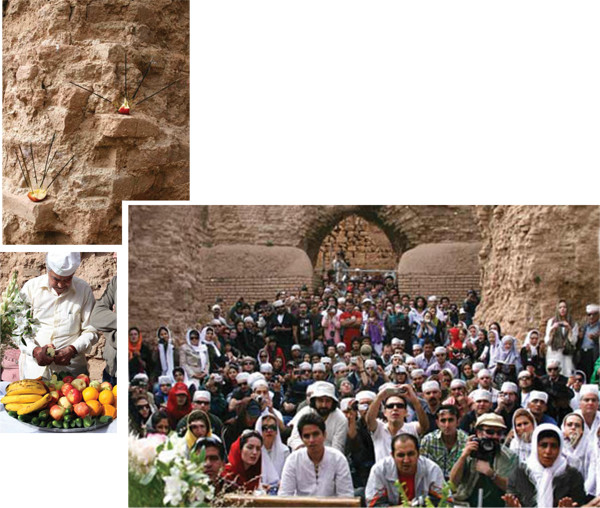
Fragrance of incense sticks and fruits being cut for distribution at the gahanbar Photos courtesy www.amordad news.com — Sima Mehrazar
Adar Goshasb, the modern Persian rendering of the Sasanian Pahlavi Adur Gushnasp, was the chief among the three great fires (fire temples) of Sasanian times. While Adur Gushnasp was the fire of royalty and warriors, Adur Khwarrah was the fire of the priests and Adur Burzen-Mihr, the fire of the peasantry. Each fire represented the three major class divisions of ancient Sasanian society, explains Vajifdar. The location of Adur Khwarrah is presumed to have been in the Iranian Helmand district and of Adur Burzen-Mihr, near Kishmar towards the northeast, although it is not certain.
Adar Gushnasp belonged to the legendary King Kay Khosru/Khosrow and was originally located elsewhere in Azarbaijan, but was later moved to Shiz. According to the Middle Persian text Bundahishn, "The fire Gushnasp used to protect the world… until the reign of Kay Khosrow. When Kay Khosrow was razing the idol temples of Lake Chichast, it settled upon the mane of his horse, dispelled the darkness and gloom, and produced light, till he razed the idol temples. He forthwith established fire altars, in the same locality, on the Asnavand mountain. For that reason they name it ‘Gushnasp,’ because it had settled on ‘the mane of the horse.’”
"For long forgotten, but long suspected, its true location was confirmed by the finds of clay bullae or stamp-seals showing its authenticity. The fire was contained amidst a vast temple complex looking out over a 40 m deep mineral lake atop a hill, obviously of volcanic origin,” mentions Vajifdar. Actually the lake forms a mineral encrusted basin which from time to time overflows into two channels down the hill.
"The entire hilltop is surrounded by a massive mud-brick wall, originally some 15 meters high and three meters thick with 38 buttress towers. The complex has north and south gateways, the former being the processional way leading into the ante chambers and pillared halls, and into view of the sanctum sanctorum where the sacred fire continually blazed. The sanctum faced south overlooking the miraculous lake,” Vajifdar explains the layout of the temple site.
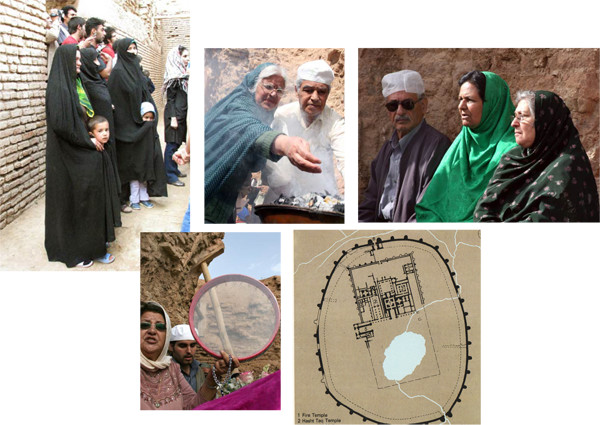
(Top row): Non-Zoroastrians and Zoroastrians attended the gahanbar, the ladies wearing traditional makna; (below) songs to the accompaniment of tambourine were rendered; (alongside) map of Azargoshasb
The principal structures that are visible today are thought to have been constructed during the reign of King Pirooz (457- 484 CE). The fire temple itself is said to have been of the chahar taqi design with a dome, the gonbad. The structure identified as the fire temple had royal quarters and a courtyard to the south. The entrance for pilgrims was from the north door and the main north gate, as per information available on the Internet.
Sasanian kings reportedly made a pilgrimage to the site upon their coronation, journeying to the temple complex on foot to endow it with costly gifts and to receive their divine investiture at the sanctuary of the eternal flame which left no ashes and from which all other sacred fires were ignited. Bahram V is supposed to have taken his Indian bride to this temple to be purified and educated in the Zoroastrian faith. And the flashy monarch Khosro II Parvez is said to have carried the embers of the Adar Goshasb fire as a kind of palladium into battle, Vajifdar sums up the historical significance.
However not all the faith reposed in this shrine could save it from the usurper, the Byzantine Emperor Heraclius from ransacking the temple and carrying off its treasures in 624 CE. To add to this desecration the corpses of his conquered victims were thrown into the lake. Worship at Adur Gushnasp is believed to have lasted until the mid 10th century, relates Vajifdar.
For the gahanbar celebration in 2009, laid on the gahanbar table were the evergreen plants of cypress and myrtle (symbols of immortality), water bowl, copper bowl, a bowl of milk, fresh fruits and lork (seven types of dried fruit) partaken by both the rich and the poor at the gahanbar. Also placed prominently was a mirror with an image of Zarathushtra engraved on it and a copy of Avesta. This is the sixth year that the ceremony was organized by the Yatha Ahu site, according to the English translation of the text on the amordad website, courtesy Rowshan Lohrasbpour.
The Zoroastrians in the congregation dutifully recited their kusti prayers and offered sandalwood and incense to the burning fire. When the prayers ended, one of the participants, known as the damavaz carried the fire censer among the congregation and as the sweet smelling incense permeated the atmosphere he repeated the Avestan word Hamazour which means "Let us unite in good deeds.” The celebration was brought to an end with the playing of the tambourine and singing of traditional Zoroastrian songs.
◆ ◆ ◆
From the archive