
Law
Managing marriage
The biggest beneficiaries of the Parsi Marriage and Divorce Act of 1865 were poor working women, notes Dr Mitra Sharafi
"As opposed to other communities, Parsis used the colonial legal system to increase their own autonomy… The Parsi matrimonial law was a creation of Parsis; as also Parsi case law, decided by Parsi judges, where most of the players were Parsis…The delegate system established under the Parsi Marriage and Divorce Act (1865) is an outstanding example of Parsi exceptionalism,” declared Dr Mitra Sharafi, associate professor, University of Wisconsin Law School, USA.

Dr Mitra Sha-rafi: researching marital strife
Sharafi was speaking on "Managing marriage: The Parsi Chief Matrimonial Court in Colonial India” at the Dr Sir J. J. Modi Hall under the auspices of the K. R. Cama Oriental Institute (KRCOI), on July 30, 2011. Her talk was based on a chapter from her forthcoming book Parsi Legal Culture in British India. The event was presided over by Dr Justice S. Radhakrishnan (retired) of the Bombay High Court (BHC) who now heads the Maharashtra State Administrative Tribunal. It was thanks to his judgment that the community won the right to universal adult franchise in the election of trustees to the Bombay Parsi Punchayet (BPP), noted KRCOI president and the BPP’s latest trustee Muncherji Cama in his welcome address.
Not only is the Parsi Matrimonial Court the only one to function from the BHC and to still function with a jury — the jury system having been abolished in India after the celebrated Commander Nanavati case in 1960 — the jurors have demanded and got a one-hour lunch break, Radhakrishnan informed the audience with a smile. The normal BHC lunch break is 45 minutes.
During her three-year research based on a set of previously unexamined case records covering the period 1893-1947, Sharafi said she had encountered 537 different cases of which only 350 had usable records. Though the earliest records have been misplaced, she admired the "rich and diverse” BHC archives and expected them to occupy her for the rest of her professional career.
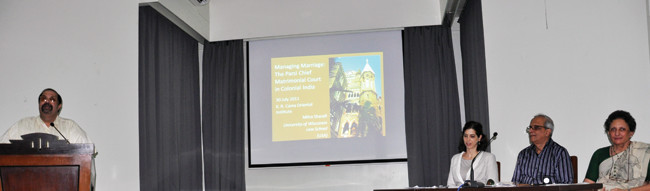
(l to r): Muncherji Cama, Sharafi, Dr Justice S. Radhakrishnan and Dr Nawaz Mody
The criminal jury system was introduced across in India "piecemeal” after 1857 when the British Crown took direct responsibility over the government of India. "It was just one of several experiments without ceding too much power to the natives, a bit of window dressing,” Sharafi noted. The courts would ask punchayets, Muslim maulvis and Hindu pandits about the community norms governing certain situations according to their tradition but initially, "their recommendations were not binding.”
Caste, community and racial bias as well as the Indians’ poor education and inability to grasp the finer points of British law were cited by those who opposed the criminal jury system. Despite that, most lawyers and judges pushed for it. Those in favor noted that the conclusions of the jurors were misdirected "because British judges misdirected the jurors.” But the jury system was approved even by the Indian independence movement as it extended the punchayet system, advanced political education and helped to balance the power of the police and the judiciary. The British tried to undermine the jury’s powers by increasing the power of the judge to raise the case to a higher level of judiciary, noted Sharafi.
Unlike others, Parsi matrimonial suits were allowed juries of their own community members, presided over by the judge who guided them on points of law. These juries comprised extremely elite Parsi men — the list of 104 delegates that Sharafi culled from the records included scions of the Jejeebhoy, Wadia and Adenwala families, individuals like Jamsetji Tata, K. R. Cama, J. J. Modi, the high priests and editors of Parsi publications, doctors and military men but only one woman, Bapsy Sabavala. The litigators, on the other hand, were mainly poor Parsi women who sought freedom from arranged marriages in which they had been trapped by force or fraud. They claimed that the husband’s side had misrepresented the facts at the time of marriage and they generally won the case, as the jurors’ decision prevailed. However, the jurors gave only conclusions, not the reasons behind them. Only when someone’s reputation could be unfairly besmirched was a brief statement added, observed the scholar. In this "court for poor women,” as it was popularly called, the community’s senior male elites disciplined their junior counterparts, noted Sharafi.
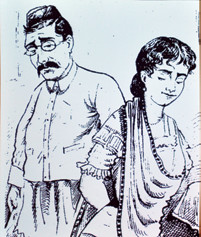
Sketch from Hindi Punch
But the personal law system introduced in the latter 1800s "actually disempowered the male elites of other communities.” Was the Parsi personal law, which also included a chapter on Parsi intestate succession, "a reward to the community for their loyalty to British rule?” wondered Sharafi who also noted that Parsis had acquired legal skills as well as jurisdiction by this time. "Parsis got the legislation drafted, pushed for it and got it passed (as Parsis were part of the governing councils at the local and all-India levels)… but it (especially the inheritance law) also displayed a lot of individual Parsi dirty linen… In Hyderabad there was a very long case that went all the way to the Privy Council.”
The British administrators went to great effort to compile and interpret Hindu and Muslim religious texts and used them to interpret cases, but the Parsis couldn’t find any equivalent religious law. So initially, pure English law was applied to Parsis, especially primogeniture or the devolution of landed property to the eldest son, said Sharafi. But the Parsi practice had been to divide property equally between their sons and in the 1860s the Intestate Succession Act was passed. "These rules were not derived from any ancient religious texts. They were based on contemporary practices and ideals of elite Parsis who also created the new system of Parsi matrimonial courts overseen by judges where 11 delegates, elected by similar Parsi elites, ruled on the issues under dispute.”
The Parsi jury then was like the early British and American institutions, not like the juries there today, said Sharafi, elaborating, "They were juries of special persons with knowledge of the subject under dispute, e.g. finance. They had a knowledge of the world, an awareness of social strata in the community.” In most cases the plaintiffs were working class women, serving as domestics and cooks. The spread of female education emboldened them to view litigation as a solution when their own natal families were unable to support them.
There were four classes of action: annulment (or cancellation) of marriage; divorce; legal separation where the couple lived separately and the husband paid maintenance, both being unable to remarry; and restitution of conjugal rights (a court order to make the spouse return to the marital home). "The husband would sue for restitution of conjugal rights and the wife would sue for judicial separation,” said Sharafi.
Bombay High Court Justice Roshan Dalvi attending the talk
There existed no such thing as divorce by mutual consent. It was fault based and nasty, she noted. And the wife had to produce more evidence against the husband than he did: if the husband could prove adultery, it was enough; the wife needed to prove adultery plus something else. "Generally, adultery plus cruelty was the standard argument,” explained Sharafi.
The custody of children was not a big issue in those days. Whoever was judged to be at fault did not get custody of the children. When desertion became a ground for divorce by an amendment to the Act in 1936, a three-year break in the relationship was enough and desertion became a euphemism for a no-fault divorce. But after that custody issues became more acrimonious.
Describing some of the case law she encountered in the archives, Sharafi noted that allegations of force and fraud from the husband’s side were made by the wife. There were cases of insanity and/or impotence that surfaced which were not mentioned by the marriage broker as the family in question believed that "marriage would cure the boy.” Thus, in 1895 an impotent and insane husband became violent on the first night. The wife left the marital home and never returned. Though the jury needed to give only a majority verdict, it was unanimous in granting divorce to the wife. Similarly, in 1919 a World War I soldier admitted that he was impotent and that his mother and the broker were aware of it. "The wife was declared a virgin after a medical examination required by the court,” noted Sharafi. In 1914 a marriage unconsummated after 14 years was declared void by the court. The husband told the doctor who examined him that he had no desire for sexual experience and had consented to marriage under pressure.
A stranger case was that of Dinbai vs Eruchsha Toddywalla in 1916 where the wife sued for restitution of conjugal rights. Questioning his wife’s racial purity, the husband had abandoned her and accused her and the marriage broker (who was paid after the marriage as per the prevailing convention) of fraud. According to him, there was no marriage because it had not been revealed to him that she had partly African ancestry. She was the illegitimate daughter of a Parsi trader in Madagascar and his mistress who was born of a Parsi father and a local mother. "The illegitimacy was not as important as the racial impurity because he contended that she was not a Parsi Zoroastrian and therefore could not be married under Parsi law,” Sharafi related the argument. "The husband had enquired of the broker, ‘Why is the girl’s complexion so dark?’ and was told it was because of the water in her village. It would improve in Bombay. The feisty wife countered, ‘Is a woman a cucumber or a watermelon to cut and see inside?’ The jury awarded the case to the wife saying her Parsi father was enough (for her to claim to be a Parsi),” said Sharafi, adding, that at that time the later, more orthodox, concept of Parsi identity had not yet taken hold.
Sharafi argued that these cases demonstrated the "dynamics of power of the senior male elites as they policed community systems and took special interest in the less privileged junior members of the community. The way they exerted social influence and legal power is unique in the colonial context.”
The well-attended lecture elicited lots of questions from the audience:
Did the 1936 amendment make it easier for the husband to inflict corporal punishment? There was a big debate on the definition of injury that would empower divorce, replied Sharafi. Basically the list of injuries in the Indian Penal Code applied, with the milder injuries removed from the divorce law. "Between 1936-47 there were no cases on this, but (later) lots of serious violence was alleged by wives.”
How did cousin marriages fare on the divorce register? Sharafi said she was expecting them but didn’t find them, perhaps because the families patched up the quarrels. "The really protracted cases were inheritance suits. It was as though some line that once crossed kept the fight going, like a switch that’s been flipped. Such family disputes got particularly bad.”
"Trying to understand the cultural complexities of the Parsi community,” one member of the audience expressed surprise that divorce was considered a solution and that the litigants were legally literate despite being very poor. "Were there fewer middle class cases because of stigma?” he enquired.
Sharafi agreed that there was stigma twice over: the stigma of going to court and the stigma of filing for a divorce. "If the woman could avoid it, she would. Her first choice would be to return to the maternal family. As for legal consciousness, how do you decide when to go to court? Was the marital strife kept a secret? Were they bullied into not going to court? It depended on the family’s reputation. But once the family’s history was generally known, the seniors pushed the youngsters to court. While their chariness about violence-nonviolence kept the Jains away, Bohri Muslims managed to keep most of their cases out of court,” the religious head of the community having the authority to decide on individual disputes. "Parsi legalism has to do with the theology of fighting untruth… In the Parsi tradition priests don’t resolve disputes.”
A member of the audience pointed out that the percentage of divorce in Nowroz Baug was extremely low. Was it due to the influence of neighbors?
"Toleration does not mean that marriages are more successful,” responded Sharafi but agreed that she had not come across many cases from Parsi colonies, ascribing the lower levels of violence to the close knit social life and the neighbors’ proximity.
In answer to a query about other communities Sharafi noted that Hindu and Muslim family law had been well established by 1865. "There are two types of rule or law, one which applies to everyone, e.g. anti-smoking. The other, when it applies to restricted numbers …The British government would not give up power to the others. The Parsi personal law did not affect anyone else. The Muslim Waqf Act was passed in 1910; divorce was broached by Mohammed Ali Jinnah in the 1930s. The Hindus got their legislation after Independence.”
"After 1936 there were more grounds for divorce and the number of divorces increased to 15 percent per year. Did more laws create the taste for more litigation?” Sharafi wondered.
Radhakrishnan noted that after the last amendment to the Parsi Marriage and Divorce Act, 98 to 99 percent of cases are filed under the provision for divorce by mutual consent. He said he had had to conduct only two trials despite having presided over the Parsi Matrimonial Court thrice. He was more concerned about the delegate system which has deteriorated as "today nobody is willing to sit as delegates” and the type of delegates and their level of knowledge leaves much to be desired. "Under the Act the judge cannot overrule the jury when they say it is not an act of cruelty. Now the community should request Parliament to do away with the jury.”
◆ ◆ ◆
From the archive