
Books
How Parsis shaped the law
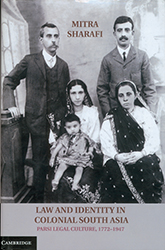
Law and Identity in Colonial South Asia: Parsi Legal Culture, 1772-1947 by Mitra Sharafi. Published in 2014 by Cambridge University Press, 32 Avenue of the Americas, New York, NY 10013-2473, USA; website: www.cambridge.org. Pp: xxiv + 343. Price: US $ 99.
Anyone surveying the contemporary legal landscape in India cannot but be struck by the steep decline in scholarship since at least the 1970s. The reasons for this, though not hard to seek, need not detain us here. The sad reality is that there has been a near complete dearth of original research even in areas where source material is abundant. Mercifully (some might say shamefully) for us, this lacuna has been filled from time to time by foreign scholars who have painstakingly thrown light on many unexplored corners of Indian law and legal history. The book under review is an outstanding example in this genre.
Mitra Sharafi is a young academic based in the United States who takes a keen interest in legal history, particularly of South Asia. Her doctoral dissertation focused on the Petit vs Jeejeebhoy and Saklat vs Bella cases which, as many readers of this magazine would know, offered captivating insights into the role that the law has played in the attempts by Parsis to forge their ethnic identity. She has since written extensively on related issues and is currently working on a study of medical jurisprudence in colonial India, another much neglected but fascinating subject.
The present book is set on a wide canvas. It is a study of Parsi legal culture from 1772 to 1947 and, geographically, it has as its backdrop the entire legal system of British India (including Burma). In simple terms, Sharafi has attempted to show how the Parsis engaged with, and to some extent shaped, the law during this period, principally through two means: intra-community litigation (which continues to this day) and successfully lobbying for legislation on such matters as inheritance and marriage. This process of engagement was clearly helped by the fact that many members of the community were prominent lawyers, judges and legislators.
Mitra Sharafi is a young academic based in the United States who takes a keen interest in legal history, particularly of South Asia. Her doctoral dissertation focused on the Petit vs Jeejeebhoy and Saklat vs Bella cases which, as many readers of this magazine would know, offered captivating insights into the role that the law has played in the attempts by Parsis to forge their ethnic identity. She has since written extensively on related issues and is currently working on a study of medical jurisprudence in colonial India, another much neglected but fascinating subject.
The present book is set on a wide canvas. It is a study of Parsi legal culture from 1772 to 1947 and, geographically, it has as its backdrop the entire legal system of British India (including Burma). In simple terms, Sharafi has attempted to show how the Parsis engaged with, and to some extent shaped, the law during this period, principally through two means: intra-community litigation (which continues to this day) and successfully lobbying for legislation on such matters as inheritance and marriage. This process of engagement was clearly helped by the fact that many members of the community were prominent lawyers, judges and legislators.

Author Mitra Sharafi
Contrary to the widely held perceptions about an inherent Anglophile tendency among Parsis, the community has, over the years, showed a remarkable willingness to distance itself from the prescriptions of English law. Nowhere is this assertion of independence more evident than in the area of inheritance. As Sharafi explains: "… the Parsis rejected English doctrines that concentrated wealth in a single person or small cluster of people. The English principle of primogeniture, for instance, entitled the eldest son to inherit all of his father’s real estate. Parsi lobbyists rejected it, insisting that all male children receive equal shares. The English doctrine of coverture or unity also had ramifications for inheritance law. It recognized husband and wife as a single legal person, making the man (upon marriage) the sole legal owner of what was formerly the woman’s property… Parsi lobbyists made coverture inapplicable to Parsis.”
 Sharafi illustrates a number of other areas, too, where the community determinedly charted a different course from that set by the English. Particularly noteworthy is the fact that many of the reforms specifically contributed to equality between the sexes, despite that concept being far from fashionable at the time. "Parsis and Britons,” notes Sharafi, "took turns championing women’s inheritance rights, making it hard to argue that Parsi law consistently lagged behind English law on gender equality.”
 Unsurprisingly – and to the edification of readers – Sharafi devotes a good deal of attention to the rise of Parsi lawyers and judges within the upper echelons of the colonial legal system – a legacy which has, of course, received widespread praise in post-independence India. Her assessment of Sir Dinshah Davar, the first Parsi judge in the Bombay High Court, will be seen by many as perceptive and balanced:
"Drawing on his own personal knowledge and an increasingly orthodox vision of Parsi identity, Davar crafted the judicial ethnography of his own community. He extended the Parsi comprador tradition from the world of trade into the world of law… Davar’s career best illuminated the magic moment that occurred for Parsis, even if it came with the inevitable pain and suffering of infighting on the public stage.”
Of such infighting, there is much in the book to both depress and amuse the reader. Sharafi’s treatment of defamation suits brought by members of the community inter se offers some hilarious insights into the Parsi psyche. Many of these suits involved periodicals like Parsee Punch and Gup-Sup which are long confined to oblivion but which, in their heyday, contributed much to the gaiety of the community and of the nation.
What, then, is the overall message of this work? It is, quite simply, that "turning to the law has become a default mode of behavior” for Parsis down the generations. "Not only did Parsis make law,” says Sharafi in slightly clichéd language, but "law also made the Parsis” (her emphasis).
Books such as Sharafi’s deserve a wider audience than they normally attract. Sadly, that would be asking for too much in the current environment of highly decimated scholarship and rampant public indifference to works of historical research within India. It is a telling commentary on the prevailing state of affairs that, despite not receiving much notice in the subcontinent, the book has won a prestigious prize from the Law and Society Association in the United States.
◆ ◆ ◆
From the archive