
Zoroastrians Abroad
Actively associated
From just three families in 1942, the Zarathushtis in northern California now number well over 1,000 families
The Zarthoshti Anjuman of Northern California (ZANC), with its headquarters in San Jose, has been serving the Zarathushti (both Parsis and Iranians) community since 1980. However, Zoroastrians had been in the Bay Area of San Francisco for at least 50 years before that, if not more. The famous Bombay pickle makers, the Poonjiajis, introduced Indian pickles to San Francisco in the 1920s with first exports of Indian condiments. But permanent residence was not recorded till the arrival from Vancouver, Canada of Rustomji Bejonji Bana in November 1942 at the height of World War II. Bana had three sons: Adi, Nusli and Nari (note all three names shortened for ease of pronunciation and spelling for Americans). Bana mentioned that in 1942 there were only three Parsi families in San Francisco, those of Rustom Patel, Kaikhushroo Hormuzd, and the Daver family who had migrated from Hong Kong. The immigration officer in San Francisco, on learning that Bana was a Parsi, informed him about the other Parsis mentioned above! Bana also went often to Los Angeles on business and came in contact with Dastur (Dr) Framroze Bode who encouraged him to form an association in the San Francisco Bay area.
A few of the above got together and met at the Lake Merced Boat Club hall on a Sunday sometime in late 1975. The ladies prepared dhansak with kachubar. So many Parsis turned up that the hosts ran out of food and had to get some cookies and cakes from the Boat Club restaurant! In addition to the Patel, Hormuzd and Daver families there were now three other families: Dhun and Gerty Pocha (partners of "Pocha’s Seeds” of Poona), Darab Dhunjisha and Dinshaw Gharda (a student at the University of California, Berkeley). For many years after this meeting these six Parsi families became very close and often met to celebrate Parsi festivities at some restaurant or the other. Thus there was the formation of a Parsi group but no formal association existed, as yet.
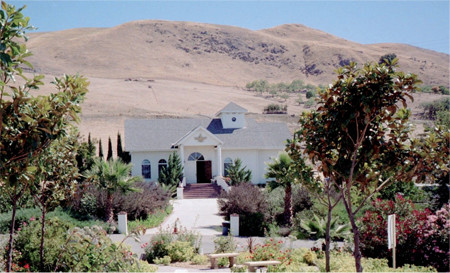
The Arbab Rostam and Morvarid Guiv Dar-E-Meher at San Jose, California
By the mid-1970s there were a sizable number of Parsis living in the Bay Area, which includes San Jose. One Sunday morning Homi and Roshan Patel, who ran a small Indian restaurant called Nataraj in upscale Palo Alto invited all the Parsis of the Bay Area to have lunch at their restaurant for a nominal charge of one dollar. The response was tremendous! Which true blooded Parsi would miss a Sunday dhansak lunch offered practically free? A directory of all Parsis was compiled and an informal organization was started by Homi and Roshan, Farrokh and Mahrukh Khambata, and others with a nominal annual membership fee of five dollars.
The community began to grow steadily and after the Islamic revolution of 1979 there was a heavy influx of Iranians, many of them Zarathushtis, who came to Canada and USA as their future looked dim in Iran with the establishment of an Islamic republic ruled by mullahs. Then one day, Maneck and Mahrukh Bhujwala, who had moved to the Bay Area from Los Angeles got together with Dhun and Katie Engineer to discuss the possibility of starting a full-fledged organization of Zarathushtis. Earlier in 1974, Maneck and Dhun had been instrumental in starting the Zoroastrian Association of California (ZAC) which caters to the community in the greater Los Angeles area (or southern California). Thus they had previous experience in the matter.
On March 23, 1980, at the Jamshedi Navroz celebrations, the entire Parsi community was invited to attend a dinner meeting at another Parsi-owned restaurant, Moti Mahal in Sausalito, a sea-side neighborhood of the San Francisco Bay area, to start a formal organization and elect a committee. The meeting led to the formation of an executive committee comprising the Bhujwalas, Shazad and Dorothy Contractor, Darius and Jeroo Captain, Khorshed and Philip Dodge, the Engineers, Khadayar and Shanaz Mazda, Jimmy and Amy Makujina, Jiji and Silloo Patel and Nargish Surti. Dr Jiji Patel was subsequently elected president. It must be mentioned here that although the men took the leading role, considerable sacrifices and initial hard work was provided by the spouses. The first formal newsletter of ZANC was published and distributed in June 1980.
In August 1980, on the occasion of Pateti, the newly formed association invited well-known philanthropists Arbab Rostam and Morvarid Guiv to attend the dinner function. At the event, Dr Rostam Sarfeh, the main trustee of the Arbab Rostam Guiv Trust (ARGT) pledged an amount of $ 400,000 to the Anjuman. The funds were to be used as down payment for acquiring a permanent building and cemetery plot for the use of the entire Zarathushti community (both Parsis and Iranians) of Northern California. Unfortunately, on October 7, 1980 Arbab Guiv passed away. The ARGT has donated substantial funds for the Zarathushti associations in several North American cities, such as San Jose, Chicago, New York, Los Angeles, Burnaby (Vancouver) and Toronto, Canada, among others. If the Zarathushti religion and culture still flourishes in North America, it is partly because of the generosity and selflessness of Arbab Rostam and Morvarid Guiv!
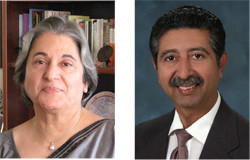
Current ZANC president, Nazneen Spliedt (left) and Maneck Bhujwala
With the increasing migration from Iran, especially after the overthrow of Shah Mohammed Reza Pahlavi, the Iranians decided to form their own association called the Persian Zoroastrian Organization (PZO). Initially, a joint ZANC and PZO committee including Rohinton Surti and Maneck Bhujwala and others worked together to search for a suitable property to house the Zarathosti Community Center as well as a dar-e-mehr. The PZO, with its good connections to the ARGT, was instrumental in eventually obtaining the donation monies verbally pledged by Arbab Rostam Guiv at the ZANC Pateti dinner. However, Sarfeh made a condition that there should be only one Zarathushti association and not two separate ones. He said that ZANC and the PZO should merge and each group should nominate two representatives to the board of the proposed Rostam Guiv Dar-E-Mehr, where they together with two members nominated by the ARGT would write the constitution and bylaws for the administration of the operation of the Dar-E-Mehr and community hall. This did not happen, and at present the Dar-E-Mehr and its property on Mt Hamilton in San Jose, which was acquired in 1984, is exclusively operated by the PZO. It is said that the PZO convinced Sarfeh that that was in the best future interest of the entire community. Nevertheless, some Parsis were upset and vociferously made a point that since the pledge of $ 400,000 was made by Arbab Rostam Guiv at a ZANC Pateti function, ZANC should handle the day-to-day running of the Dar-E-Mehr properties. Maneck Bhujwala, who was the ZANC president at the time, convinced the rebellious group to refrain from wasting monies on filing lawsuits (litigation is very, very expensive in America) which would eventually result in bad feelings between the Iranians recently arrived from Iran and the Parsis originally from India/Pakistan. The running of the San Jose Dar-E-Mehr properties remain the responsibility of the PZO, although ZANC has full access to the same.
In 1984 Erach and Silloo Tarapore proposed holding religion classes for adults and children and with the help of volunteers the first classes began at various Parsi homes in the San Francisco Bay area. Among those who actively took part in organizing, giving talks and preparing lunch afterwards were the Tarapores, Maneck Bhujwala, Mahrukh Khambatta, Homai Kasad, Annahita Jasavala, Peshotan and Hilla Irani, Feroze Doctor, Pervez and Shireen Modi, Kobad Jamshed, Nilufer Vania and Ervad Jimmy Makujina. Makujina acted as the chief priest of Northern California and delivered inspiring sermons at each prayer meeting. At the request of many, he recorded two CDs of prayers that are being used to prepare young Zarathushtis for their navjote ceremony. Unfortunately, he passed away on June 13, 2002.
After much discussion that had been continuing since 1986, a majority of the ZANC members (Parsis) agreed to contribute a sum of $ 70,000 towards the building of a new Dar-E-Mehr (a separate atash kadeh) on the Arbab Rostam Guiv Dar-E-Mehr property. The new air-conditioned fire temple which was completed in 1992 was inaugurated on Jamshedi Navroz of that year with both PZO (Iranians) and ZANC (Parsis) participating in the joint festivities. The religion classes moved to the Arbab Guiv Zoroastrian Community Center in San Jose once it was constructed in 1992. Since then, the PZO and ZANC have several joint activities each year for the youth as well as adults.
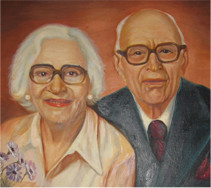
A painting of ZANC benefactors Morvarid and Arbab Rostam Guiv
ZANC frequently invites visiting scholars to give lectures on Zoroastrianism and its influence on other subsequent religions. In recent years we had lectures delivered by learned scholars such as Prof James Russell of Columbia University, New York, Profs Stronach and Schwartz of the University of California at Berkeley, as well as senior priests like Ervad Burjor Aibara, Dastur (Dr) Navrooz Minochehr-Homji and several other eminent persons.
Today, almost 30 years after the founding of ZANC, the organization continues to thrive and serve the community. A lot of time and effort have been given by the office bearers and volunteers to ensure the success of ZANC. There is a bright future for our community in North America, due to the rekindled interest and dynamism of our youth who now wish to learn more about our religion and Parsi culture. It is to this youth that we pledge the safe keeping of our Parsi heritage. As a result of timely guidance and full support from parents, several Parsi youth are marrying within the community now. Youth congresses are held each year which are attended by absolutely stunning and well-qualified Parsi and Irani youth of both sexes. They are encouraged to inter-mingle and a matrimonial bureau with a database of all prospective brides and grooms has been created.
In 1854, the Parsis of Bombay had sent Limji Manekji Hataria to Iran to improve the conditions of the Zarathushtis still living there under great oppression. Arbab Rostam Guiv whose family lived in Iran at the time never forgot the valiant efforts and courage of Hataria. He repaid that help by consolidating the Zarathushti community all over North America by donating almost his entire fortune for the purchase of property and construction of dar-e-mehrs that have kept Zarathushtis focused. I am almost certain that Arbab Guiv must have known that the future of the community rested in North America, not India or not even Iran.
At present the combined membership of PZO and ZANC in Northern California is 500 families and 555 families, respectively. But there may be many Zarathushtis who are not members. Both organizations are very active. The area covered by both PZO and ZANC is Redding to the north to San Luis Obispo in the south and Sacramento and Roseville to the east and San Francisco to the west. The PZO (http://www.pzo.info) organizes all the gahanbars, youth camps, as well as Yalda, Sadeh and Navroz functions at the Dar-E-Mehr and Community Hall. The Iranian Zarathushtis also take a leading role in organizing participation in parades that are held annually in San Jose. There are plans to set up a semi-permanent tent made of thick material which can accommodate both Parsis and Iranians at a single function. Because of strict building rules and codes in California this project has not materialized as yet. A middle-aged couple, Mehraban and Shirin Garibshahi, originally from Iran, act as onsite caretakers of the Dar-E-Mehr properties on Crothers Road off Mt Hamilton Road at a height of almost 2,000 feet. The property includes a playpen for children, a community kitchen and a lovely garden with flowering and fruit trees. A panoramic view of the city can be seen at dusk. The president of PZO at present is Shahrod Shoja.
Under the dynamic leadership of president Nazneen Spliedt, ZANC has increased its activities manifold in recent years. Spliedt (née Thanawalla) was born and educated in Karachi. With help from husband Ehler, she organizes religious classes for kids and adults, Pateti and Navroz functions, treasure hunts, picnics and visits to interesting places. A newsletter is regularly published as hard copy as well as online at ZANC’s website: http://www.zanc.org
◆ ◆ ◆
From the archive