
History
The China connection - II
After the decline of the “golden age” of Parsis in China they had little choice but to slowly retreat from the world of commerce in that country
Though Parsis were of crucial importance to several aspects of the history of modern China this has been neglected by Chinese scholars. Guo Deyan, a PhD in history who is chief of the Preparatory Department of the Palace Museum of the Nanyue Want in Guangzhou and has done research on Chinese foreign relations, has attempted to fill this lacuna in his detailed study paper titled The Study of Parsee Merchants in Canton, Hong Kong and Macao. Parsiana has reproduced edited excerpts from his study. The first part dealt with the arrival of Parsi merchants in China and how they gained acceptance in that country by adapting to its culture. The photographs published in the first installment (August 21, 2009) were sent by Hong Kong resident Jimmy Master. The second installment, carried in this issue, refers to the decline of prosperity. The final installment will dwell on the resting places reserved for the deceased Parsis.
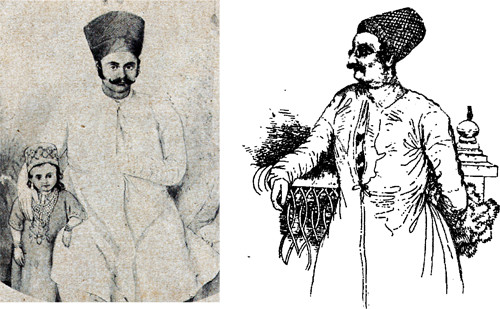
K. C. Banaji (left) and R. C. Banaji Photos: Parsi Lustre on Indian Soil
In writer Zhang Ailing’s description, Banaji had fallen on hard times. This is a realistic reflection of the decline of the Parsis’ "golden age” in China. Recall that Banaji did not have enough money to buy an extra movie ticket for Ailing. From Ailing’s description of what they got for the two cheap tickets that he could afford, we can see how down and out he was:
"It was a cinema in Central, housed in an old building that looked a bit like the early Australian-style buildings one saw in pictures. Dark and dirty, large but ungainly, these buildings made the surrounding streets seem narrow and crowded by comparison. The cinema’s billboard was plastered with huge posters of gory scenes from one of the latest films — really a big gruesome mess — but anyway, that wasn’t the movie we wanted to see, and there was already too much for the eyes to take in…
"Our tickets were for balcony seats — the cheapest seats in the very last row at the back. In this old cinema, the balcony was large and banked at what seemed to be a dangerously precipitous angle such as I had never seen before. In the dim yellow light of the lamps, we followed the usher as he clambered up to the summit of the steep, narrow staircase whose steps were covered in palm grass mats that looked like burlap sacking. Looking down, we saw the densely packed rows of balcony seats spread out like a fan below us, so steeply it seemed they would topple over at any minute. Along the edge of the balcony ran a railing, which appeared to be suspended in midair against an even lower backdrop; the whole effect was dizzying. Even after I sat down, I was afraid that I would tumble out of my seat, and gripped the armrests for dear life. When the movie started, the screen was so small that it was hard to see much of anything, and we couldn’t hear very well either. In the darkness, she [Yan Ying] handed me a little piece of fried bread to eat. Holding it in my hand, I was afraid that the oil from the bread might drip on my dress and stain it, so I ate it right away. It wasn’t bad, but I couldn’t appreciate it in such an environment. After we finished eating, we sat there doggedly trying to watch the movie; but after a while, we said to each other, ‘Let’s get out of here.’”
According to Ailing’s description, not only was Banaji able to afford only the cheapest movie tickets, but he was also hardly as well-dressed as his Parsi ancestors (once described by Zhang Deyi):
"(He was) a tall man over 50, but as thin as a skeleton. He wore a white suit, yellowed with age, in a style that had been popular 10 or 20 years before but had gone extinct almost immediately. He gave the overall impression of a character in one of Maugham’s novels, a Westerner adrift in the Orient or the South Pacific. His hair and skin were sallow; his large eyes, bloodshot and jaundiced, were the only things about him that looked Indian.”
Why did Ms MacDonald force her daughter to marry a man in such a state of decrepitude? Yan Ying provides a hint: namely, that Banaji had been "very successful in business.” In point of fact, the Banaji family had enjoyed a stellar reputation in the China trade community for over a hundred years.
Banaji (or Banajee) is a common Parsi family name. From inscriptions in Macao’s Parsi Cemetery and other original source materials, we may find the names of some of the more illustrious members of the family who ran the China trade enterprise during the Qing dynasty, such as K. C. Banaji (1812) and R. C. Banaji (1829). In the custom of the Parsis themselves, therefore, the correct polite form of address would be "Mr Banaji,” rather than simply "Jeejeebhoy” or "Framjee,” which was how they were addressed in the Opium War era. But exactly how well-off was the Banaji family? The following is not a full account of their trade activities in China, but it highlights the importance of this family:
"In the first half of the 19th century, the Banajis were leading in the Bombay-China opium trade; this earned them enormous profits, and was one of the two factors that made the Parsis ‘succeed in placing their mark upon the economic development of Bombay and India.’
"The Parsis were closely allied in business with the British firms in the early days, especially in the ownership of the clippers. Often many sixty-fourths were held by Jardine, Matheson and Company in ships which were nominally under the ownership of the Banajis or the Camas, and vice versa.”
In 1831, the Banaji family’s 305-ton ship Sylph was built in Calcutta. It could get from India to Macao in only 16 days, and so became one of the most famous clippers of the era.
In October 1839, on the eve of the Opium War, after receiving Lin Zexu’s expulsion order, and after agreeing to return to their homeland immediately, they instead lingered on the coast at Guangzhou to continue their opium trading. The British were willing to pay an inflated price for the Banajis’ clipper Sylph, but the family would not sell. Instead, they used the boat to continue smuggling opium during the War, in order to earn more money.
The Banajis were very powerful in Hong Kong after the signing of the Treaty of Nanjing. Rustomji Cawasji Banaji was a major shareholder in the firm of Rustomji, Turner and Company, which owned 27 ships that plied the route between London, Calcutta and the China coast.
The Banaji family thus epitomized the rise and fall of the Parsi merchant community in China. After the end of the Parsis’ "golden age” of trade with China, for a variety of reasons, they had little choice but to slowly retreat from the world of commerce in China.
To be concluded
◆ ◆ ◆
From the archive