
History
Gandhi and the pa-rishis - IV
Reacting with skepticism to some of the claims and demands made by the community Gandhi wrote that Parsis were “so strong that they could take care of themselves”
Poring over Mahatma Gandhi’s collected works in 98 volumes numbering nearly 50,000 pages, Dinyar Patel, a PhD student at the Department of History, Harvard University came across umpteen references to the Parsi community. The outcome of his study resulted in two academic papers on the relationship between Gandhi and the Parsis.
His first paper titled "Like the Countless Leaves of One Tree” refers to Gandhi’s efforts to engage the community in the independence movement despite the Bombay riot of 1921 when Parsis supporting the future British monarch were targeted by the nationalists. His second paper "Gandhi and the Parsis” refers to Mahatma’s efforts to involve the community, especially the ladies from well-known industrialist families, in khadi production. The salient features of his study were presented by Patel in a talk at the K. R. Cama Oriental Institute on May 28, 2009. Beginning with the July 21 issue Parsiana has been carrying edited excerpts from his papers.
Over a period of four days, the Prince of Wales Riots had claimed at least 58 lives, including three Europeans, two Parsis, one American, and five police officers. Of the 600 establishments within Bombay city licensed to sell alcohol, 135 were damaged and four were completely destroyed. Claims of compensation for personal injury or damage to property totaled Rs 2.5 million by mid-December: 132 of the total of 159 claims were filed by Parsis, including 14 of the 19 claims exceeding Rs 10,000.
In addition to this physical damage and loss of life, the riots also threatened to unravel Gandhi’s delicate diplomacy with the Parsis and his efforts to secure their widespread participation in the nationalist movement.
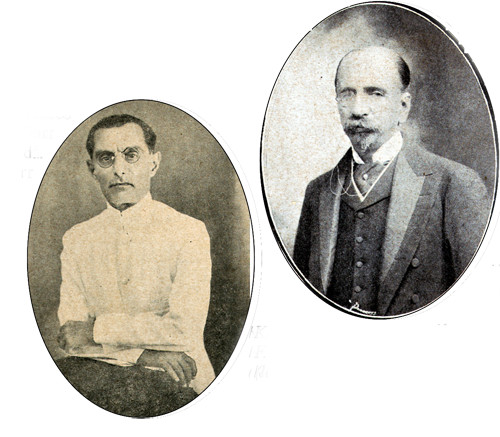
Khurshed F. Nariman (left) and Sir Cowasjee Jehangir Photos: Parsi Lustre on Indian Soil
Remarkably, the Prince of Wales Riots did not represent the breaking point between Parsis and the nationalist movement. Gandhi’s strident efforts to condemn anti-Parsi violence, outreach to the community, and his post-riots emphasis on the rights of minorities helped, to an extent, in mollifying Parsi sentiment. Importantly, some of the most vocal criticism of Parsi participation in the Prince of Wales’ welcome emanated from within the community. Khurshed F. Nariman, who had warned before the Prince’s arrival that the Parsi Punchayet’s communal address would endanger relations with other communities, held aristocratic Parsi loyalists and their "persistent and deliberate provocation” as being ultimately responsible for violence committed against the rest of the community. "…(T)he real culprits are securely enjoying the comforts and luxuries of the Malabar Hill,” Nariman wrote during the early stages of the disturbances, "while the poor masses and middle classes are left unprotected in the thick of the fight deserted to the violent fury of a fanatic mob.” Nevertheless, by 1921 even the loyalist aristocrats to which Nariman referred faced increasing difficulty in defending British rule as benign and just and, consequently, justifying their defiance of a boycott sanctioned by the moral authority of Gandhi and the Congress. The government’s sheer incompetence in handling the riots — aside from alleged arms smuggling to the Parsis, many observers claimed that soldiers and police simply stood aside and watched the violence unfold — helped diminish its credibility. Perhaps the greatest consequence of the riots was that Parsis found a position of indifference toward the nationalist movement an increasingly untenable position to hold — the community was no longer isolated from the political currents sweeping the rest of the nation — resulting in a widening chasm between pro-British and pro-Congress elements.
While Parsis, Anglo-Indians and Jews never joined the campaign for swaraj in overwhelming numbers, these communities did embrace and engage with the Mahatma’s ideas on the special rights of minorities. Gandhi, however, reacted with skepticism toward some of the claims and demands made by the Parsi community, feeling that many transgressed a fine line between rights and undue preferences. During the first Round Table Conference, Sir Cowasjee Jehangir proposed a franchise scheme weighted in favor of Parsis and other educated communities and classes; in the following months, many in the community openly called for Parsi communal representation and legislation safeguarding specific minority rights. Gandhi was clearly dismayed by such proposals, telling the Kaiser-i-Hind, a pro-nationalist Parsi paper, that "Parsis were so strong that they could take care of themselves.” Addressing an audience of the Karachi Parsi Rajakiya Sabha, an organization led by Karachi mayor Jamshed N. Mehta and Burjor F. Bharucha, the Mahatma sought to reassure Parsis that their interests "do not need to be safeguarded in any scheme of swaraj, in as much as the handful of men and women belonging to that adventurous and resourceful community have never found any difficulty in any corner of the globe wherever they may have chanced to go.”
When the Congress-led government in Bombay Province introduced prohibition in 1939, Parsis attacked the measure as a violation of minority rights and their religious principles, subsequently requesting special exemption for the community. According to Sapur F. Desai’s History of the Bombay Parsi Punchayet, 1860-1960 in a letter to the chief secretary of Bombay Province, M. P. Khareghat of the Parsi Punchayet declared that prohibition "violates the religious rights and interests of a minority community which have to be safeguarded under the Government of India Act.” Parsis also complained that prohibition would particularly harm their community due to their involvement in the liquor trade, resulting in mass unemployment. The community’s anti-prohibition efforts were complicated by the fact that the minister of health and excise responsible for introducing the measure was Dr M. D. D. Gilder, himself a Parsi. The Jewish community and the Archbishop of Bombay expressed similar concerns.
The Mahatma — who, incidentally, cited Dadabhai Naoroji as an inspiration for his views on temperance and prohibition — refused to compromise. Responding to scores of angry letters sent by Parsis, one of which cast prohibition as a Hindu plot to ruin the Parsi community, Gandhi excoriated the "terrorism of minorities” and declared that the "cry of minorities is a calumny.” The Mahatma had written in Navajivan as early as 1926, "There is no such thing as the right of drinking and, therefore, there would be no question of depriving people of a legitimate right.” In the same year he had declared, "If I have addressed my appeal to Parsis, that is because they are more enlightened than others and I expect more from them.”
In 1931, 10 years after the Prince of Wales Riots, the Mahatma traveled to Bombay to receive an official address by the Bombay Municipal Corporation, which had been dominated by Phe-rozeshah Mehta and influenced by so many other Parsis during its history. Heartened by Bombay’s support and maintenance of communal harmony during the recent civil disobedience campaign, Gandhi praised the city as "Bombay the beautiful.” He once more paid homage to the Parsi community, acknowledging that "(i)f Bombay is the premier city in India it is chiefly because of the Parsis.” Yet the Mahatma urged Corporation members — and all Indians — to look toward a future less shackled by communal boundaries and identifications. "Let all of us Hindus, Mussalmans, Parsis, Sikhs, Christians, live amicably as Indians, pledged to live and die for our motherland,” he proclaimed.
If Parsiana readers have any personal reminiscences or family stories involving Mahatma Gandhi or any of his associates, acquaintances, or volunteers, about various important Parsi Gandhians and nationalists such as Dr M. D. D. Gilder, Burjor Bharucha, Sorabji Adajania, the Captain sisters, Jamshed Mehta, or Mithubehn Petit they can contact the author at dinyar.patel@gmail.com or +001 (650) 796-2486. His mailing address is: Department of History, Robinson Hall, 2nd floor, Harvard University, Cambridge, MA 02138, USA. Concluded
◆ ◆ ◆
From the archive