
Zoroastrians Abroad
Ace astronomer
Astronomer Anahita Sidhwa, the instructor from Brookhaven College in Farmers Branch was invited to join the Oxford Round Table, July 26-31, 2009 to discuss reconciling science, humanities and religion. "The Oxford Round Table at the University of Oxford in England is a forum that strives for diversity. Invitees have been presidents, provosts and chancellors of universities. Others have been charter school, business and religious leaders,” noted a write-up in The Dallas Morning News of July 5, 2009. Pakistan born Sidhwa who is now a naturalized US citizen, told the daily, "When you look at the sky, you can’t help but be amazed and inspired by everything that is out there…And so you do get a great sense of the divine.”
Referring to the "rewarding experience,” Sidhwa outlined for Parsiana her motivation to attend the meet and her contribution, "Since the symposium title specifically had the word ‘religion’ in it, I thought it would be a good opportunity for me to address how the Zoroastrian faith and our emphasis on good thinking and individual choice have helped me find a balance between the definite and the divine.”
For her paper titled, "The Sky: Connecting Science and Symmetry with Reverence” Sidhwa used the vernal equinox as a global phenomenon that connects many cultures through the ages. "During my research I discovered that some archeoastronomers claim that the lion and bull motif found at Persepolis signifies the position of the constellations of Leo and Taurus during spring which helped our ancestors pinpoint the time of Naurooz. However for us in the 21st century, the significance of Naurooz could be that the vernal equinox represents a golden mean when the sun is neither too hot nor too cold for any location on earth and it could be used by the global community for a celebration of moderate values.”
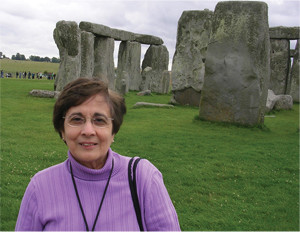
Anahita Sidhwa: "a balance between the definite and the divine”
With participants mainly from the US, Sidhwa observed, "While some of them were vaguely aware of Zoroastrians, they were surprised to hear that our faith is still very much alive. I used the word ‘ushta’ to encapsulate the teachings of our faith, since it represents the inner contentment one feels when one understands…I hope I have created awareness and appreciation for the teachings of Zarathushtra.”
Having taught at Brookhaven College, one of seven colleges in the Dallas County Community College District, almost since its inception about 30 years back, Sidhwa originally taught physics before she took over astronomy when one of her colleagues retired. "Over the years I have become more interested in astronomy and find that it is an ideal vehicle to learn to teach students science, literature, history and culture,” she conveyed to Parsiana. Nearly a decade ago she initiated two online courses in astronomy — Fundamentals of Astronomy which deals with planetary astronomy, and General Introductory Astronomy which is about stars and stellar evolution. Doing the labs online was a major challenge as each course is a four-credit hour, lab science course taken by non-science majors. Some labs are done using the planetarium program on the CD provided with the textbook, while others involve a hands-on activity using simple materials that are easily obtained, surfing the net to read of NASA (National Aeronautics and Space Administration) projects, computing and graphing. Yet, being an astronomy course, weekly campus star gazing sessions were important to give students the opportunity to look at the real sky and put eye-to-eyepiece.
A founder member of the Zoroastrian Association of North Texas and having served on various FEZANA (Federation of Zoroastrian Associations of North America) committees, Sidhwa declares, "As I see our second generation of immigrants I am very optimistic. Our children have experienced the best of all worlds, excellent educational opportunities in school and strong moral values at home. At conferences our young people speak with clarity and conviction. The Zoroastrian community may not look the same in 50 years but it will be there to continue to spread the message.”
◆ ◆ ◆
From the archive