
Business
Challenges of construction
Shahrokh Bagli and Khurshed Daruvala speak of latest trends in the construction world
"Shapoorji Pallonji is the oldest operating construction group in India. It is 143 years old. Shapoorji Pallonji and Company is the first Indian construction company to have earned the ISO 9001 certification and the first to venture into the Middle East markets in the 1970s,” stated Shahrokh Bagli, vice president, business development. Bagli was addressing World Zarathushti Chamber of Commerce — India (WZCCI) members and guests who had assembled at the West End Hotel on July 4, 2009, braving the torrential rain, water logging and traffic snarls of a typical monsoon day in Bombay, to hear his presentation entitled "Modern trends in execution of construction projects” and a talk by Khurshed Daruvala, managing director, Sterling and Wilson, an associate company of the SP (Shapoorji Pallonji) Group.
"Fortune magazine has stated that the top 500 corporates of the world average a life span of 40 years. SP has been in business for over 140!” stated WZCC Mumbai Chapter chair Pheroze Kharas. "Obviously they have done things right… The word that best describes the company is innovation, to constantly change and improve with new product processes and financial patterns, adapting to modern technological changes to sustain growth.”

Shahrokh Bagli (left): defining client-contractor relations; and Khurshed Daruvala: diversifing into new sectors
"The tried and tested way to prosperity is through business and enterprise. The House of Tatas and the SP Group would not be where they are if it were not for business,” remarked Kersi Limathwalla, president, WZCC International Board. The WZCC is a vehicle for community prosperity. "It is the only community organization that discusses, encourages and promotes economic and business matters. We leave it to other community organizations to do what they have to do.”
Bagli gave a brief overview of SP Group activities. "Shapoorji Pallonji is the holding company… (It is) solely owned by the Mistry family (who is) also the largest private shareholder (18.5 percent) of Tata Sons, the holding company of the Tata Group.” Pallonji S. Mistry is the chairman; sons Shapoor and Cyrus are the managing directors of the various business divisions. A very private person, Pallonji has chosen to remain away from the limelight, though his name has for several years figured in the Forbes list of the world’s billionaires. Group turnover in 2007-08 was US $ 1.73 billion (Rs 6,920 crore).
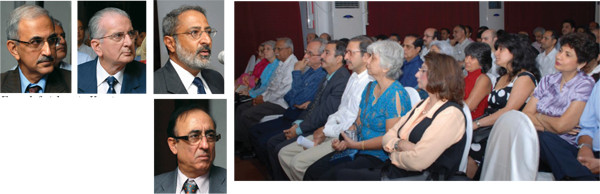
From left (above): Kersi Limathwalla, Pheroze Kharas, Shavak Bhumgara; (alongside) Vispi Mistry, a section of the audience
From small beginnings, "Shapoorji Pallonji has evolved into a conglomerate…it draws vital support from other Group companies to be able to execute turnkey projects, swiftly and efficiently,” states the SP Group brochure. Other "jewels in the SP crown” are SP Fabricators Private Limited (which specializes in high quality aluminum and glass facades and curtain walling for buildings), Afcons (a pioneer in large and complex infrastructure projects), Forbes Group (with multifarious activities in shipping, textiles, publishing, household appliances and water purifiers, precision tools, business automation systems, etc), Sterling and Wilson [a leading electro-mechanical engineering company whose range of activities covers air-conditioning, fire alarm and security systems, generating sets, HVAC (heating, ventilating and air-conditioning) projects], SP Construction Materials Group (which provides state of the art interiors from cellar to dome), SP Real Estate and Samalpatti Power Company Private Limited (which operates a diesel-fired power plant in Tamil Nadu) and other companies, the brochure adds.
"Construction is the creation of immoveable assets, be it infrastructure (i.e. heavy engineering), residential, office or industrial buildings. Construction can also involve rehabilitating old buildings,” Bagli explained. "Construction relies on the national economy. It prospers or suffers accordingly, as contractors’ prices would be too low to be viable. This was the situation in UK in the 1990s.” In a pictorial presentation, Bagli traced the genesis of construction from 10,000 BC. In the early days, the tools were simple — ramps, levers, pulleys… "Contrary to Hollywood hype, the Pyramids in Egypt were not constructed by slaves but by free men,” he quipped. Concrete was invented in ancient Rome, arches and domes were used to create spans. The Hanging Gardens of Babylon were constructed by Nebuchadnezzar II circa 600 BC but were destroyed by several earthquakes in the second century BC. In 550 BC Cyrus the Great chose the site at Persepolis as the capital of the Persian Empire and construction continued there till the fall of the Achemenians.
Civil engineering is derived from military engineering, Bagli related. The Romans built roads, bridges as part of military strategy, later transferred to civilian use. GPS (global positioning system) was first used by the military; today even cell phones have it. As construction became more organized, guilds of craftsmen were formed. The challenges of construction were overcome in myriad ways. At the Taj Mahal in Agra, for example, the invisible caisson foundations are as much a marvel to an engineer as the superstructure is to the rest of the world.
The first Industrial Revolution of the 19th century brought in railways, canals and macadam roads. The invention of optical devices, use of explosives and the steam engine ushered in a construction boom, as did the mass production of steel from the mid 19th century. In America the second Industrial Revolution in the early 20th century saw the invention of cranes and elevators, leading to the construction of landmarks like the Chrysler building at Manhattan in New York. The era also brought in the distinctive art deco culture of buildings in Bombay.
India was slow to pick up changes in construction, but very fast on computer changes! Calculation tools like the slide rule became obsolete; the computerized total station of the 21st century became the norm. Old practices continued even in manufacturing, with well-established managerial skills and practices slow to find favor in India.
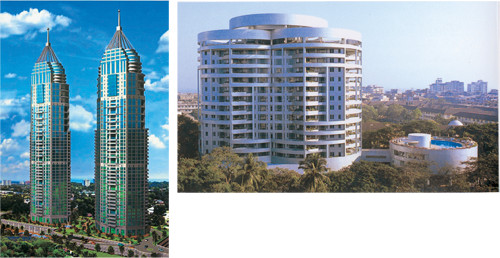
Artist’s impression of the 60-storey Imperial Towers (left); Taj Wellington Mews, Bombay
Bagli elaborated how client-contractor relations have evolved over time. "The first operating platform for construction contracts was the "item rate contract” where the architect or consultant calculated quantities but drawings were often not fully ready when the tenders were called for. Tenders were hence not accurate. Contracts were awarded to the lowest, not the most competent contractor. Terms were often stiff and unviable. In the "design and build” operating platform the contractor comes in much earlier. The owner executes a single contract with one entity (design-builder). As the maximum project cost goes to the contractor, this leads to more practical construction, with single window responsibility and focus on quality.
In the "cost plus business” model, the cost of the project derived is the GMP (guaranteed minimum price) where, if the cost works out to less than the GMP, profits are shared in agreed ratios. "There is pain share and gain share…cost overrun penalty or under-run reward…(one is looking at) business-as-usual profits, not windfall profits,” Bagli stated. "This is how we redid Kabul Serena Hotel where only the outer shell of the hotel had remained standing, the interiors had to be completely redone.”
In the "partnering or alliancing” model, the contractor makes an alliance with the owner. "It is a single multi-party contract, with common emphasis on standards, costs and time, with investment put in by each of the partners. There is no blame culture, no finger pointing, no master and no servant. Reasonable profit is good for a project. Partnering leads to improved cash flows…(there is no doubt) money makes the mare run,” Bagli described. Unfortunately partnering hasn’t really caught on in India, he added.
The key word for any project is excellence — what is required is a lean construction culture as far as money, manpower and materials are concerned. Construction today has to focus on new drivers — importance to ecology, energy conservation, greater use of natural resources, reducing adverse impact on the environment, enhanced safety, etc. ONGC (Oil and Natural Gas Commission) has the green building norm for all its structures, Bagli stated.
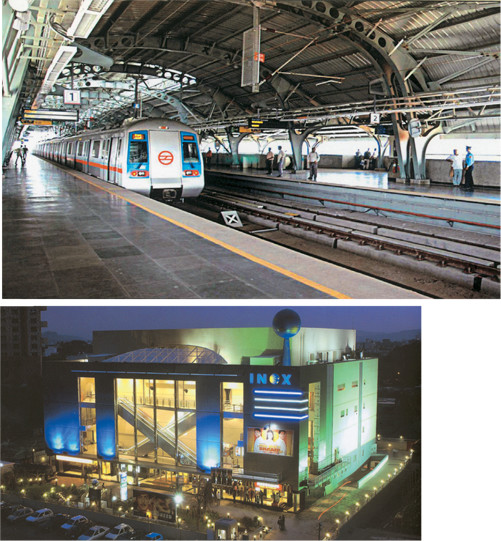
Wazirpur Metro station, Delhi and (bottom) Inox in Poona
Sterling achievement
Khurshed Daruvala took over the reins at Sterling and Wilson from his father Yazdi who passed away in 1997. The firm, established way back in 1927 by grandfather Meherwanji Daruvala as Wilson Electric Works, has grown exponentially over the last decade and has consolidated its position as one of India’s premier electrical engineering companies. Foraying into providing turnkey MEP (mechanical, electrical, plumbing) solutions, Sterling and Wilson has become, in a short span of four years, one of the top four HVAC contracting companies and among the top three DG (diesel generating) set manufacturers in India, Daruvala recounted. Sterling Generators manufactures DG sets and electrical panels at its state of the art facility at Silvassa and is one of the largest plants in Asia making such sets, with in-house facilities for fabrication, assembly, powder coating, acoustic enclosure unit and sophisticated test banks. When Sterling and Wilson entered the air-conditioning business in 2004, capturing market share from heavyweights like Voltas and Blue Star was not easy. "We are the third largest air-conditioning contracting company in India,” Daruvala stated.
In 2008, Goldman Sachs invested in a minority stake in Sterling and Wilson. "We get more solid (financial) balance to take the hit of downmarket conditions,” said Daruvala. "Catch a trend early,” he advised. "Offering MEP services has been a catalyst in our growth and, as percentage of business, has moved to 54 percent of turnover.” Though an SP associate company, Sterling and Wilson has handled large projects from reputed corporates like Hindustan Unilever, C. L. Raheja Group, Inox Leisure, Pantaloon, Metlife Insurance, Skoda, Wipro and many others.
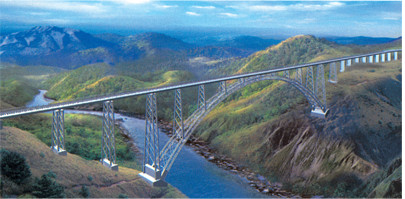
Bridge on the river Chenab
The company plans to move to gas-based distribution of power as well, with Reliance going countrywide with a gas network. "The new Four Seasons Hotel in Bombay, for example, takes no power from MSEB (Maharashtra State Electricity Board). It has three gas engines and three standby DG sets. We have positioned ourselves for this (sector) and hope to take it up in the future,” he stated. In answer to a question from the audience, Daruvala averred that the company’s strengths lay in its nimble footedness. "You place your order and we can start the next day. Corporates like Siemens, for example, cannot do that. It is a disaster to get into a business if you’re not ready…we have flexibility and a large band of satisfied clients which gets us repeat orders.”
In response to a query regarding the stability in case of earthquake of the 60-storey Imperial Towers, currently India’s tallest residential buildings, Bagli stated that the buildings are fully clad and have an intricate skeleton of RCC slabs of very high grade. Intricate software simulates seismic activity and the stresses on each member. In wind tunnel analysis, the stresses are electronically monitored and the buildings well designed for stability.
With several WZCC members evincing interest in working with/supplying SP firms goods or services, Bagli and Daruvala stated they would be happy to encourage Zoroastrian companies as vendors or specialists in particular areas like water-proofing, labor sub contract, etc.
◆ ◆ ◆
From the archive