
Welfare
The Time and Talents tiara
Whilst contributing to the sociocultural life of Bombay for the last 75 years, the Time and Talents Club has expanded its scope by providing infrastructural facilities to the neighboring rural pockets
Generations of members, editions of cookbooks, renditions by artistes, contributions to causes. The fervor is palpable and the flair is distinguishable as the ladies prepare to adorn the Time and Talents Club (T&T) tiara with a platinum jewel on the occasion of its 75th anniversary. The committed team is motivated to pursue the ideals enshrined by the philanthropic founders "who were determined to spare time from their social lives and pool together their vast talents to raise funds for the benefit of the underprivileged…” as noted the appeal from retiring president Meher Amersey.
As an all-ladies nongovernmental organization, theirs is "perhaps one of the oldest in India today,” remarks Amersey, summing up, "People know us for our music concerts (featuring international and national talent), our Recipe Books (the 11th edition of which has been printed) and the food (served at the erstwhile Victory Stall at Apollo Bunder). All this is more recent,” her outstretched hand points to the chairpersons of different committees who had assembled at her residence on June 29, 2009 to brief Parsiana of their noteworthy activities. "But like in any other organization, from a membership of around 200, there are 20 who do the work,” conveyed Amersey who handed over the reins of presidency to Zeubin Palia in June this year. Assisting Palia in her tasks are vice president Feroza Patel, treasurer Ayesha Jeejeebhoy, joint treasurer Shireen Desai, secretary Avi Dastoor and joint secretary Sanobar Irani.
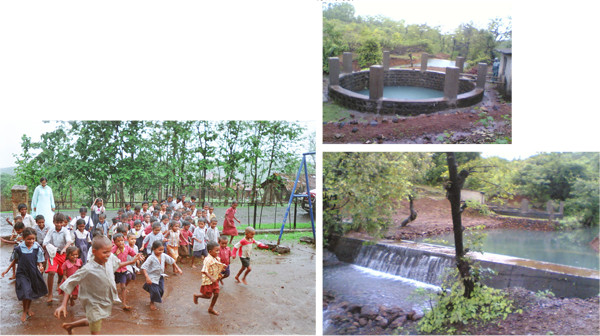
Top right and below: projects undertaken by Time and Talents at Nagloli village; (left) anemia management program for children
The core team has been organizing different fundraising events in its platinum jubilee year starting with a Kharia Party, a game of housie, fete, a raffle of handpainted porcelain pieces, and a much looked forward to gala dinner dance at the Taj on September 19, 2009. And the beneficiaries of these efforts will be the disadvantaged members of society who need medical or educational aid in urban areas, or those struggling in the rural areas of Maharashtra with inadequate water, sanitation and power facilities.
Reaching out to the differently abled or mentally challenged children, the spastics or those residing on the pavements, the Children’s Welfare Committee under chairperson Palia endeavors to enliven their lives by organizing parties at McDonald’s or fun melas. "99.9 percent of them have never been to a restaurant,” she notes appreciating that "they want to pack half the goodies served to them so that they can share them with their siblings.” Their popular fun melas see challenged children being brought to south Bombay all the way from Mulund or Vashi to avail of the gaiety offered to them.
Patients suffering from cancer, kidney failure, orthopedic problems, sensory failure have been regularly helped by the Medical, Educational and Social (MES) Relief Committee, reports chairperson Piloo Cooper. But last year it was surprised to receive an appeal from a lady who bore the brunt of a knife-wielding thug in a local train and required several plastic surgeries thereafter. Besides individuals the committee also assists hospitals, clinics and institutions with equipment and appliances like an ambulance presented to the St John’s Ambulance Brigade, equipped vans for family welfare programs… As educational scholarships, the MES Committee believes in giving aid for postgraduate and research studies rather than primary education. "It is children from the lower strata of society, like the kanda-papétawala (onion-potato seller) on the road who need financial aid more than our Parsi children who get it from other funds,” points out Cooper. The courses for which assistance is sought are generally MBA, engineering, nursing, hairdressing and in recent times even PhD studies by visually impaired students.
"When we pursue our rural pro-jects, we are indirectly helping urban areas,” explains Kamal Mulla, chairperson of the Rural Projects Committee. With the introduction of rainwater harvesting, drinking water, sinking of borewells and installation of hand pumps, tree plantation, toilets and solar lighting facilities in areas around Karjat, Panvel and Raigad, "the self-sustained villagers are less likely to migrate to cities in search of work.” The availability of water at their doorstep is convenient for the women who have time now to devote to balwadis (nurseries) and income-earning activities, for the men who can consider the possibility of a second crop, and the children who can be accorded better hygiene and nutrition. The Club has also initiated the project of constructing one toilet for every household by making the families undertake shramdaan (voluntary labor) and contribute one-third of the cost of the facility. As against defecating in the open fields earlier where "they encountered snakes, scorpions, were susceptible to fecal-oral and reproductive diseases, and the women could have been assaulted,” a separate toilet offered each family privacy and self worth, states Mulla. While the cost of constructing a toilet is around Rs 10,000, the cost of providing solar lighting to each hut is Rs 3,800, but it is only with light "can the children study. There are so many dropouts,” she regrets. By giving the villagers health supplements, lessons in nutrition and diet, promoting organic farming and kitchen gardens, the T&T ladies have found that the height-weight ratio of the children has risen and so too their immunity.
In the urban areas the Welfare Committee under the chairmanship of Shirin Katgara and Dina Davar makes efforts to visit the aged and destitute in widows’ homes, hospices and institutions with food parcels and other necessities, organizes sales of food, clothes, linen and arranges to send two batches of 20 deserving housewives and working ladies on vacation to different holiday destinations. There are other T&T projects that encourage members to recycle their discarded items like the Paper Collection Committee under Perveen Lalkaka and the Clothes Committee under Jeroo Balsara.
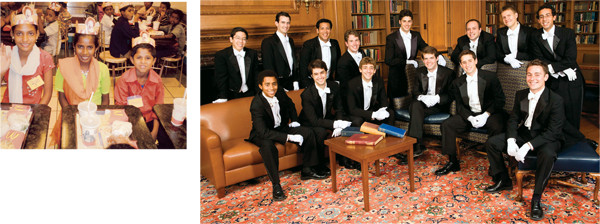
(Right): The Yale Whiffenpoofs who were invited to Bombay; (left) a treat for underprivileged children
Food has always assumed great significance for the members of the T&T Club, starting with The Victory Stall at Apollo Bunder in 1963, and the aroma of their recipe book has drifted across the globe, says Villie Mehta, chairperson of the Recipe Book Committee. They have two books on sale: the Millennium Recipe Book, sold for Rs 350 and the Classic Recipe Book, now in its 11th edition, sold for Rs 550. With over 3,000 recipes, contributed by the members, the staff and even visiting musicians, the book is regularly updated and includes Indian, international and, of course, Parsi dishes. The beauty of this cookbook is that "every recipe featured here — some practical and usable, others absurd and fattening — has been tried out before inclusion,” says Mehta. The well-endowed early members of the T&T Club must have "never heard of the word ‘cholesterol,’” Mehta reminds us. "This cookbook is an undoubted classic… (with) recipes that can be followed by a new bride or an aspiring escoffier… Wherever Indians have settled abroad, the book has been in great demand,” states Gita Mistry whilst compiling articles for their next brochure. In fact, the Cookery Demonstration Committee under chairperson Ava Mistri regularly organizes lectures and demonstrations by expert chefs.
The popular eatery, The Victory Stall, was started during the Chinese aggression to generate aid for the widows and orphans of the jawans. The ladies would bring to the Stall delicious food cooked in their homes and sell it at affordable prices. Later the cooking was done on the premises. The success of The Victory Stall was primarily due to the late Aimai Adenwalla and Mary Jamsetjee. Also on the premises they operated a fair price shop, a non-profit making venture, called The House of Bamboo. Subsequently The Victory Stall was relocated to the NCPA (National Centre for the Performing Arts) complex and had to eventually close down when the premises had to be surrendered.
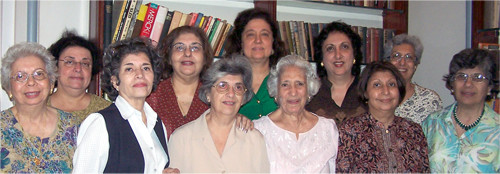
Office bearers and key workers of the Time and Talents Club (from left): Roshan Sidhwa, Kamal Gagrat, Gita Mistry, Feroza Patel, Piloo Cooper, Meher Amersey, Villie Mehta, Zeubin Palia, Kamal Mulla, Shireen Desai and Ayesha Jeejeebhoy
"Music though has been the leitmotiv running through 75 years of the Club’s history,” note the T&T ladies, all diehard music aficionados who take great pride in reporting that their very first concert in the 1930s was a violin recital by Mehli Mehta with the Club’s own member Gool Bharucha on the piano, at Mongini’s ballroom. The clock striking seven notes in the midst of a pause, forcing the musicians to resume their movement thereafter has been recorded in their golden anniversary souvenir. A special attraction was the complete score of all the works, printed as part of the program and distributed free to the audience. The chairman of the Music and Arts Committee, Amersey, takes pride in mentioning that the Club "has not paid a single artiste. All have waived their professional fees for us.” Over the years the Los Angeles, New York and Munich Philharmonic Orchestras have played at different times under the baton of Zubin Mehta. Soloists include greats like Yehudi Menuhin who contributed a generous sum when the Club invested in its own Bosendorfer piano (sold last year), and Benno Moiseiwitch who gave the ladies a complimentary second show on the understanding that they play an all-night game of bridge with him.
It is not only western music that has preoccupied the members. Sitar maestro Ravi Shankar has enthralled them as also other legendary musicians and vocalists like Ustad Vilayat Khan, Amjad Ali Khan, Pandit Jaisraj and Pankaj Udhas. Ballets, dance performances, jazz, fashion shows from the couture houses of France, Dior and Cardin were the other cultural shows hosted by T&T to mark different anniversaries. An annual solo and group singing competition in classical and popular Indian and western music sees nearly 30 schools from Bombay participate. In more recent times they have had a group of 12 cellists from Sri Lanka, the Cantando Cello Ensemble, perform for them, as also a rock concert by The Other People. Last year they had 14 students from the Yale University, The Yale Whiffenpoofs, sing à capella (without musical accompaniment). Towards the end of the year they have singer Usha Uthup’s performance lined up. With so many programs to organize, assisting the Music and Arts Committee is the Box Office Committee under chairperson Goolu Adenwalla. Yet another effective group is the Food for Thought Committee under Avi Dastoor and the Accounts Committee under chairperson Kamal Gagrat.

All funds raised by the organization (donations are tax exempt) are distributed to charities for the dynamic ladies do not believe in using this money for administration purposes. Similar was the objective of Lady Jerbai Mulla and her sister Maneckbai who in 1934 encouraged cousins Gool, Hilla and Sooni Mulla, their friend Roshan Sethna and some other socialites to sell the articles they had crafted so that the income generated could be used for worthy causes. On the recommendation of Gool Shavaksha that the name of The Time and Talents Club that she had interacted with in England be adopted for this nucleus of workers in Bombay, the Time and Talents Club in Bombay took form with Shavaksha as its first president. "After 24 very successful years…the Club got entangled with the menace of modern times — red tape. It became a public charity trust and so had to have a constitution,” notes their golden jubilee souvenir. At the time of its silver jubilee in 1959, a mammoth talent competition was organized, a four-day fete on the grounds of Lady Saklatvala’s house and a grand ball at the Raj Bhavan. A play on the life of Zarathushtra, entitled The Splendoured One, was staged on its 35th anniversary. It was written by Shavaksha, produced by Roshan Kalapesi, with the designs and décor by Pilloo Pochkhanawala. The 40th anniversary was marked with a Ruby Year Fete on the grounds of the Atomic Energy Establishment, the last one to be held there. The golden jubilee was celebrated with a Gourmet Food Fantasy in the gardens of Zarine Chothia’s home, gala fete and a concert by the New York Philharmonic Orchestra conducted by Zubin Mehta. For its diamond jubilee, a Gujarati natak was staged and the premiere screening of the movie Pelican Brief.
All momentous moments have been preserved for posterity in the souvenirs printed on different occasions. And so too would they like to continue making an impact. As notes their appeal, "This is a landmark year for the Time and Talents Club. We want to make it a significant one in our endeavors to help improve as many lives as we can…”
Time and Talents Club, Anushakti Bhavan, Chhatrapati Shivaji Maharaj Marg, Apollo Bunder, Bombay 400001, tel: 64513011, 65258075; e-mail: ttclub@vsnl.com
◆ ◆ ◆
From the archive