
Zoroastrians Abroad
The magic of the matches
India’s cricketing legends Nari Contractor and Dicky Rutnagur were felicitated by the Zoroastrian Trust Funds of Europe
Cricket aficionados in London were treated to an evening of nostalgia as former Indian Test captain Nari Contractor and long-time All India Radio cricket commentator Dicky Rutnagur evoked memories of international matches at Bombay’s Brabourne Stadium, in Delhi, Calcutta and around the world, especially the West Indies. For it was in Barbados that Contractor sustained the injury that ended his international career.
The reception at the Zoroastrian Centre hosted by the Zoroastrian Trust Funds of Europe (ZTFE) on April 5, 2009 was on the heels of Contractor’s trip to Queen’s Park Oval at Port of Spain for the re-launch of the Sir Frank Worrel Memorial Blood Drive, in memory of the late West Indies cricket captain.
The Sir Frank Worrel Memorial Committee in conjunction with the National Blood Transfusion Service, the Friends of the Blood Bank Association, the University of the West Indies and the University of Trinidad and Tobago form part of this resurgent initiative, notes an on-line article by Paras Ramoutar dated March 13, 2009. Ramoutar quotes Prof Mootoo, chairman of the Blood Drive, who recalled the effort to save the life of Contractor:
"During India’s 1962 cricket tour to the West Indies, their captain Nari Contractor was severely injured in their tour match against the West Indies in Barbados. He was struck by a vicious bouncer and sustained a fractured skull. (Being unconscious for six days) Contractor required two life saving operations and several blood transfusions during his hospital stay before being able to fly back to India. The late Sir Frank Worrel was among the first donors to give blood during the crisis, followed by several players from both sides, in an effort to save Contractor’s life.”
"Contractor in his address said unknown to most people in the Caribbean, each year on February 3, there is a blood donation drive in the state of West Bengal in India to commemorate Sir Frank Worrel’s magnanimous act to save his life,” notes Ramoutar, adding, "The presence of the Indian cricket team in 1962, just before Trinidad and Tobago gained independence from Britain on August 31, 1962, was a cause of much jubilation and Contractor as the captain was revered as, indeed, were all members of the Indian team.
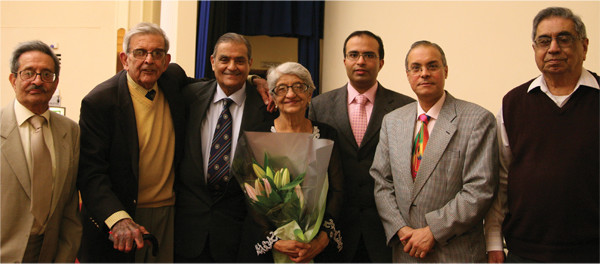
From left: Rusi Dalal, Dicky Rutnagur, Nari and Dolly Contractor, Paurushasp Jila, Dorab Mistry and Ervad Jal Karkaria
"Several Indian families here have named their children either ‘Nari’ or ‘Nari Contractor.’ Indians — principally from Uttar Pradesh and Bihar — came to Trinidad and Tobago between 1845 and 1917 to work on the faltering sugar and cocoa plantations.
"Some 1,48,000 Indians came here and over 98 percent of them remained.”
Clayton Murzello in an article in on-line Midday dated March 7, 2009 speaks of the 75-year-old former cricketer’s contribution to the game in India: "He was a steely opening batsman and led the country with distinction. Richie Benaud (renowned Australian captain) once rated him as one of the best openers in world cricket and legendary Aussie all-rounder Keith Miller said that Contractor should get a Victoria Cross for his bravery. Contractor is proud of the fact that he returned to first-class cricket after the injury. "Not many players would have come back,” he said.
Godhra born Contractor was called up "to replace the Gujarat captain who got injured on the morning of the match. Contractor scored hundreds in both innings of his debut, becoming the second man after Arthur Morris to do so,” notes the entry in Wikipedia.
"At Lord’s in 1959, he had two ribs broken early in the first innings by Brian Statham, despite which he scored 81. Later in the year, his 74 in the second innings at Kanpur was crucial in India winning its first Test against Australia. This innings ended when he pulled Alan Davidson who was bowling left arm spin at the time. Neil Harvey at short leg ducked and turned, but the ball got stuck between his legs. "Contractor led India to a series win against England in 1961-62 and captained the side to West Indies the same season,” Wikipedia notes.
The ZTFE function was flagged off by a brief welcome address by its president Paurushasp Jila. ZTFE treasurer and former president Dorab Mistry followed up by recounting some of the landmarks in Contractor’s distinguished cricketing career, his appointment as captain of India "which was a fitting recognition of his standing as a batsman of the highest class as well as a leader who commanded respect and admiration in the field of play,” states Jila in an e-mail to Parsiana.
"Nari thanked ZTFE for inviting him and said how fortunate he had been to play cricket at the highest level and to have the love and support of his family and friends. He then took questions from the floor and responded with the same assurance he had shown at the crease,” notes Jila. Contractor now coaches at the Cricket Club of India Academy.
"That famous voice from yesteryear… Dicky Rutnagur who many remembered as an excellent squash and cricket radio broadcaster and later as cricket correspondent for the Daily Telegraph, took the stage. Although looking somewhat frail, Dicky was nevertheless in fine form and regaled the audience with some mighty humorous anecdotes,” writes Jila.
Decrying the surfeit of cricket matches and endless coverage on TV in recent times Soumya Bhattacharya who is features editor of The Hindustan Times, Calcutta notes in an article titled "The end of imagination,” how it "has killed the sharpness of our memory about particular performances. I still remember India’s tour of the West Indies in 1976 and the third Test at Port of Spain. I recall Dicky Rutnagur and Sushil Doshi on the radio and sitting up in the small hours with a mug of Bournvita as Brijesh Patel raced to his 50 after Gavaskar and Vishwanath had laid the foundations of that incredible chase to victory with their centuries…”
The interview with Amit Roy in Calcutta’s The Telegraph dated July 3, 2005, speaks of Rutnagur sitting in his "small but neat London flat, filled with a full set of Wisden, the cricketing Bible, and his memories… There is probably no one with his encyclopaedic knowledge of Indian cricket or his ability to file accurate match reports on time.”
Bombay born Rutnagur had come under the influence of famed cricketer Russi Modi during his years at St Xavier’s College. Modi told "his impressionable protégé about cricket in England. In 1966, Rutnagur arrived in England, with an agreement to work every day during the summer covering county matches for The Daily Telegraph and then disappear abroad for the winter for Test matches,” notes Roy.
"My hair still stands on end when I go through the Grace Gate after all these years,” 74-year-old Rutnagur, combatting difficulties with vision, revealed to Roy. "It is a privilege to go to Lord’s. I will wear my best clothes to go to Lord’s always, even for a county match.”
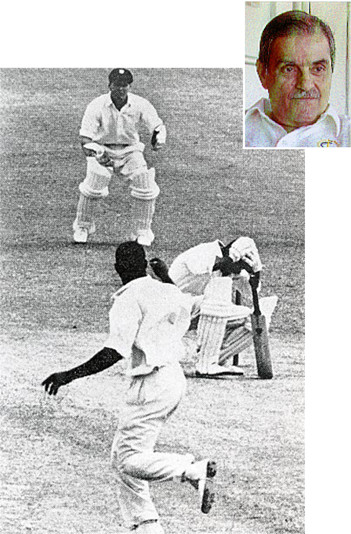
Contractor (inset) and clutching his head after being hit by a Griffith ball
"Anyone who suspects Rutnagur has reservations about one-day cricket would be right,” notes Roy. "That is one thing I do not like about modern cricket — the partisanship and jingoism that goes with it and that has been bred by one-day cricket and the bloody tabloid newspapers although the heavies have also fallen into the trap now,” grumbled Rutnagur. "‘Bloody’ is probably Rutnagur’s favorite word to denote disapproval, along with ‘bastard,’” states Roy, adding, "He is not a Luddite.” "What the game has lost is its dignity to some extent with the colored clothing and all the trappings of one-day cricket. Commercialization has come in and it has damaged the image of cricket in eyes as old as mine. But it had to come for the survival of the game,” Rutnagar told him.
"Rutnagur has a unique perspective on cricket, partly because he has been writing about the sport for so long. In his time, he has reported for many papers in India, the Gleaner in Jamaica and achieved quite a bit in broadcasting as well.
"When the Indian captain, Nariman Contractor, was nearly killed in the India-Barbados game in 1962 by a delivery from Charlie Griffith, ‘I was on air,’ remembers Rutnagur. ‘You could see blood coming out of his ears, one of the most ghastly sights I have ever seen.’ Those were pre-helmet days and Contractor never again returned to Test cricket but he became firm friends with Rutnagur,” observes Roy.
According to Roy, Rutnagur likes to listen to jazz and lists Mozart, Rachmaninov, Tchaikovsky and Beethoven among his favorite composers. He wants the Ranji Trophy revived in India: "You know you need a strong base of domestic cricket and we had it in India and they destroyed it, the bloody idiots.”
"At a personal level, he calls himself a Zoroastrian and not a Parsi because he alleges Parsis discriminate by not allowing other faiths into their fire temples in India. ‘Anybody who excludes anyone from a place of worship has to be bigoted. I can’t take you to a Parsi fire temple in Bombay,’” Roy records Rutnagur’s dissatisfaction.
The formal part of the afternoon, which had begun with a dhansak lunch, ended with the guests being presented with mementoes and flowers and Ervad Jal Karkaria reciting a Tandarosti prayer for their good health and long life. They "were visibly touched by this unique gesture by our senior ervad saheb on behalf of the anjuman,” notes Jila, and Contractor and his wife Dolly mingled with the audience answering questions "long after the president had called ‘Stumps!’”
◆ ◆ ◆
From the archive