
Consummate cricket commentator
"Dicky was the voice of cricket,” summed up Dorab Mistry, former president of the Zoroastrian Trust Funds of Europe (ZTFE) at the memorial service on July 12 attended by family and friends after the funeral in the Writing Room at Lord’s, a ground he loved above all others. Mistry added that he had grown up, like millions of Indians, listening to Test match commentary by Rutnagur and Vijay Merchant on a transistor radio.

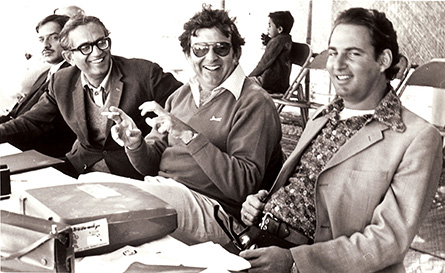
Dicky Rutnagur (top) in the Bangalore press box flanked by Bapu Nadkarni (left) and Tony Cozier
Turning to the casket, John Woodcock, 86, the celebrated cricket correspondent of The Times from 1954 to 1988 and editor of Wisden Cricketers’ Almanack for six years from 1981 until 1986, struck an informal, conversational tone as though he was chatting with Rutnagur in the press box. Having made an effort to come from a long distance Woodcock’s remark was quoted by The Telegraph, Calcutta, of July 15, 2013: "Well, Dicky, I hope you know the affection in which you are held — and I use the present tense intentionally — not only by all of us here today but by so many who are already with you in the great pavilion in the sky, and others who would be here now but for the Test match at Trent Bridge. Thank you, Dicky, from all of us, for many years of warmth and humor, for becoming one of us as naturally as you did and for keeping our friendship in repair. Of all those brought to this country through cricket, many great players among them, you, a journalist, have been as well-loved and respected as any.”
Rutnagur is known to have covered over 300 cricket Tests in a career that spanned five decades. It was fitting that the memorial service was held during an Ashes Test between England and Australia. Leading the mourners were his son Richard Sohrab, with many cricket correspondents present. Richard was an Oxford Blue and represented his University in 17 first-class matches as a medium-pace bowler and a useful lower-order batsman. This was a matter of great pride for dad Dicky.
Before the body was taken to the Golders Green Crematorium, he received a traditional funeral with two priests, Ervads Rustom Bhedwar and Marzban Dastoor, in attendance, praying from the Avesta. As reported by Amit Roy in The Telegraph (India), "There had been an hour of prayers at the funeral parlour as well before the hearse arrived. The entrance music was Lionel Hampton’s September Song — September is when the English cricket season draws to a close. The committal was to Sarah Vaughan’s What a Difference a Day Makes. The exit music was the calypso, Cricket, lovely Cricket.
"Rutnagur would have loved the verse: ‘Cricket lovely Cricket/At Lord’s where I saw it/Cricket lovely Cricket/At Lord’s where I saw it/Yardley tried his best/But Goddard won the Test/They gave the crowd plenty fun/Second Test and West Indies won.’”
Rutnagur’s first wife, Doris Cassim, a Trinidadian air hostess with British West Indian Airways, whom he met during India’s tour of the West Indies in 1962, was present at the Memorial Service. So was his middle sister, Arnavaz Jehangir Dubash, who had flown in from Bombay. Youngest sister Shernaz Pervez Sukheswala could not get a visa in time. His second marriage to Delshad Karanjia, a journalist and program producer of note, had also been dissolved.
One of the finest All India Radio commentators and sports journalists ever willing to guide greenhorns, Rutnagur’s rich contributions earned him a "Lifetime Achievement Award” by the London based Indian Journalists Association in 2010. "There is probably no one with his encyclopedic knowledge of Indian cricket or his ability to file accurate match reports on time,” noted a report in The Telegraph adding that the doughty commentator was "on best behavior… He used neither ‘bloody’ nor ‘bastard,’ two of his favorite words.” As the candid columnist had then commented, "What the game has lost is its dignity to some extent with the colored clothing and all the trappings of one-day cricket. Commercialization has come in and it has damaged the image of cricket in eyes as old as mine. But it had to come for the survival of the game.”
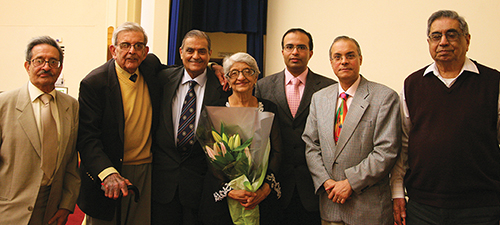
Nearly four years ago he and veteran Test cricketer Nari Contractor were felicitated by the ZTFE when although looking frail, Rutnagur was in fine form and had regaled the audience with some humorous anecdotes. Preferring to describe himself as a Zoroastrian rather than a Parsi, Rutnagur believed, "Anybody who excludes anyone from a place of worship has to be bigoted.”
Born in Bombay on February 26, 1931, Dicky was studying at St Xavier’s College when he became a protégé of Test cricketer Russi Modi. Journalism was in his blood as he started working in the family business which published The Indian Textile Journal. Soon he began his illustrious freelancing career, writing for The Bharat and then for the high-circulation Hindustan Times from 1958 to 1966. He also contributed richly to The Hindu and Sport and Pastime. Anandji Dossa, now 97, who had edited Indian Cricket-Field Annual with Rutnagur from 1957 to 1966 was quoted in Mid-Day, June 22, 2013, "Dicky was very systematic in everything he did. He edited the Annual superbly for eight years before he left for England.”
Subsequently he became a freelance writer based in England. He covered cricket, squash and badminton for The Daily Telegraph from 1966 to 2005 and would occasionally officiate at table tennis matches. At times he wrote for two national newspapers in the UK at the same time, using the pen name Dileep Rao when covering matches for The Guardian and his own name when reporting for The Daily Telegraph. He first wrote for Wisden Cricketers’ Almanack, the "bible of cricket,” in 1963 and his most recent article appeared in the 2007 edition.
All through the bribery, corruption and match-fixing controversies which have plagued cricket in the last few decades, Rutnagur reported events as they occurred in his own inimitable and balanced style with a touch of Parsi humor. He was not afraid to investigate match-fixing allegations during Pakistan’s series in India in 1979-80, even when threatened by bookmakers.
He also authored two books, Test Commentary (India v England 1976-77) and Khans Unlimited, the history of squash in Pakistan in 1997. In later life he suffered from cancer but went on writing regardless.
Cricket connections
As a student in the 1950s and 60s, having avidly followed Test cricket on All India Radio through the eyes of Test great Vijay Merchant, statistician Dossa and the dulcet-voiced commentator Rutnagur, it was a thrill meeting Rutnagur in person several times at the Sydney Cricket Ground press box. By then, this writer had taken up base in Australia whilst Rutnagur would come all the way from London to cover the Tests Down Under. To witness two Parsis typing away their columns in a Sydney press box was a unique event.
We had been introduced by former Test cricketer Polly Umrigar who had come as manager of the 1977-78 Indian cricket team. Soon we became friends. A caring, jovial person, Rutnagur visited our home in Sydney many times when we enjoyed his free and no-holds-barred views on cricket and cricketers, and he tucked into Villie’s Parsi cuisine. A close friend of cricketers Farokh Engineer and Rusi Surti, he narrated amusing anecdotes and ensured that even non cricket-lovers were regaled with his funny stories.
Only once he declined an invitation to our home as he had to report on a one-day international between Australia and New Zealand in Melbourne in January 1981. That was the infamous match when Australia’s captain Greg Chappell ordered his brother Trevor to bowl an underarm delivery. It produced a huge controversy which is still hotly debated. "Just as well I attended this spicy hot match, else I would have been in big trouble with my editor,” he mentioned with a smile the following week.
When asked about his most memorable moments in 50 years as a journalist, he said, "Do you know that I am the only person to have watched both of two high flying cricketing feats? I was present when the great Garry Sobers of West Indies hit six sixes in an over from Malcolm Nash in a county championship match in Swansea in 1968. Sixteen years later I saw India’s tall Ravi Shastri hit six sixes in an over for Bombay against Baroda in a Ranji Trophy match in Bombay. The bowler was left-armer Tilak Raj.”
We took the genial Rutnagur to the world famous Bondi Beach in Sydney and discussed the problems surrounding Indian cricket. He had the highest opinion of Sunil Gavaskar but when asked as to who was the better opening batsman, Vijay Merchant or Gavaskar, he said after thinking: "Merchant.”
With his eyesight failing him in the last few years, Rutnagur chose to pursue other pastimes like music. As he told Roy, "I would say that cricket has been almost — almost — all consuming. But I am very fond of classical music — and jazz. Mozart and Rachmaninoff, Tchaikovsky, and latterly in the last few weeks I have been listening to a lot of Beethoven.”
No wonder the veteran cricket scribe Raju Bharatan described Rutnagur as the Zubin Mehta of cricket writing.
Rutnagur is survived by his son Richard, and sisters Arnavaz Jehangir Dubash and Shernaz Pervez Sukheswala.