
Businessman, banker, benefactor
The man who built the eponymous Seth Jeejeebhoy Dadabhoy Agiary Baug in Colaba was known as much for his mercantile acumen as his munificence
No one knocked on his door twice. His purse was always open,” said Prof Aban Sethna of Seth Jeejeebhoy Dadabhoy (1786-1849) at a lecture given on this relatively lesser known Parsi philanthropist of the early 19th century. Modern association with Jeejeebhoy would appear to be only as the founder of the Seth Jeejeebhoy Dadabhoy Agiary Baug (Colaba ni agiary in common parlance), but he was industrialist, financier, banker and a sethia in the true sense. Sethna acknowledged his contribution to Bombay, while giving the fourth Gulestan and Rustom Billimoria Memorial Lecture at the K. R. Cama Oriental Institute (KRCOI) on September 29, 2014. The first lecture of this series had also been delivered by her. A Dakshina Merit Scholar, Sethna still teaches at Rizvi College of Architecture after being faculty for several years at the Sir J. J. College of Architecture. The professor expounds on facets of Bombay, her particular interest being Colaba, where she leads heritage walks with special mention of the area’s historical delights.
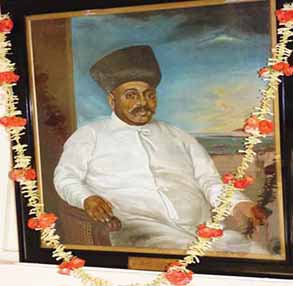 Muncherji Cama, who is distantly related to the Jeejeebhoys and is president of the KRCOI, said that Jeejeebhoy laid the foundation of commerce in Bombay, taking advantage of its natural sheltered harbor. He also stated that Parsis became brokers of British firms and then went on to establish their own, as did Jeejeebhoy. Cama introduced Sethna whilst Dr Nawaz Mody, joint honorary secretary of KRCOI gave the vote of thanks.
The entrepreneur was a broker, banker and merchant for 40 years and established the firm Jeejeebhoy Dadabhoy and Sons. The firm was well known all over France, Egypt, Scotland and even China and is said to have been one of the first members of the Bombay Chamber of Commerce. Jeejeebhoy was also in the cotton trade as were the Petits, Framji Cowasji and the Banajis of Surat. This trade plied mainly between Bombay and England.
"He established the Bank of Bombay (1840), the Bank of Western India (1842) and The Commercial Bank of India (1845). He was also one of two trustees of the Parsi Insurance Society and the first Parsi trustee among three trustees of the Great Indian Peninsula (GIP) Railway. Having established the Bombay Steamship Navigation Company (around 1840), a new age in the history of Bombay was written,” Sethna said. One of the steamships commissioned by him from London was called Sir James Rivett-Carnac (1st Baronet) which plied between Bombay and Surat. In fact, when the ship arrived at Surat it is stated that thousands came to see the marvel, named after the Bombay born governor of the Bombay Presidency of British India 1839-42. Jeejeebhoy also had a ship built at Mazagon Docks named Sir Jamsetjee Jeejeebhoy which was inaugurated on November 12, 1849. By introducing river steam navigation, he brought down transportation costs, enhancing both travel and trade.
Jeejeebhoy not only had business interests but also contributed to the city in umpteen ways — he built a bridge opposite Thana creek to facilitate communication; he promoted the Gujarati daily Mumbai Samachar by being one of its first 67 subscribers!
Among the several innovative introductions he made in India, Jeejeebhoy brought "a steam powered sawing machine in 1843 which turned out standard wood planks and considerably lowered the cost of construction,” Sethna enlightened the audience. He first installed this on his own land, to set an example.
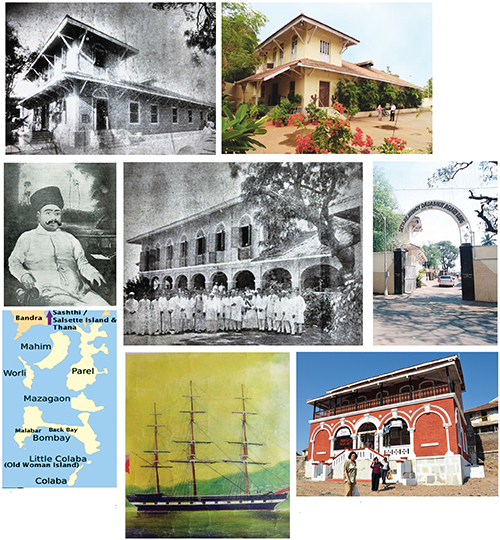
3rd row: Map of old Bombay; the ship Sir Jamsetjee Jeejeebhoy; school at Bharuch
After this, he entered the textile industry as he foresaw vast potential for growth. It was brought to fruition after the doyen’s death by his son-in-law Manockjee Petit, married to his daughter Hamabai. Their son Sir Dinshaw Petit (1st Baronet), established a mill in his father’s name as he wanted to make Bombay the "Manchester of the East.”
Besides, the family had vast agricultural estates in Sri Lanka where Jeejeebhoy’s capital was engaged in advances on coffee, sugar and coconut. "As the philanthropist’s fortunes peaked, he dropped his family name Mughana,” informed Sethna "One of his forebears was mugha (mute),” hence the cognomen. Mughana, the family name for long, later simply became Jeejeebhoy Dadabhoy.
Following the times, he supported every call for an educational institute and built schools and madressas. Of the 42 schools established from his largesse, only three stand today — the one in Bharuch on the banks of the Narmada; in Udvada, facing the Arabian Sea and in Bombay located near the erstwhile Minerva Cinema at Grant Road. The one on the banks of the Narmada survived the floods of 2013, though it was badly damaged. The school in Udvada had 30 Parsi students in 1906 and none today.
A staunch Zoroastrian himself, Jeejeebhoy was passionate about educating poor Zoroastrians in the villages of Gujarat. He established Avesta classes at madressas by inviting poor priests to impart religious education, navjote instruction to initiates in Illav, Khajot, Amroli, Hansot, Siganpore, Suvali and Indore. Trustee of the Bombay Parsi Punchayet for 20 years, he also donated generously towards the refurbishment of the Anjuman dakhma.
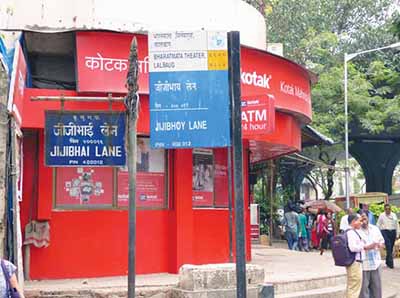
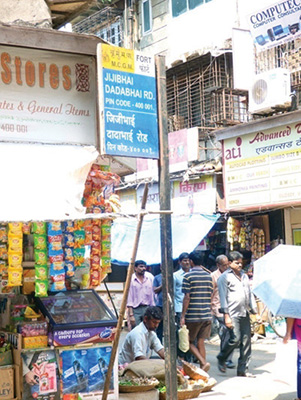
Streets named after Jeejeebhoy Dadabhoy
In 1834 the residents of Colaba appealed to the sethia to build a fire temple, as crossing the creek between Colaba and Bombay island involved trials and tribulations. There was no ferry after sundown between the three islands: Bombay, Colaba and Old Woman’s Island. Further, at low tide sailing was not possible. At high tide several dhows capsized due to overcrowding. These carried not only impatient people — 40 instead of the permissible 20 — but also palanquins and horses. If folk ventured on foot, the hard rock pierced their feet on the irregular road. The area had a population of 10,738 in 1826 — of which 124 were Parsis in Colaba and 6,308 in Fort. Due to the channel that lay between these islands, Doongerwadi, as well as all the agiaries in the Fort area, were geographically cut off.
In response to the request for an agiary in Colaba, within three months the philanthropist acquired 4,500 sq yds near the seashore. As today, even then the army mess lay to the north, an army tenement to the south, Pilot Bunder Road to the west, and the sea to the east. On March 9, 1836, the rich and poor were invited to a jashan conducted by Dastur Edulji Darabji Sanjana, head priest of the Seth Hormasji Bomanji Wadia Atash Behram. In addition to the Jeejeebhoy family, the Colaba Parsis played host in acquiring boats and helpers. Invitations were sent out to all with the request that employers "allow their Parsi staff to attend.”
.JPG)
Prof Aban Sethna
The Colaba causeway was built two years later in 1838 by the Government. This was necessitated as cotton bales were now being stacked in Colaba before transportation, the storage having shifted from Fort (Cotton Green) and Horniman Circle.
Bombay was dotted with Jeejeebhoy’s estates — Sethna related that some still stand; some, the family donated and others have disappeared. His main house stood in the then swish locality of Bora Bazar Street in Fort. The street is now named after him. He breathed his last at his residence at Rampart Row (now K. Dubash Marg). He had another mansion in the Fort, where the head office of the Central Bank of India is located today. When he yearned for peace and quiet Jeejeebhoy visited his home in Parel and also stayed occasionally at another home in Worli. The home in Parel was gifted to his daughter and is today the Bai Sakarbai Dinshaw Petit Hospital for Animals. There is also a road in his name at Parel as he gave up a part of his wadi (orchard) to connect it to the main Parel road. This is located diagonally opposite the Bharatmata cinema at Parel, Sethna specified.
As summed up the professor, "He lived life relatively low key and modest… Was not given to parties… He earned much. He gave much.” At his funeral 4,000 Parsis walked two by two in paiwan from Rampart Row to Doongerwadi to salute him.