
Seminar
“A journey of discovery: III”
The provision of home based professional medical and legal services would best serve the needs of the community elderly as per the research of Dr Siva Raju of the Tata Institute of Social Sciences
The first part of the report on the two-day Parzor seminar held in Bombay last December focused on Dr Shalini Bharat’s study on family and marital issues. The second part dealt with Dr Lata Narain’s report on a quantitative study of the Parsi youth. Part IV will report on Dr Katy Gan-devia’s identification of the community’s health problems.
"We are in the second stage of demographic transition: there is a reduction in the birth and death rates. It is a characteristic of most democratic societies. The Parsis have already reached a negative growth rate,” Dr S. Siva Raju of the Tata Institute of Social Sciences (TISS) noted as he presented his "Situational analysis of the Parsis in India.” Contrasting the national statistic of the elderly — 7.7 percent of the population — with the Parsi elderly who amount to 31 percent of the community, he noted that his study covered 12 cities and was done in collaboration with the Census of India. His data covers a sample of 835 elderly residing in their homes plus 51 residents of old age homes in Bombay, Navsari and Surat, bringing the total sample to 886 individuals.
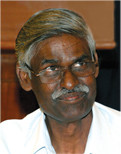
Dr S. Siva Raju: "sensitize the caregivers”
Both sexes are almost equally represented in the sample but Raju noted a high incidence of widowhood (40 percent) among the women while the men were largely bachelors.
"The tendency of not getting married is observed from the generation of these respondents born in the second and third decades of the last century,” noted Raju.
Among the married most had averaged two conceptions.
The community based elderly generally had a room to themselves and had their own financial assets. Their own economic perception was that they had just enough for their basic needs and had no intention to transfer their assets. Many of the ladies acknowleged their child-ren’s financial contribution. Only an insignificant number had recourse to Parsi charities, noted Raju.
The self-dependent community elderly generally reported better health than their institutionalized counterparts. The institutionalized women had a greater tendency to be depressed. Overall, the single people showed a better health status, followed by the married ones and the widows — in that order.
Visual and locomotive disability was most constantly reported. "In other communities, people turn towards NGOs, but not Parsis,” said Raju. In his report he notes, "Most of the community elderly consulted a general practitioner and specialist with the exception of those from Bombay who preferred a Parsi doctor (53 percent)…Nearly all the respondents stated that they did not use the facilities provided by their community (92 percent) indicating a need to create greater awareness about the services and reach out to a larger number by catering to specific medical requirements of the elderly.” A taste for alcohol was seen among the community (83 percent) as well as institutionalized elderly (90 percent), both male and female.
Raju found that most community elderly (91 percent) were not willing to join hobby classes or day centers; 40 percent were unaware of Parsi laws; 68-71 percent want to depend on their children. The spinsters necessarily depend on neighbors. A third among them complained of physical abuse. Once the elderly are institutionalized, there is little interaction with the family and they are not taken out again. A loss of confidence is most noticed when coupled with failing health and inadequate income. It was particularly so among females living in nuclear families. A desire to die before becoming incapacitated and dependent on others was voiced by many elderly, especially the men.
Looking into age at marriage of the elderly, their parents and their children, Raju found that there had not been much change. But there was a higher proportion of the unmarried in the present generation in comparison to their parents’ generation. The institutionalized elderly were more prone to believe that the customs and traditions of the community will continue. The elderly staying at their residence were not as convinced.
Raju’s report advocates the provision of more home based services rather than the establishment of homes for the aged as they progressively become unable to access the services they normally did. It would need training professionals in the medical, legal and accounting fields so that they may look after the particular problems of the elderly whether in health, investment, taxation and other aspects of life that continue and need to be addressed. These services may need to be subsidized. He suggested the enrolment of the "young-old” — 60-69 years — as volunteers and the establishment of more day centers where the elderly can share problems.
"You have nearly 20,000 elderly. Review the existing services and priorities. Sensitize the caregivers. If the problems of the elderly can be taken care of, the youth can live their own life including marriage,” Raju told the trustees of various punchayets in the audience.
In the audience participation that followed the presentation Delhi’s Kavas Kapadia urged Parzor to "put the studies together. We find the community (as represented) more complex than it seems to be. There are too may contradictions.” Parzor director Dr Shernaz Cama agreed, noting that the studies are to be published but pleaded lack of funds for the present.
"Youth and parents are at different stages (of their lives). People in institutions are neglected by the family because they are well cared for by the institutions. Also, they live in different places,” Parzor research coordinator Dr Armaity Desai sought to put the information in perspective. "Loneliness and deterioration are much faster in institutions. It is less expensive to look after them in one’s own home but there are constraints which we are not looking at in the face. The nuances are coming out in the family studies. We know about them but these systematic studies are verifying our perceptions. Let us work out some minimal plan of action, share out the work and become responsible in different ways. We have to get away from some of our ideas.”
HelpAge India’s Nirja Bhatnagar Bhandarkar noted that his NGO was already working on some of the concepts referred to by Raju and noted, "We will work with Parsi punchayets all over India.”
Jamsheed Kanga, a member of the B. D. Petit Parsee General Hospital’s (PGH) executive committee referred to its "yeoman service,” noting that it provides free medical aid to the tune of five to six crore rupees a year. "In my opinion if you wind up the Bombay Parsi Punchayet (BPP) nothing will happen. But if the PGH stops there will be chaos.” He urged the incoming BPP trustees to take up this "concrete agenda that has been identified.” In response Rustom Tirandaz noted that the PGH belongs to the BPP. (Though the PGH property had been handed over to the BPP by its founder Bomanji Petit, the Hospital’s executive committee is an independent body — editors)
While Dinaz Damania from Bangalore noted that "old people seem to think they have less than they actually do,” Cama said some of the personal interviews at the Nariman Home in Surat were corroborated by the management. She was told that they had once received a call to say "Aunty né bahar muki didhaach. Lai java hoy to lai jav (Aunty has been put out in the street. If you want to collect her, do so)!”
Kanga noted that people with less than Rs 5,000 as monthly income get free treatment at the PGH. He also provided some information from the Hospital relevant to the issues under consideration: The number of births at the PGH is half that of 10 years ago. He described it as an "exponential fall.” One of the reasons was genetic — polycystic ovaries. According to Kanga, among Caucasian communities this condition occurs among less than10 to less than 20 percent of the population. Among Parsis, he said, this is said to be over 20 percent. "It’s a complex genetic trait that runs in families and is not completely understood.” Excess weight due to a higher occurrence of the male hormone, high blood pressure and diabetes are other impediments to a successful conception and delivery, he noted.
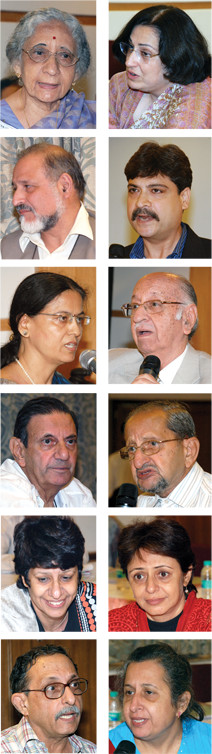
Clockwise from top left: Armaity Desai, Shernaz Cama, Noshir Dadrawala, session chair Soli Arciwala, Aspi Moddie, Nawaz Gherda, Perviz Bhote, Kavas Kapadia, Dinaz Damania, Jamsheed Kanga, Shalini Bharat and Khojeste Mistree
"One call does it all”
Nawaz Gherda of Calcutta has already been doing all that Raju has suggested. A granddaughter of Dr Sir Jivanji Modi, she says "caregiving is in my genes.” Noting that 278 members of the 467 who constitute the Calcutta community are over 70 years old, Gherda started out by doing social service — doing whatever the old people wanted like paying bills, taking them to the doctor, doing sundry errands, etc. She even helped celebrate their birthdays. It was when one of them requested her to stay for lunch that she "realized that their emotional needs have to be looked at.”
Gherda started by taking three of them for medical attention. Now she needs to cater to 16 and finds it difficult to cope. "There are many different aspects,” she notes and has created a database, good contacts with ambulance services, credit facilities at hospitals. She stands by when one of the old people is undergoing surgery, finds ayahs and nurses to take care of them. Her flock not only includes senior citizens who are poor and lonely but also those who are moderately well-off but whose children have settled abroad. They get excited at the prospect of going to the movies or if Gherda remembers their birthday.
Three to four years of Gherda’s care-giving created an awareness of the very strong need for such a service and a lot of friends now volunteer their services. The Calcutta anjuman has also recognized her work and values her contribution. "Loneliness is a big factor. I visit them once a week, share a cup of tea. Now my mother who is 88 is complaining ‘You have no time for me!’ If an anjuman can start a care-giving service, it can be a very comforting, very reassuring factor,” she says.
Prof (Dr) Shalini Bharat of TISS spoke of a mobile doctor in Bombay’s Girgaum locality who makes it a point to visit old people living alone. "They could die a painful and lonely death,” she notes, wondering if Parsi physicians could spare the time to provide a similar service.
Dr Kainaz Dotiwala, a clinical psychiatrist, stated that in our headlong individualism our generation is forgetting social values. "The flip side of individualism is loneliness,” she reminded the audience. It is the lack of responsibility that sets everyone asking, "Can the BPP do this? Can UNESCO give money? But what of oneself?” Dotivala was in favor of balance, moderation in everything, for "the flip side of social sanctions is lower aspirations, permissiveness.”
Dotiwala struck a chord with Ashdeen Lilaowala. Youngsters in baugs were asked what activities they would like to participate in. "They wanted dancing, entertainment, which is good because it promotes intermingling. But their moral values? There were no entries for an elocution competition or religious studies,” stated Lilaowala who remembered as a small child in Rustom Baug how "Dasturji came every week and all we young children used to go to him.”
Dr T. S. Saraswathi suggested that the community start with the framework suggested by the TISS researchers and create a super structure by and by. Bharat added that a reliable child care option is also economically viable in places where there are enough children to support it. Perviz Bhote of Avesthagen felt young couples could synergize for child care and retired people could be organized to oversee tutorial and study classes. Bharat felt that even volunteers should be trained to be effective. How do you address the mindset? she wondered.
Kapadia felt that religious training is considered irrelevant by the young — like "you need Munnabhai to talk to kids about Mahatma Gandhi!” Ervad Rooyintan Peer suggested that old people in the community could start full-time counseling for 18-year-olds and above but Dotiwala felt 18-year-olds are not interested: "There are some things they don’t want to talk about or listen about.”
"Telling the community that we are dwindling has a negative effect on the youth. They lose their zest for having children,” stated BPP trustee Khojeste Mistree, adding, "We have facilities to counter infertility. Thirty Parsi kids are to be born in the next few months, that is an increase of 10 percent (in our birthrate).” No one takes religious education seriously, he complained, emphasizing that without a grounding in the principles of Zoroastrianism the Parsi community will not be preserved. "If you want to preserve the community, religious education must be provided in a modern, proper way. Parsi parents have not put a premium on religious education, the unique value system of Zoroastrianism; it’s always glossed over. What makes Parsis take the happy-go-lucky path? We don’t know who we are. The identity crisis has to be resolved.”
Former IAS officer and corporate honcho Aspi Moddie spoke of the community feeling torn between its so-called western heritage and the problem of becoming more Indian. "In the process of globalization we have lost something fundamental to family values — quality time with the family and children, quality time to educate ourselves before we can influence children,” he asserted. "We are torn between many worlds. I see snags in both western and Indian culture. Indian public schools have no solid concept of common cultural values, only caste, community and contacts/influence. The children are confused because the parents say one thing but don’t support it when confronting the outer world. …There are great ideals in the epics but the children see their parents as greedy, materialistic…The youth of today don’t know where they stand.”
Dotiwala referred to the youth camps in Jamshedpur and the Farohar classes in Delhi but Bharat noted that holiday programs haven’t helped much. Mistree spoke of the BPP developing crèches staffed by professionals. "We want to improve value education…give the youth a sense of identity,” he said, including sports and dances to give the baugs a chance to interact. Premarital counseling and promoting marriage through companionship and how people gain thereby was the tack he wanted to take.
Desai suggested a program for small children who live outside the baugs. "Kids today are net savvy. Put it on the net,” suggested Lilaowala.
BPP trustee Noshir Dadrawala referred to the TISS presentations as "a mirror held up to us…We are looking into the mind of the community. There are lots of things we may not like.” He suggested a small think tank to increase the "happiness quotient of the community…provide conflict resolution, counter mental fears…”
Using the infrastructure of the baugs Gool Austin suggested an information meeting with the seniors. "Ask for their needs and match the needs to volunteers. Make sure they want help. Do not force it on them,” she cautioned, noting that various resources were available like police stations, senior citizens’ groups like Dignity Foundation, HelpAge India. "We need one information number where people can call. Where is that information center going to be?” She thought it best for BPP to arrange it with HelpAge India.
Committees of youth and seniors in each punchayet, the involvement of the Federation of Parsi Zoroastrian Anju-mans of India and the revival of its youth wing, the Federation of Zoroastrian Youth Associations, were other straws in the wind. To be continued
◆ ◆ ◆
From the archive