
Seminar
“A journey of discovery: II”
Nearly three-fourths of the youth that Dr Lata Narayan interviewed said that provision of child care would not persuade them to have more children
A report on the two-day Parzor seminar held in Bombay last December is being serialized in Parsiana. The first part had focused on Dr Shalini Bharat’s study on family and marital issues. Future issues will deal respectively with Dr S. Siva Raju’s research on the elderly and Dr Katy Gandevia’s identification of the community’s health problems.
To study youth perceptions and attitudes related to their life goals within the reality of their ethnic identity, Dr Lata Narayan of the Tata Institute of Social Sciences selected 761 individuals married, unmarried and divorced between the ages of 18 and 35 representing both sexes, a range of educational qualifications from SSC to professional, from different locations in India. Their personal income ranged from less than one lakh to six lakhs and above and the work profile included students, self-employed, professionals, priests, those in service and home-makers.
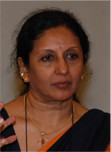
Lata Narayan:"family is the strongest influence”
The majority of respondents said that the parents had left the decision regarding education to the youths themselves and 33 percent reported that they had been helped for education by a Parsi trust or charity. While there were those who felt there had been no decline in the educational standards of Parsi youth, nearly 50 percent stated that negative peer pressure in the baugs was one of the reasons for the decline. The trend of girls going in for higher education more than boys was explained by over 50 percent in terms of girls being more academically inclined. Of the 19 percent who were running their own businesses, it was found that large business owners were largely men whereas those involved in small businesses were women.
The student group and those in service were more interested in migrating while 47 percent of the respondents had no wish to migrate. The favored destinations: US, Australia, Canada. New Zealand had only 14 takers. Their main reason for migrating would be better opportunities and a better lifestyle. As for migrating within India, 24 percent would be amenable if a better job opportunity was available elsewhere while 34 percent said they would not like to shift from their hometown. The balance 26 percent were ready to shift wherever. Narayan observes that most people were agreeable to shift to the metros. But only people from the smaller towns like Navsari or Valsad were prepared to go to Jamshedpur. On the other hand, in Dahanu and Jamshedpur the youth were advised to migrate for higher education.
More females than males wanted a separate household after marriage. Narayan adds that this choice was not perceived as shirking responsibility to their parents. They felt that they could manage both more comfortably. In marriage, 38 percent sought compatibility, 33 percent care/understanding, 23 percent companionship, 20 percent good education and 19 percent physical attributes. Narayan notes that financial stability was not rated high in their preferences. Factors like love, religiosity, sense of humor, intelligence and ability to adjust with inlaws did not figure in the first six preferences among any of the youth groups in India.
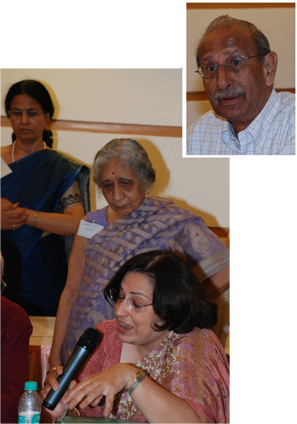
Left to right: Drs Shalini Bharat, Armaity Desai and Shernaz Cama Inset: Rumy Mistry
"All the youth said that they would like to marry a Parsi, but if they do not find a suitable partner, then they would consider marriage outside the community. The perception is no longer that they will remain unmarried if there is no suitable Parsi, as was in the earlier generations,” writes Narayan. Many (45 percent) were sure that their parents will not accept an interfaith marriage, 21.7 percent said their parents would be open to the idea while 23 percent felt their parents would accept it, but reluctantly.
While 35 percent felt that living in a Parsi colony provides a sense of community, is good for children and also helps find a spouse, 41 percent found there was less privacy, more gossip and annoying familiarity.
Asked to state the five values they strongly believed in, 69 percent spoke of honesty and integrity, 34 percent of respect for elders, 31 percent for truth, 27 percent for importance of action and hard work, 25 percent for loyalty.
Fifty-one percent of the respondents identified themselves as Indian first 33.7 percent as Parsi. Interestingly, 41 youths from Bombay said they would like to be identified as individuals without any tag.
Gujarati and English were the two main languages spoken and known in all locations. In their description of the Parsi image, 9 percent spoke of honesty, 38 percent of trustworthiness, 37 percent of a happy go lucky attitude to life, 28 percent as helpful and religious and 24 percent as respectful. In their estimate the public image of Parsis was an honest people (43 percent), trustworthy (34 percent), happy-go-lucky (28 percent), non-interfering and helpful (19 percent), religious and successful (17 percent).
While 93 percent considered themselves as believers in Zoroastrianism, 4 percent registered themselves as non-believers. The believers valued the powerful prayers as giving peace of mind, the values of good thoughts, good words, good deeds being applicable in daily life. They attributed their knowledge of the religion to their parents (81 percent). Only 11 percent said they learnt about the religion from the priests. This, says Narayan, underscores that "in spite of all the environmental changes, societal influence, it is the family which is the strongest influence in a person’s life.” 64 percent of the respondents wear the sudreh kusti all the time (59 percent in Bombay). The reasons for not wearing it included incompatibility with certain outfits and sports, for personal reasons, as uncomfortable, for being teased in school and because they do not believe in it.
The dwindling population was considered a critical issue by 67 percent followed by intermarriages and issues related to conversion (22 percent). Twelve percent of the respondents saw the community as divided due to these issues. As measures to counter this state of affairs the respondents suggested more interactive meets, more children, banning intermarriage, opening up the religion to others and greater interaction within the community. While 87 percent agreed the population is dwindling and expressed concern about it, 50 percent stated that children of intercommunity marriages (28 percent each for father or mother) should be accepted into the community after a navjote. Only 15 percent were in favor of having three children though 60 percent said they would like to have two and 12 percent wanted only one. The provision of child care would not persuade them to have more children, opined 74 percent. Most (65 percent) saw no contradiction in the community advocating more children while the country was nationally advocating the small family norm, being essential for community survival. A small percentage spoke of contributing ‘quality’ citizens, "a response that suggested a superior attitude among these Parsi youth in comparison to other communities or class which were even named in some instances,” notes Narayan.
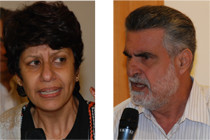
Dinaz Damania (left): "a mentality of less” and Rustom Tirandaz (right): "Efficacy of the vernacular Press?”
Among the suggestions offered by the group: More young people in decision making body for Parsis (47.6 percent), think about the community, not self (43.7 percent), open up the religion and be liberal (17.6 percent), no gender bias with regard to laws about intermarriage (12.9 percent), ban intermarriage (9.8 percent), reform laws about conversion, adoption, etc (five percent).
Prof Rumy Mistry of Baroda who chaired the session noted that their youth group had organized a marriage mela. "It made a lot of money, though I don’t know how many marriages came about. They donated the money to the Baroda Parsi Punchayet to reward excellence in youth… Even working people say they would like their own business. If we have seed money to start them off, it would help the community.” Warming up to the suggestion to involve youths in decision making Mistry declared, "I would say include a youth among Parsi Punchayet trustees…Of the seven or nine on the board at least two should be youths.” He was also in favor of a cutoff age for trustees.
In answer to Jamsheed Kanga’s question whether the youth was satisfied with the leadership of the community in Baroda, whether there was infighting among the leadership, Mistry noted, "We have had a unified Parsi punchayet for the past five elections…The Punchayet should be responsible for giving guidance, mentoring.”
Narayan drew the attention of the audience to the youths’ questioning of some of the community norms like conversion, demography, intermarriage. Neurologist Dr Noshir Wadia was unhappy that not a single Parsi boy was currently studying at Grant Medical College in Bombay where the previously there used to be 15 to 20 in a class of 120 and underscored the need for reservation. Voices from the audience noted that this was true even in Gujarat adding that there is not a single Parsi boy in the National Defence Academy. According to Parzor director Dr Shernaz Cama, daughter of a distinguished Indian general, this was because parents do not normally support the decision to go into the army. Narayan noted that parents in all communities are not supportive of their sons joining the police or the military. But there is no one even in politics any more, she noted. "As for civil society initiatives, to what extent are Parsi youth involved?” she wondered, saying she was only aware of Farzan Mazda sticking his neck out in Dahanu.
Then second seniormost trustee of the Bombay Parsi Punchayet (BPP) the late Rustom Tirandaz introduced a red herring: "What was the efficacy or failure of the vernacular press (as he termed the community press) in meeting the expectations of the community? Have they failed? Could they have done better?” Narayan noted that Parsiana and Jam-e-Jamshed were the most commonly read but Paula Mistry, a member of the audience, felt that Parsiana readers were elderly people.
"Is there an action plan? Do we have the organizational capacity to implement it?” asked Kanga. Referring to fellow BPP trustee Jimmy Mistry’s Parsi Resource Group Tirandaz noted that the young man had "gathered a volunteer force of 700 people long before he became trustee. The youth are doing much more than the elderly,” he noted, exempting trustees from the ‘elderly’ group.
Narayan noted that youth across the world was giving greater emphasis to religious identity. "In our study no youth wanted to break away from Zoroastrianism. But it should not lead to fanaticism,” she cautioned.
Comparing the two papers of TISS Prof (Dr) Shalini Bharat and Narayan, Dinaz Damania noted that the former depicted "poverty of mind: if I love my mother I can’t love my wife; I can’t look after more than one child. It’s not a mentality of more, but a mentality of less. If fear is the base of decision making, no strategy will work. The quantitative study is rosy as versus the angst of the qualitative study.”
Narayan spoke of a small-town girl who had told her, "Only if my parents move with me, I’ll get married (in another part of the country). But she was not negating responsibility.”
"People want to be sure, secure in all aspects. There is a need to look at the two studies together,” responded Bharat. Mistry told her, "You were searching for answers. So some of those things may not come out in a quantitative study.” To be continued
◆ ◆ ◆
From the archive