
“Immersive reading”
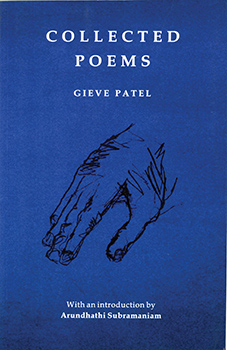
Collected Poems by Gieve Patel. Published in 2017 by Poetrywala, Paperwall Media and Publishing Private Limited, 1201/D, Octacrest, Lokhandwala Township, Kandivali (East), 400101. Pp: 159. Price: Rs 350.
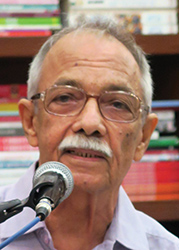 Gieve Patel’s (pictured on page 220 and 226) poems have been published in three books: Poems (Nissim Ezekiel, Bombay, 1966), How Do You Withstand, Body (Clearing House, Bombay 1976) and Mirrored, Mirroring (Oxford University Press, Madras, 1991). Printed copies of these are almost impossible to obtain; hence, one cannot underestimate the importance of the Collected Poems which have been written over the last 60 years. He, Adil Jussawalla and Keki Daruwalla are probably the most prominent contemporary Parsi poets writing today. There has been an overwhelming new lot of Parsi novelists in recent times; however, the poets have taken a back seat. It has become an overused cliche to describe Patel as the perfect renaissance man: he has the distinction of being not only a poet, but also a very well respected artist and a successful playwright.
Collected Poems "offers a reader the rewards of an immersive reading,” says Arundhathi Subramanian who, being a poet herself, has written a sensitive and perceptive introduction to the volume. She points out that "Patel’s poetic universe is one of nerve-endings and viscera, ragged fibre and vein, gnarled root and ‘leprous hide,’ pervaded by overwhelming corporeal odors.” This comes as no surprise, as Patel studied medicine and worked as a doctor for the greater part of his life till he decided to concentrate solely on art and writing. Even in the first published poem (and possibly his best known and most widely anthologized) On Killing a Tree, the imagery is violent and hard-hitting and almost medical. You can’t kill a tree with a single "jab of a knife,” one has to "hack and chop” and still "The bleeding bark will heal... The root has to be:
. . . Pulled out —
Out of the anchoring earth;
It is to be roped, tied,
And pulled out — snapped out
Or pulled out entirely,
Out from the earth-cave…”
 Several poems deal with post-mortems. In some, the tone can be soft and sympathetic. In Post-Mortem Report (Child aged 4: Military T.B.) he ruminates on the last few days of a little girl. He wonders if there were any signs of what was happening and whether there was a "sense of withdrawal.” The bacillus is almost personified as an enemy invading every organ and the child dies two hours before the post-mortem is conducted. In another poem Post-Mortem the tone is angry and the imagery violent. The entire procedure is described in a manner which seems to diminish the dignity of the individual who is "swiftly…sliced/From chin to prick.” His bones which seem to be strong and protective are "snapped,” various organs examined only to:
"Be dumped back into the body,
Now stitched to perfection,
Before announcing death
Due to an obscure reason.”
There is great sympathy for the poor and the downtrodden. Whereas his grandfather cannot understand his views on the servants and finds the peasants "Difficult, ungrateful, / Double-faced, unreliable,” Patel, on the other hand, in Servants seems to sympathize with these individuals who have been forced to take up this job because they are "Truant from an insufficient plot.” He paints a wonderful picture of them, relaxing in the darkness after a day of hard labor, smoking, sitting silently without thought.
Patel can also be extremely cynical and ironic when he chooses to be. In the poem The Ambiguous Fate of Gieve Patel, / He Being Neither Muslim Nor Hindu in India he regrets that "To be no part of this hate is deprivation.” However, there is great sadness in the last few lines when he sarcastically comments:
"... Bodies
Turn ashen and shrivel. I
Only burn my tail.”
In his paintings, the dominant motif of his work is the well. Looking into a well for him is similar to looking within oneself. Whereas no wells appear in his poems, there is much introspection in the third volume of his poetry, Mirrored, Mirroring. In The Difficulty, he mentions how impossible it is to utter the word "God” in the beginning as one has lost the habit and one feels embarrassed to mouth the words. He compares this to:
"…lisping in public
About candy.
At fifty!”
Also included are seven poems by the 17th century poet Akho Bhagat whom Patel has been translating on and off for several years. In these poems, Patel captures, what Subramaniam calls "the savage indictment of the spiritual hypocrisies of (Akho’s) time.” In one of the poems, Ahko says that the "true gem, abides / clasped round your neck” but we waste our time searching for it everywhere and the "agonized search” is fruitless unless you are aware "of the One Magnificent / secure at your breast.”
Included in the anthology are 19 new poems which are a delight. In Sidewalk, he compares a blind man "tap-tapping the sidewalk at Toronto” and the care with which his cane rests against a wheel of a parked bicycle to a butterfly which has alighted on a flower. Just as the rocking of the stem does not disturb the butterfly so also the walking stick of the blind man which is now compared to an "antenna
…examines the wheel, and satisfied
with what it has found allows you
to take two steps to the left,
And forward.”
Subramaniam perceptively notices "a fascination with skins, sheaths, tissues, veils and integuments” in the later poems. These poems often have a lighter and more humorous touch than his earlier poems. Maybe years away from his practice as a doctor have lessened his predilection for medical matters and imagery. In Magenta, he humorously describes an incident on a beach where he picks up a magenta underwear left on a bench. It is almost new and after a careful inspection ("No shit, no spunk, no piss”) he wonders why it has been so carelessly and hastily abandoned "innerside out.” He ponders if it is a "young Adonis” but concludes that the owner must be probably 70 or 80 on account of the size of the garment.
In Carrying Bras and Panties to the NCPA, he once again, in a light-hearted manner, describes an incident when his wife Toni who is away with his parents instructs him to bring "three bras and three panties.” This leaves Patel in quite a dilemma as he does not know how to transport these garments. After a lot of soul-searching he decides to carry them in "a firm, crackling, envelope” received from the USIS (United States Information Service) and hands them over during a performance of Verdi when "the new Russian bass (is) at his peak.”
After reading the poems, one hopes that the Collected Poems does not represent the finale to Patel’s poetic work and that he will continue to enrich and entertain us with further poems in the future. F. G.