
Books
“A strong inner necessity”
The release of Dr Gieve Patel’s Collected Poems at Kitab Khana on May 19, 2018 was indeed a long and eagerly anticipated event. It was a decade after the launch of his last book, Mister Behram and Other Plays. The 2018 release was made even more interesting as he was in conversation with Arundhathi Subramaniam — poet, artist, journalist, classical dancer, curator and poetry editor. In addition to writing a perceptive introduction to Collected Poems, Subramaniam performed her role exceedingly well and managed to draw out the shy and reticent Patel and make him speak freely and frankly on several subjects, literary as well as personal.
Subramaniam started the conversation by drawing our attention to how "significant” this book of poems was, as "you are holding almost 60 years of poetry in your hands. It is almost like being present at an artist’s retrospective.”
Patel confessed at the very start of the evening that since they were first published he had not changed a single word of the poems in the present edition. Even though he found some of the earlier poems weak and off the mark, he left them exactly as they were.
Subramaniam started the conversation by drawing our attention to how "significant” this book of poems was, as "you are holding almost 60 years of poetry in your hands. It is almost like being present at an artist’s retrospective.”
Patel confessed at the very start of the evening that since they were first published he had not changed a single word of the poems in the present edition. Even though he found some of the earlier poems weak and off the mark, he left them exactly as they were.
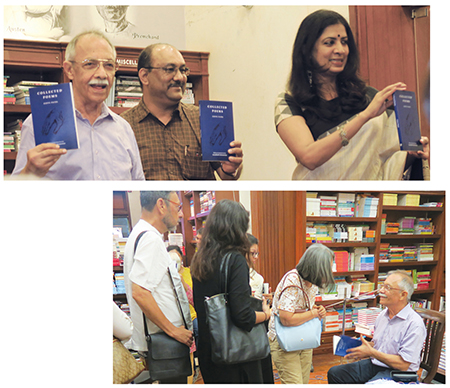
Top, from l: Gieve Patel, publisher Hemant Divate and Arundhathi Subramaniam at the book launch;
above: Patel signing copies
Patel has published three collections of poems: Poems (1966), How Do You Withstand Body (1976) and Mirrored, Mirroring (1991). Why were there such large intervals between these volumes? asked Subramaniam. Patel mentioned that much of this time, he was also a practising doctor, writing plays, assisting his wife Toni in directing them, and of course, painting, which has now been his primary area of interest for the last several years. But mainly, he was very struck by the principle of "inner necessity” which he read in the Russian painter and art theorist Wassily Kandinsky’s book, The Spirit in the Art and which has become a touchstone for all his work. "You do something because a strong inner necessity dictates that you should do it; otherwise, you don’t do it at all.” Of course, he added this was a very personal point of view and gave the example of Russian novelist Fyodor Dostoevsky who wrote furiously to pay off his gambling debts!
Subramaniam asked if he had to choose between being an artist, a playwright, a poet or a doctor and "whether there was a hierarchy of self-definition, a primacy of poetry.” Patel replied that this was not so. "Each of these acts fulfil some inner need and each has given me my own reward. All my activities are dictated by a wish for knowledge and different aspects of knowledge come to me from all these various quarters and I need to address them.”
The early poems were written soon after his training as a medical student and the poems are full of hospitals, encounters with patients and the shock of medical practice. As he could not take human suffering in his stride as some of his colleagues did, the way out was writing a poem. "When you feel helpless, that is when you write a poem.” Patel read three poems, one of a general encounter with a large group of patients, the second focused on a single mother and child and the third, Post-Mortem dealing, as the title suggests, with a single corpse.
The second volume, How Do You Withstand Body, was published when Patel was in his 30s, vulnerable and sensitive to the conflicts all around the world. The poems deal with a mediation on violence and why it takes place, the different kinds of violence that the body is subject to, "and a lot of metaphysical speculation of what the body is meant for and if you are subjected to pain, why is it that I don’t feel the pain. Is pain localized or do we all share it?”
Subramaniam noted that in the third volume Mirrored, Mirroring, something had shifted. "Though the preoccupation seemed to be the same, the body seems to be just as beleaguered, the world just as insane, the mind just as bedevilled, the tone has shifted and there is something buoyant in the poems.”
Patel spoke about his friendship with the poet A. K. Ramanujan which lasted for more than two decades. A palmist once told Ramanujan that he would visit several temples, but would worship at none. Both he as well as Ramanujan were very curious about mystical life but at the same time very wary about false spirituality. In both their poetry there is an engagement with the carnal body. Hence, there was the feeling of the "sense of one profane monk recognizing the other.”
At this point, Patel also grew very interested in meditation. For him, meditation is an activity whereby the outer world is temporarily put away; but the key word is "temporarily” because the outer world comes back to haunt us. "The poems in Mirrored, Mirroring are a dialectic between the inner world and an outer world, between the demands of the inner world and the objections put forward by the outer world.” The poems also arose from his idea that God was a unitary person, "a self enclosed perfection” till (the poet) feels lonely and is convulsed with the desire to see the flood of creation. Hence, he feels that we mirror God and God is mirroring us.
On a hot and dusty afternoon in Baroda, Patel’s friend Suresh Joshi — Gujarati poet, critic, translator, novelist, who led the modernist movement in Gujarati literature — introduced him to the work of a 17th century Gujarati poet, Akho Bhagat. Patel was fascinated with the poems and decided to translate them. He has been translating them off and on a sporadic basis since 1960 but somehow felt that he was unable to make much progress till he met Ramanujan in Chicago, a skillful and experienced translator from Sanskrit, Kannada and Tamil into English. He advised Patel to translate literally, and not, in the initial stages worry about the essence or the rhythm. Only once this was done could the translator play around with words or syntax and Patel found this very helpful. "Each poem is like a crystal,” and Patel read three poems where he shows different aspects of Bhagat’s poetry. The general theme seemed to be human folly: in some poems Bhagat makes sharp, bitter and dismissive observations, whereas others are compassionate and a few are instructional.
There are 19 new poems in this book and Subramaniam points out that there is a recurring image of skin and garment in several of these poems. All the earlier preoccupations continue, but there is "an exuberant and erotic quality reminding us about the body and the beyond and that they are inextricable and cannot be separated.” One poem Patel read, entitled Carrying bras and panties to the NCPA, was written in the 1990s when Toni was still alive and she seemed very happy with the poem though she felt that she ought to be displeased. She was nursing a sick relative and requested Patel to pass on some underwear when they were to attend an opera at the National Centre for the Performing Arts.
An excerpt follows:
No, Just/
an unveiling of rustling linen,/
fresh, newly laundered,
delectable as only/
the choicest potato crisps could be, picked/
one by one from a neat package/
and doled out to each other in the dark,/
to the accompaniment of Verdi.
One cannot forget the remarkable work he has done with the students of Rishi Valley School in the south where he would hold a workshop every year for two or three weeks. The earlier batch of students were very reluctant and very often Patel felt that he was merely wasting his time. The pattern he followed was reading great, world poetry (translated in English, of course) carefully chosen for the age group he was dealing with. The students would then write their own poems based on the inspiration they received from the great poets. Patel met students who were in the seventh standard (around 12 to 13-year-olds) and mentored them till they reached the 12th standard and were in their late teens. He even got them to read their poems in front of the entire school and eventually a book was published Poetry with Young People which is an anthology of the best poems written by the students, for which he has written an introduction.
Subramaniam ended the conversation by talking about On Killing a Tree, one of Patel’s most famous poems which has been anthologized not only in India but also in Britain and other parts of the Commonwealth. She related it to another poem, one of the newer ones, about a tree, All night. These two trees stand like protagonists on either end of the spectrum. Whereas the first tree seems to be the "voiceless recipient of a violent act,” the second tree seems to be capable of "colluding in its own destiny. Rather than succumb to the axe, this tree seems to say that extermination and ecstasy go together.” And it was on this point that the conversation ended.
Patel confessed at the beginning of the evening that the Collected Poems was thanks to the constant persuasion from Subramaniam. I’m sure his fans wish she would convince him to take up writing new plays as well.
FIRDAUS GANDAVIA
Gandavia holds a doctorate in English literature and is a retired chartered accountant. He is a compulsive reader of fiction.
◆ ◆ ◆
From the archive