
Business
An eye to the future
Faith in Baliwalla and Homi’s eye care and eye wear has endured for 110 years
For the last 110 years Baliwalla and Homi Private Limited have kept a vigil eye on advances in the optical business. When the directors realized that their long-standing store in the busy Flora Fountain area would be sharing a wall with a competitor from the multinational Zeiss chain which had chosen to start operations next door, they adjusted their focus and readied themselves for the challenge.
"When we provide good quality products, backed by a name and reputation, we are able to hold our own even when the retail optical business is getting highly competitive,” maintains Zarir Baliwalla, the fourth generation from the Baliwalla family to associate himself with the family’s optometric business. "Our strengths are different. We have to build on those strengths and live with the competition,” explains his sister Anahita Dastur who has seen the importance of customer relations and quality controls in this business. "Eye care needs a lot of personal touch,” she reiterates, happy to remind us that their customers span two or more generations from the same family.
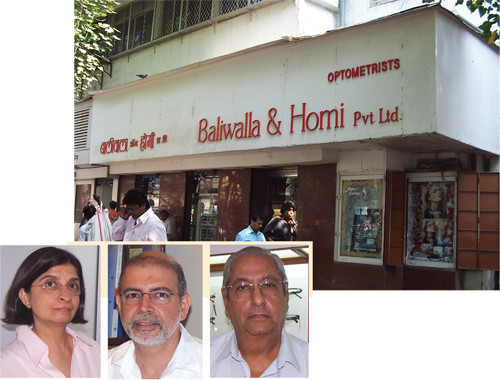
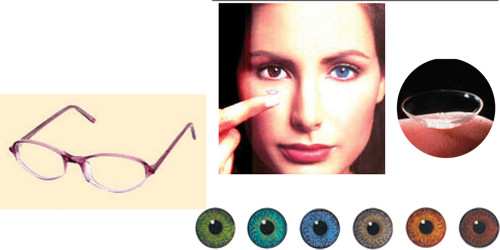
From left: Anahita Dastur, Zarir Baliwalla and Rattan Surveyor; (above) the flagship store; (top) contact lenses and spectacles
"Many of our good customers have migrated,” points out Rattan Surveyor, a director of Baliwalla and Homi who finds it particularly reassuring when they continue to receive orders from their loyal clientele settled in the USA or UK. Some of the NRIs (non-resident Indians) get their optical frames and lenses from one of the Baliwalla outlets in Bombay when they visit their homeland. Surveyor sees it as a measure of "their trust and satisfaction in our quality.”
Among their loyal clientele are many Parsis who reside in south Bombay as also employees of the Tata group. While some of the older Parsis require to be handled with greater tact and respect, Dastur is happy doing business with them "because they don’t bargain as much as other communities.” Admitting his "bias towards Parsis,” Baliwalla adds, "They have their idiosyncrasies. They are a good time-pass and doing business with them is always a pleasure.”
Their retail optical business is carried out from four outlets, their flagship store being at Fort which has been in existence since 1916, another one in Parel since 1919, the one next to the Anjuman Atash Behram at Dhobitalao since 1928, and a counter at an eye hospital in Kalyan where for the last nearly 50 years they have been dispensing low cost spectacles. "A different way of doing retail business is coming in,” observes Dastur, "with the monopoly enjoyed by small family businesses being taken over by the multinationals… As the city keeps growing, people don’t have time to travel to meet their needs.” Thus mushroom optical shops in different localities to meet the needs of the customer. "As the market grows, so also does the supply with the addition of new shops. There is a lot of new expansion in the suburbs but then volumes too are moving to the suburbs,” she states. Additionally "computerization will affect any business.” Aggressive promotion is also noticeable. "No business would survive without marketing. Even if you are a professional you have to market yourself today,” she has noticed.
"My father Naval was among the pioneers of contact lenses in India in the 1940s,” mentions Dastur. Despite its rising popularity over the years, for eye correction, 70 percent of the market uses spectacles, estimates Baliwalla. Besides being "time-tested and cost effective,” it is favored over the two alternatives of lasik surgery and contact lenses as "there is no fear of anything being done to the eye.” Yet another factor in support of spectacles is that those suffering from presbyopia (problems with near vision) can’t be comfortable with lenses. On the other hand there are certain eye conditions like keratoconus (degeneration of the cornea) where good vision is possible only with contacts, points out Dastur. In such cases "there is a medical use for contacts rather than cosmetic.” Advancements in science and technology bring in specialized lenses and spectacles which may be more expensive but they provide superior comfort and vision.
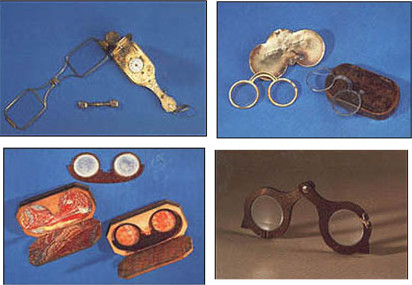
Above and below: Opthalmic instruments and equipment made by the firm
To supplement the optical business, the directors are now "concentrating on another niche market — ophthalmic instrumentation. Our instruments and equipment are used by eye surgeons for diagnosis and treatment of eye ailments. In fact ophthalmic instruments contribute 70 percent of our turnover. We do this on all-India basis and even export to countries like the UK,” declares Baliwalla. Their workshop at Tardeo has been operational since 1936. Among the instruments that they manufacture are the trial lens sets used for testing refraction in the eye, the synap-tophores for the treatment of squints… Additionally they are the authorized and exclusive distributors for companies like Keeler Limited of UK, Kowa of Japan and Quantel Medical of France, covering the complete range from basics to sophisticated ultra sound laser, says Baliwalla. The "clearcut and amicable” work division among the three key players is such that while 73-year-old Surveyor looks after finance and overall management, 50-year-old Dastur oversees the optometric side, and 47-year-old Baliwalla, the instrument business and overall management. While Surveyor and Dastur operate from the Fort premises, Zarir sits at the Dhobitalao shop.
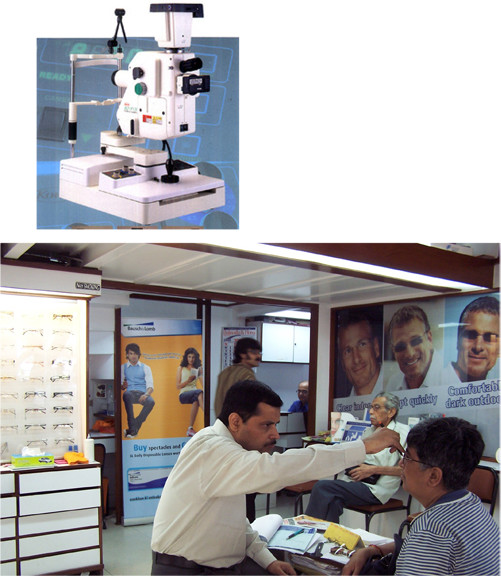
An optometrist examines a customer’s eyes
It was in 1899 that Naoroji Jehangir Baliwalla launched his small optical shop at Kalbadevi which was then a thriving optical market, relates Dastur. He was joined by his brother Pirosha who was a skilled craftsman and personally handcrafted optical frames. In 1913, Naoroji’s son Pirojsha formed a partnership with Homi Guzder and thus was born Baliwalla and Homi. Today it is a private limited company with Zarir and his mother Gool Baliwalla being the directors from the Baliwalla family, and Surveyor (the nephew of Homi Guzder) and his wife Mehroo being the directors from the Homi side.
After his schooling from St Xavier’s, Surveyor proceeded to study commerce at the Poddar College but gave up midway and chose instead to do his Government Diploma in higher Accountancy (GDA) before joining Baliwalla and Homi in the accounts department around 1949-50. Over the years he has worked in different departments — glazing (lens cutting), eye testing, sales, general administration.
Initially for three years Baliwalla worked part-time at Baliwalla and Homi after he completed his schooling from Cathedral and John Connon, graduation from Sydenham College and law studies from Government Law College. "Training at the factories of some of our principals whom we have been representing” he soon received the necessary hands-on experience and confidence to be an asset to his own organization. With a staff strength of nearly 90 of whom seven are Zoroastrians, presently his priorities are "trying to increase the range of instrumentation as also to increase penetration into the market.”
Dastur completed her schooling from J. B. Petit, did two years of science at St Xavier’s and then proceeded to the City University in London where she did a four-year degree course in optometrics. After working there for some years she returned in 1986 to join the family business where she has been working as an optometrist, examining eyes and specializing in contact lenses.
"What will you do for the profession which has nurtured you?” Dastur can vividly recally her father’s words soon after she had earned her degree overseas. With India having the largest number of blind and partially sighted in the world, Dastur refers to the quantum of work that needs to be put in for preventable blindness through eye camps that could bring medical care closer to the poor. The Baliwalla and Homi Low Vision Aid kits are dispensed to the National Association for the Blind as also to the Happy Home and School for the Blind "as a kind of social service to those in the low income group who have neglected their eye care at some stage due to reasons like inadequate diet,” supplements Baliwalla. They also dispense spectacles (almost at cost price) through the Bombay Municipal Corporation as they are collaborating on a project — Sight for Kids — a joint venture between Lions and Johnson where children in municipal schools are screened all over Bombay. A tie-up with the B. D. Petit Parsee General Hospital helps about 20-25 poor Zoroastrians a month in need of spectacles. They bring a slip from the Hospital and on providing them the spectacles billing at cost price is done directly to the Hospital.
Referring to the advancements in optometry all over the world with which they have to remain in touch, Dastur states when she went abroad to study there were no degree courses in optometry available in Bombay. Presently there are three colleges including the Lotus College of Optometry, founded by her father in 2000 and where she is presently managing trustee, which offer a four-year degree course in optometry.
"There are a lot of openings for optometrists in India with more and more optometric shops opening. Earlier ophthalmologists considered optometrists a threat but today they realize they are a great asset and with their assistance can attend to many more patients,” reveals Baliwalla. "There must be 4,000-5,000 qualified optometrists in India but the demand is still not filled,” states Dastur. "A lot of my students are doing very well although they may be small timers operating from their home or from some small place. I would like Parsi youngsters to become optometrists,” says Dastur who is planning to take the message forward to young school-leaving students attending the Bombay Parsi Punchayet’s Holiday Programme for Youth. She feels gratified that this year, for the first time, a Parsi student enrolled for the optometry degree course.
Having been in the business of eyecare and vision, Baliwalla would have liked the elders in the community to adopt a wider vision: "I wish they would fight less and I wish certain groups would be less dogmatic in their ideas about religion.” Children of women who have married out of the Zoroastrian faith "should 110 percent be accepted,” though he was not in favor of accepting converts. Surveyor too felt that with the community strength declining, children of outmarried women should be accepted. Dastur though believed, "It is a difficult call to take.” She was more emphatic though that "dakhmenashini should not continue in the absence of vultures. According to our religion we should not pollute the environment.” The need of the hour is to dispose the body in the most environment friendly manner, not to support a system with artificial means like breeding birds in captivity. Baliwalla reasoned, "When somebody has passed away, personal feelings should be given more priority than the rules of the religion.”
Entrepreneurship within the community "we don’t see as much as we used to in the past,” declares Baliwalla, "probably because young educated Zoroastrians want to move out of the country. I personally find the younger generation laid-back.” Dastur though is happy to see "a lot of Parsi businesses doing phenomenally well,” but is disappointed that "such a large percentage are moving out of India. Soon the figures will be greater outside India.” While conceding that "the world is a global village and we are multinational citizens,” she adds, "The Parsi community has contributed so much to this city, this country…I would have liked to see that contribution continue.”
◆ ◆ ◆
From the archive