
Cover Story
“Let’s have some refinement”
Major controversies have set their stamp on the working of the BPP board, says trustee elect Noshir Dadrawala
"At best, the BPP Review can represent the Bombay Parsi Punchayet’s (BPP) point of view. It can never have the credibility of an objective, informed community Press,” says BPP trustee elect Noshir Dadrawala, recalling the "cordial, healthy” interaction between the Punchayet and the Parsi Press in the 1980s when quarterly press conferences debated detailed handouts from the BPP depicting its position on various contemporary issues. A journalist by avocation who had functioned as editor of in-house newsletters of the CER (initially Committee for Electoral Reform, later renamed Committee for Economic Revival) and WZO (World Zoroastrian Organisation), Dadrawala has been a consistent contributor to the Jam-e-Jamshed and had represented it at the BPP press conferences.
Though aware that "some people are peeved with the Parsi media,” and conceding that "most editorials are based on assumptions,” Dadrawala maintains that he has told his fellow trustees that "there is no reason why if the board makes the right information available, it would not be reflected in the Press… But if you alienate the Press, they are bound to be hostile.” Dadrawala was sharing his thoughts in answer to Parsiana’s queries at his Centre for Advancement of Philanthropy (CAP) office at Flora Fountain on December 12, 2008.
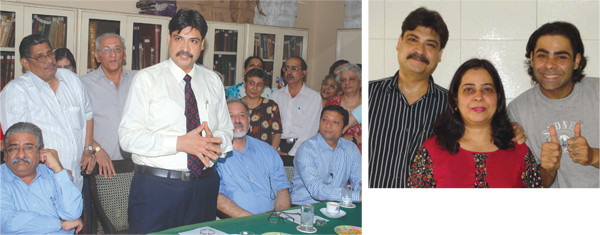
Left: Noshir Dadrawala (center, standing) in the BPP board room and (above) with wife Mavaz and son Darius
One view of the election mandate is that the community is in favor of orthodoxy. How homogenous is the new team in this respect? Does everyone favor the same brand of orthodoxy? we wonder. "Only with time we’ll know who stands where,” responds Dadrawala. "So far there has been no issue. Each chairman has had a landmark controversy to deal with. In Dr Aspi Golwalla’s time it was Roxan Shah; in Minoo Shroff’s time it was Dhun Baria…The Originating Summons is likely to come up soon…”
Dadrawala was referring to the plea filed by former BPP chairman Golwalla, former trustee and former Bombay Muncipal Commissioner Jamsheed Kanga and Tata Sons director Homi Khusrokhan in the Bombay High Court for a mandate to provide a bungli at Doongerwadi for the funerary prayers of those who opt for cremation or burial instead of dakhmenashini. This "cremateni bungli” is a contemporary hot potato. Dadrawala, who had staunchly opposed the idea when mooted by the erstwhile DDD-AG (Disposal of the Dead with Dignity — Action Group) in 2001 is now in favor of such an arrangement outside the Doongerwadi precincts. He says seeing the evidence presented by Baria has made him realize that the dakhmas are really not functioning the way he had imagined they did. Though he says he would still opt for the dakhma in his personal capacity, it’s now a matter of conscience for him to work towards such an arrangement, albeit outside Doongerwadi, for those who cannot abide the thought of their loved ones putrefying in a heap.
Another nettle this board of trustees has to grasp is the question of providing housing to the 104 applicants cleared by the old board in the charity commi-ssioner’s (CC) court. There is a move to appeal against the CC’s order. Dadrawala has declined to join his co-trustees in the appeal against it, saying they are welcome to name him as a respondent.
A professed traditionalist who in 2002 had been the conservatives’ candidate against Dinshaw Tamboly who was seeking re-election, Dadrawala had chosen to withdraw from the race midway. We wondered if he had regretted standing for election to BPP trusteeship this time as part of the AFP (Adult Franchise for Progress) panel which its competitors had branded "reformist.” Indeed, he has been taunted as being a "pendulum.”
"The whole issue has been totally misconstrued,” responds Dadrawala. "AFP had the best professional team. It did not have a religious agenda, never even contemplated it. It only looked at social reforms. I don’t think I made any mistake standing on the AFP platform. I consider all of them as good friends and will look to them as resource people outside the BPP for guidance in the legal and housing fields. My opinion did not change. The ‘ultra’ brand of orthodoxy goes against my thinking. I am not in sync with its aggressive running down of people. Let’s have some refinement!... Let’s be good human beings with basic respect. You can’t bypass that!”
Of course, the BPP board will continue with dakhmenashini as a system and co-trustee Khojeste Mistree has taken charge of the Doongerwadi portfolio, says Dadrawala. "There is a need to optimize the solar panels, perhaps incorporate better reflectors, build on what’s existing,” he adds.
Dadrawala says he has "always been opposed to intermarriage …because it does lead to dilution of the ethnic identity. But there should be no discrimination on the basis of sex. What is sauce for the goose is sauce for the gander. However, if two people can find happiness with each other, I wish them luck.” As for the acceptance of the children of Parsi women married outside the fold, he abides by the legal position vis-à-vis the rights of the women if it is a civil marriage they have contracted under the Special Marriage Act where each party is deemed to preserve his/her religious affiliation. However, there is no such legal right for their children, he notes.
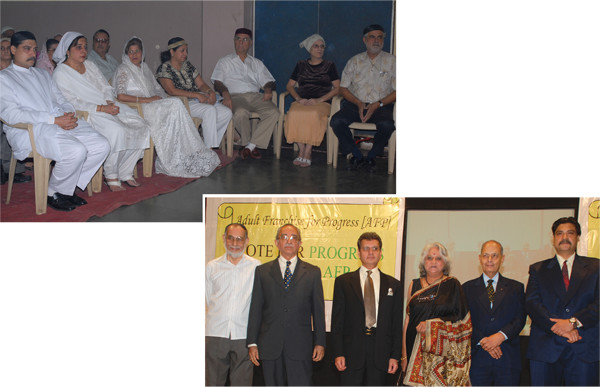
Above: Dadrawala (ext L) at the Dadar Parsee Gymkhana celebratory jashan. Inset: With members of the AFP team at its launch at the Y. B. Chavan Auditorium
Described as a "charity management expert,” Dadrawala, chief executive officer of the CAP, says he had "dreamt of doing things for the community, taking a different approach,” but with the present mixed board is dubious about how much he would be able to implement. He wants to know "How many BPP beneficiaries are on the dole? Why are they so dependent? Are they too old? Have they missed the bus? How many are sheer mercenaries looking for a free lunch?” According to Dadrawala, the community is totally dependent on its trusts in the area of housing but not for other things. For example, he says the BPP contribution even for education abroad — the highest it gives — is Rs 50,000 as a grant and Rs 50,000 as a loan when the need is upward of Rs10 lakh. Even when it comes to housing, Dadrawala is of the opinion that though "the baugs have their value, the Borivli and Suburban Zoroastrian Anjuman is a classic example of a happy, lively anjuman with lots of functions and interaction” though its members do not all live in a baug. Dadrawala says he has always lived in a cosmopolitan milieu and never regretted it.
The BPP program for the third child — the Punchayet contributes Rs 1,000 towards the upkeep of the third child — is hardly an incentive for the community to opt for larger families, says Dadrawala though he is not about to oppose its continuance. He is warmer in his assessment of the Fertility Clinic which is "useful though it does not have too many patrons. It’s a good service which should be maintained.” He is equally enthusiastic about the venture capital scheme where most young entrepreneurs have done well.
Dadrawala also believes it is "time to get off our high horse” and seek reservation in educational institutions. "The competition is so high…Our kids need it. They are missing out on medical/engineering admissions” by small percentage points, he notes.
The current economic downturn, which Dadrawala feels may be a five-year business cycle, is unlikely to affect the BPP and its programs: "While donations in the cosmopolitan community are drying up, the BPP is not dependent on donations at the moment and interest on its endowments is fairly stable at 10 percent.”
As for the Federation of Parsi Zoroastrian Anjumans of India, "it helps to keep the all India community connected, but how productive is it?” asks Dadrawala, adding that he would like to explore what can be done to make it more effective. And "just as the Federation is useful to keep us in the know about what is happening at the national level, a representative world body would keep us in the know of what is happening to our people internationally.” He says "it would be best if we can keep the neo-Zoroastrians out,” restricting the membership to federations such as ZTFE (Zoroastrian Trust Funds of Europe) and FEZANA (Federation of Zoroastrian Associations of North America) even though in the latter case its member associations accept non Zoroastrian spouses as members. "We cannot interfere with their autonomy. After all we do accept the Delhi and Jamshedpur anjumans (where too non Zoroastrian spouses are members, albeit with restricted rights) in the Indian Federation. That shouldn’t be a ground to oppose it.”
Son of the late Perin and Homi Dadrawala who had devoted 35 years of his life to the Central Bank of India’s legal department, Noshir is an alumnus of St Peter’s School in Mazagon and a science graduate from Bhavan’s College. Thereafter he had a short stint at the City University of New York, acquiring a diploma in non-profits management. Noshir and his wife Mavaz have an only son, Darius, who is a professional in the field of marine diving.
Still wet behind the ears, Dadrawala’s first job was with Jamshed Modi’s Zoroastrian Community Development Institute (ZCDI). Modi was then involved in microfilming rare Zoroastrian books, recalls Dadrawala, one of whose jobs at the ZCDI had been the compilation of community trusts. After five or six years at ZCDI Dadrawala took on the job of assistant secretary at the B. D. Petit Parsee General Hospital where he lasted one year. "It was not exciting enough, though it was quite cushy. I was only 27, surrounded by oldies like Dr Homi Mehta and Pheroze Jhabvala (then joint honorary secretaries of the PGH whose points of view were often contradictory),” laughs Dadrawala. When Russi Lala, CEO of the Sir Dorab Tata Trust and H. T. Parekh, founder of the Housing Finance Development Corporation, set up the Centre for Advancement of Philanthropy, Lala offered him the job that has brought him professional fulfillment, building the institution "brick by brick.”
For a long time the Centre had functioned from the Forbes-Marshall office of Darius Forbes. Then Deana Jejeebhoy got the Centre a grant of Rs 50 lakh from the Ratan Tata Trust that enabled it to acquire its own office space in Mulla House. "I am eternally grateful to her for her initiative,” says Dadrawala for whom the next big break came with the Ford Foundation questioning, "Why are you so Bombay centric? They gave us a grant of $ 100,000 in 2000 and we were able to start on national activities, research, better publications. After a year they gave another $ 200,000 as endowment grant. I am very proud of this institution, very grateful to Russi Lala, Darius Forbes, also to Rati Forbes. But for their support, this wouldn’t have been possible. They were also very enthusiastic, very supportive of the AFP.”
The Centre provides professional assistance to philanthropic organizations in the area of charity laws, effective administration, financial management, taxation, investments and resource mobilization, serving as a clearing house for information in the field. Apart from Philanthropy, the Centre’s newsletter which Dadrawala edits, he has authored several books on various aspects of philanthropy, participated in international workshops like the one at the Harvard University Asia Center, where the paper he presented has been published along with those of other participants by the Harvard Center as Diaspora Philanthropy and Equitable Development in China and India. He was also invited by the Asia Pacific Philanthropy Consortium to research and present a paper on the Indian experience, published in the book Philanthropy and Law in South Asia. The project had been jointly funded by five international agencies including the Ford and Rockefeller Foundations.
BPP trusteeship has not daunted Dadrawala from continuing his editorial contribution to Jam-e-Jamshed "week after week.” And there is no way he’ll give up the tour to Iran he conducts annually: "I really enjoy taking the tours, it’s one of the joys in my life, my annual working holiday! I won’t deprive myself of it!”
◆ ◆ ◆
From the archive