
Politics and Policy
“A rough diamond”
Two close friends invited a select gathering to meet Bombay Parsi Punchayet trustee Dinshaw Mehta who is aspiring for re-election
Referring to the Jam-e-Jamshed Weekly as Bombay Parsi Punchayet (BPP) trustee Dinshaw Mehta’s "chief biographer,” Tata Sons director Farrokh Kavarana welcomed around 150 guests to meet the candidate at the Cricket Club of India’s C. K. Nayudu Hall on September 23, 2008.
A long-time friend and confidant of Mehta, Kavarana who along with publisher Maneck Davar had hosted the evening function alleged the weekly followed German Nazi leader Adolf Hitler’s policy of repeating lies ad infinitum so that people eventually accepted them as truths.
"Dinshaw is a tough person who always stands up for what he believes against anybody, including his friends. The Jamé though says he only helps his friends,” said Kavarana referring to Mehta as a "rough diamond.” Kavarana recalled his late mother and Mehta colleague Silloo as saying, "‘kéva heera maa chhaant nathi (doesn’t every diamond have a flaw)?’ I’ve not known Dinshaw to do anything wrong and I’m prepared to vouch for him,” said Kavarana.
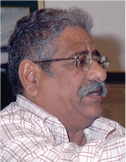
Dinshaw Mehta: knows what to do
A friend and colleague of Mehta from the early days of the Committee for Electoral Rights (CER) who unsuccessfully contested the BPP trusteeship election against lawyer Homi Ranina, Fali Poncha, asked the audience "to sift the truth from the lies… in court if a witness states one lie” the judge and/or jury will be prejudiced against all other facts sworn by that witness.
"Why are people out to get Dinshaw?” queried Poncha. Mehta won the trusteeship elections in 1994 and 2001. "What happened after?” he asked. "Dinshaw goes at (everything) like a bulldog… not sethia style… it upsets people.”
He referred to the "rift” this style caused among the trustees in 2006 when four resigned. "I wondered how eminent people could make such a drastic blunder. Two trustees do not constitute a quorum. How could the Punchayet function at all? The charity commissioner could have appointed an administrator. "Dinshaw could have done nothing” and allowed an administrator to be appointed, said Poncha. But "he swallowed the insults leveled against him and signed a concordat” (a formal agreement). Accordingly all "allegations were unconditionally withdrawn as never having been made.”
Poncha recalled that in 2002 when pugree (amount paid by new tenant to the vacating tenant and the landlord as compensation) was made legal some BPP flats were rented out on a tenancy basis and others on leave and license. At that time "30 lakh rupees was the largest amount paid to the BPP in Ness Baug (for a flat). The Punchayet was not in a mood to accept that amount so I made an offer of 36 lakhs.” An additional 34 lakh rupees was to be paid to the outgoing tenant making a total of 70 lakhs for a flat on a leave and license basis.
Poncha felt "no one would” at that time have paid so much for a flat on leave and license as it offered no protection to the occupant under the Rent Act. "The leave and license agreement has a quaint clause. If the family members dwindle in number the Punchayet has the right to shift you anywhere in Bombay… only a crazy person could accept this. I’m not crazy. The Punchayet said ‘okay pay five lakh rupees more’ for tenancy.” Poncha agreed.
On February 7, 2003 the Wadia committee accepted Poncha’s proposal and the BPP ratified it. "People said I was a friend of Dinshaw and that he did me a favor. I think I did a favor to the Punchayet. At that time Godrej Properties Limited was selling ownership flats at Saat Rasta at Rs 3,500 a square foot… I had paid Rs 5,000 a square foot” for a flat on tenancy. Poncha termed the allegations of favoritism leveled against him and Mehta by the Jam-e-Jamshed Weekly and others "a most blatant lie… If this is a lie then what else is true?” he asked rhetorically.

From left: Rusi Sethna, Fali Poncha, Maneck Davar, Farrokh Kavarana, Eruch Desai, Dadi Engineer and Rustom Tirandaz
Poncha spoke of the 37 norms laid down by the Press Council of India that apply to the fourth estate. Among the requirements are: "accuracy and fairness. All sides (of the story) must be reported. Rumors should not be set forth as facts. Pre-publication verification should be done... I don’t think this document will be found on the premises of the Jamé.” Mehta is charged with being guilty of many offences, he noted. "I agree he is guilty of devoting endless hours to the Punchayet, neglecting his family, friends and business.” He is guilty also of "using BMC (Bombay Municipal Corporation) contacts to advantage the Punchayet” (his father Rusi and brother Noshir were corporators and his sister Anahita is a corporator from the same constituency).
Mehta’s efforts have "legitimately saved taxes.” He cited the example of Godrej Baug where the ratable value was lowered thus lessening the tax liability. Poncha recalled how Mehta "removed the kharwas from Doongerwadi” along with Silloo Kavarana, Rustom Tirandaz and himself. The workers carrying out the demolition of the squatters’ premises "were threatened. We stood our grounds. We are landlords. Twenty thousand square feet were illegally occupied by the kharwas. Dinshaw played the main role. It was done at personal risk to him.”
Poncha spoke of how when heading Tata Housing he had managed to get "development permission for the excess lands of Petit Sanatorium.” He approached Sir Dinshaw Petit with a proposal to construct a multistorey building on the grounds.
Mehta intervened stating the Sanatorium was for Parsis. "Parsis must benefit.” Finally it was agreed that flats in the new building would be offered at lower rates to Parsis/Iranis and from the sale amount received some would be set aside to construct flats for poor Parsis, Poncha stated. Sir Dinshaw Petit was upset with Mehta but said "I can’t fault him!”
Noted solicitor and one of the CER leaders Rusi Sethna said he had known Dinshaw for 35 years or more. "He is sincere and honest — trustee material at its best.” Sethna said he had worked with many BPP trustees in the past including Lady Hirabai Jehangir, Homi Banaji, Erach Nadirshaw, Maneck Mistry and Peshotan Hansotia but "Dinshaw is a cut above them. He is not Sir Dinshaw Mehta (that’s why many don’t like him) but he works at the grass roots level. Dinshaw is a diamond — a rough one, so what? (His) intentions are good but I don’t agree with his methods.”
Referring to Mehta giving up the chairmanship in favor of co-trustee Dadi Engineer (the second in seniority after Mehta), Sethna said, "Dinshaw would make an excellent chairman but if it was coming in the way” of the BPP functioning he would eschew it.
Referring to the allegations made against Mehta in the Parsi Press Sethna said, "What the Jam-e-Jamshed and The Bombay Samachar is doing is helping Dinshaw… I believe he will come out on top. He does not need (electoral) meetings. His actions speak for themselves…People say he takes money. I say he gives.” Sethna noted that when dealing with government agencies certain costs are involved, and Mehta would often bear those expenses from his own pockets.
"We don’t want sethias. We want people like him… He is helping the community by giving flats on pugree — I call it premium. From the consideration received several more flats could be built… In last Sunday’s Jamé five of the Adult Franchise for Progress (AFP) panel parrot-like repeated they would spend two to three hours a week at the Punchayet. The parrot trainer (a reference to AFP founder Berjis Desai) taught each of them to say the same thing — one naughty parrot said three to four hours.”
Referring to the AFP panel’s assertion that they "would not go into micro management, let the staff deal with it,” Sethna noted, "you need staff of that caliber.” Attracting talented people to a trust was difficult. "In a corporation a peon can become a managing director. In trusts, an accountant remains an accountant or at the most becomes a chief accountant… People want to talk to a trustee, not the Punchayet CEO (chief executive officer).”
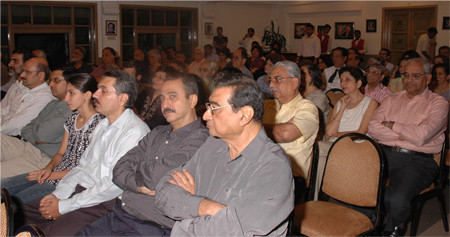
Audience at the Cricket Club of India
He wanted Mehta to win the elections not by a small margin but by garnering 14,000 of the 15,000 votes Parsi/Iranis are expected to cast in the first three weekends of October.
Davar reiterated that in his case also where the Jam-e-Jamshed Weekly alleged that he had been given a flat on the southern border of Khareghat Colony free of cost by Mehta, he had "paid by cheque. Everything was legal… The facts are before the charity commissioner.”
Terming the entire Parsi print media, primarily the Jam-e-Jamshed and The Bombay Samachar as being controlled by one person (Berjis Desai), he claimed the papers made "a travesty of all journalistic principles.”
Mehta wanted to "print his manifesto in the Jamé on payment. He was told to clear it with Berjis.” Mehta reportedly was asked to omit two paragraphs pertaining to the Marzban Sanatorium and the Petit Towers. But finally Mehta believed that printing the manifesto in the paper may only invite more attacks from the Alert Zoroastrians Association, Mehta’s bête noire.
"Democratization in its full form will come to the Punchayet when Dinshaw becomes a trustee (again)… A trustee is like a municipal corporator. He has to be available 24x7,” stated Davar.
"Dinshaw Mehta works like a corporator,” said former BMC corporator and former trustee of the BPP Rustom Tirandaz. "Whenever there is a problem Dinshaw is there… he knows what to do, when to do it and how to do it.”
When there were problems at Dhunbaiwadi and Panthaky Baug, Mehta suggested building a wall at one colony and purchasing some property at another, thereby saving both baugs from being bifurcated, recalled Tirandaz. Given a choice between Mehta and himself, assuming the voter had selected six other candidates, Tirandaz, a contestant himself, advised voters to cast their ballot for Mehta.
Terming him "a glutton for punishment” BPP trustee Dadi Engineer noted how Mehta spent four to five hours a day at the BPP. "I’m fed up” after serving two terms, said Engineer, "and am not seeking reelection. Dinshaw should be reelected for the work he has put in… all honor to him.”
Noting that it took him six months to familiarize himself with the BPP when first elected, former BPP chairman Eruch Desai stressed the need for continuity in the trust. Adding that all seven seats were up for election at the same time, an unprecedented event in the annals of the 330-year-old trust, Desai termed "Dinshaw’s continuation (in office) a great boon for the community.”
Mehta addressed the gathering at 10 p.m. (the speeches started at 8.15 p.m.) and noting the late hour, spoke briefly. "Every decision taken by the trustee regarding housing is unanimous.” A resolution is signed "in one meeting and ratified at another.” Before the system of accepting pugree the corpus of the BPP was 16 crores and the monthly expenditure on charity one lakh rupees. Now the corpus is 120 crores and the expenditure 55 lakh rupees a month, he stated.
Referring to the 1,00,000 FSI (floor space index) in Dadar that was given up by the Punchayet on the grounds that 15 percent would have gone to MHADA (Maharashtra Housing and Development Authority), Mehta said it could have been purchased back from MHADA at the market rate and sold on ownership basis to Parsis. This had happened in the case of Hilla Towers at Lalbaug.
To the existing tally of BPP flats, Mehta believes another 1,960 can be added at Dadar Parsi Colony, Nowroze, Contractor, Bharucha and Panthaky baugs by availing of the development rights rules upheld by the Supreme Court of India in September 2008.
◆ ◆ ◆
From the archive