
Politics and Policy
“We have five people”
The World Alliance of Parsi Irani Zarthoshtis and sitting Bombay Parsi Punchayet trustee Dinshaw Mehta form an electoral alliance
After initially distancing themselves from the candidacy of sitting trustee Dinshaw Mehta, the World Alliance of Parsi Irani Zarthoshtis (WAPIZ) publicly stated at the Khareghat Colony/Aderbad Group electoral meet that the two have formed an alliance.
"On issues like the dakhmas and conversion, Dinshaw Mehta is with us. We do have an alliance… So we have five people. Don’t you think we can be successful?” asked WAPIZ founder trustee Khojeste Mistree addressing the packed hall at Khareghat Colony on September 26, 2008.
"The Bombay Parsi Punchayet (BPP) is a very complex body to run. Dinshaw is a walking talking encyclopedia as far as housing is concerned. (We have) a gentleman’s agreement (to work together). My sincere plea: vote for all four of us and Dinshaw Mehta.”
The talk under the auspices of the Khareghat Colony and Aderbad Group which was chaired by president Paeterasp Patel and compered by Perviz Dotivala saw a lively, sometimes boisterous question answer session. Three of the WAPIZ panel addressed the gathering (Bomi Kavina was unable to attend due to a previous engagement) followed by Mehta.
Introducing himself as a "Khareghat Colonyite” Mistree who has been residing in the high-rise ownership building Shahnazeen for the past five years stated, "I feel I am talking to my own extended” family.
In his introductory remark Mistree spoke of the aviary project and of bringing the vultures back to Doongerwadi. An elderly woman sitting in the front rows who did not wish to disclose her name pleaded with him not to.
She stated the sight in the dakhmas according to some social workers was "just awful and terrifying. Parts of (the) body are fallen outside the dakhmas. Cats, mice and cockroaches are all eating” the corpses.
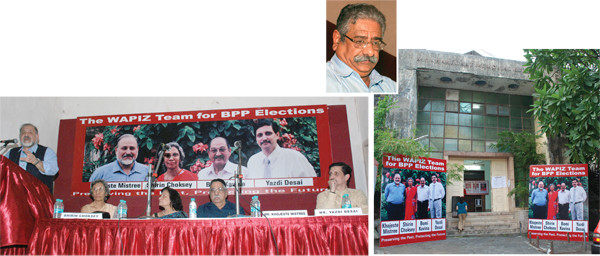
Above (from left): Khojeste Mistree, Shirin Choksey, Perviz Dotivala,Paeterasp Patel and Yazdi Desai Top: Dinshaw Mehta and (alongside) entrance to Khareghat Hall
When some members of the audience mocked her statements she retorted, "Don’t laugh. Go and clean up” the mess instead. "We told the Punchayet to go and look around. I saw this child’s small hand” near where the khandhias rest the body on the slab for the final obeisance. "I fired the khandhias… they replied some vulture dropped it. I said ‘It is your duty to put it back.’ We suffer in our lifetime. Must we even suffer in death? Don’t bring those vultures back.”
Mistree observed that vultures "cannot fly with food in their mouths,” a remark which was greeted with loud applause and accompanied with derision for the lady’s comments. "Our job is to look after dakhmenashini,” added Mistree noting that the scriptures exhorted Zoroastrians to look after their dakhmas even before their agiaries.
Shahrookh Wadia who works on the solar panels at Doongerwadi said "the aunty is wrong.” The panels are "operating well.” Corpses were classified into four categories, thin, medium, fat and very fat. Most bodies were dehydrated by the reflected sun’s rays from the solar panels in four to five days while an obese person may take at the most 10 days. Benafsha Irani said there was "never ever a smell of rotting corpses in and around Doongerwadi.”
Mistree said "the government of India has agreed to give us land at Borivali for breeding vultures.” He claimed that the drug diclofenac which reportedly causes renal failure and the subsequent death in vultures was no longer a threat as the drug had been banned for livestock and humans consumed too small a quantity to be harmful to the birds. Nariman Dalal inquired, "How long will it take to complete the vulture project?” Two to three years, replied Mistree.

Above (from left): Benafsha Irani, Merwan Irani, Shirin Wadia, Ervad Dinyar Vajifdar, Mehroo Bamboat, Bakhtiar Vajifdar and Rustom Vakil
Pervez Patel complained about the attitude of priests at Doongerwadi. "They have a ‘take it or leave it’” approach. "They dictate terms.” When the corpses arrive at the bungli and the family members ask for a priest to begin reciting the prayers, they "are told priests are not available,” stated Patel. "We are grieving. We are not in a mood to fight.” Dinyar Sethna referred to the "monopoly system” prevailing amongst the priests at Doongerwadi. When a relative’s body was brought the family were informed "no mobeds are available.” The paidust finally began at 5.45 p.m. instead of the usual 3.40 p.m. time, he stated.
Patel noted that a particular mobed answered his mobile phone four times while reciting prayers until an agitated young worshipper took it away from him. We have to "instill discipline” in our priests, he emphasized.
Mistree replied that "everyone likes good mobed service. But for every seven mobeds who die, only one comes in.” He did not cite the source for his data.
"Make mobedi more attractive… priests are not given enough respect,” Mistree commented. Mobeds complain that while traveling in public buses "Parsis make fun of us but non-Parsis give us seats. Women don’t want to marry priests.” Referring to the oft repeated complaint that priests visit the racecourse, Mistree asked, "Is it wrong for a Zoroastrian priest to go to the racecourse? They also have a right to enjoy life.”
Mistree also noted that there was not much the BPP could do regarding the priests and that the apex trust only controlled two agiaries (the Jokhi Agiary at Godrej Baug and the Godavara Agiary at Fort. The dadgah at Doongerwadi is also under their control — editors).
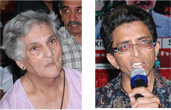
Lady who complained about dakhmas and Shahrookh Wadia
Bakhtiar Vajifdar inquired why priests could not be paid by the BPP at Doongerwadi. "Have one complete package. The Punchayet handles everything.”
Mistree noted that the BPP found it difficult to even "employ one priest at Godavara Agiary.
"What can the apex body do? They cannot legislate. Give us a better system,” he asked the audience. "Let’s not be unfair. What do we do if fewer people are becoming priests? God’s work and good work should not suffer.”
Merwan Irani spoke of water being taken from agiary wells till late at night despite religious sanctions forbidding water being disturbed at night. At the Sodawaterwalla Agiary at Marine Lines, tankers fill water from 6 a.m. to 10 p.m.
At the Indawalla Agiary he alleged the person awarded the water contract "goes into the agiary.” Irani suggested a scheme should be drawn up whereby tenders are called for on a yearly basis. If a contractor does not honor the agreement, he should be penalized. The Anjuman Atash Behram ended a contract when payment was delayed for several months, claimed Irani.
"A parjaat (non-Parsi) will come from the backdoor into the agiaries,” he prophesied.
"See heritage wells are not violated,” said Benafsha Irani referring to the WAPIZ manifesto regarding protecting religious heritage structures. "We will do our best,” replied Mistree.
Dilnavaz Billimoria who resides at Tardeo spoke of the hardship that tenants in private Parsi trust buildings face from rapacious landlords. Mistree mooted the formation of "a grievance cell” to adjudicate in such matters.
WAPIZ founder trustee Yazdi Desai recalled his ties with Khareghat Colony as he and his brother Viraf had their navjotes performed in this very hall in 1968. He alleged that the editors of The Bombay Samachar, Jam-e-Jamshed Weekly and Parsiana "are behind the Adult Franchise for Progress (AFP) panel and debunked their credentials. (Parsiana had lent its name to the formation of AFP but beyond that has not been connected with any of the activities. The panel was selected by The Bombay Samachar columnist noted solicitor Berjis Desai and the leaders of the Alert Zoroastrians Association (AZA). We wish we could take credit for inducing such fine people to stand for office but credit should be rendered where it is due — editors.)
The Jamé editor Rusi Dhondy prints "lies, lies and lies.” Parsiana published the photograph of the two navjoted Sikh girls on its cover and Berjis Desai labels the dakhmas "garbage dumps.” "Is Parsiana reporting everything faithfully? Is Jamé? Only WAPIZ is doing” that, Yazdi Desai claimed.
He alleged the AFP was a panel "of reformists, by reformists, for reformists. If you want to disintegrate the Parsi community then vote for AFP,” he counseled.
He voiced his appreciation of Ahmedabad businessman Areez Khambatta "without whose donation of one crore rupees WAPIZ could not have been founded. He is the man I admire most.”
In a move that caught some of the audience unawares, Desai in response to a question about converting leave and license agreements into tenancies termed leave and license agreements "a sound policy. It perpetuates the wishes of our settlors.” Terming the notion that tenancy was more economically viable "a blatant lie,” he qualified there is "a right move and a popular move.” We have to "make sure that all leave and license tenants are not harassed.” The Rent Act does not extend the same protection to licensees as it does to tenants.
"What happens when our kids marry out?” Mistree noted, "non-Parsis will be living in community property (meant for Parsis). In tenancy this happens.” If men married outside the faith their children are Parsis but not so with women. "People are marrying out, like it or not. They can be asked to legally leave. We have to keep (community) property safe… leave and license means greater income for the Punchayet, not the trustees.”
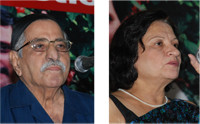
Paeterasp Patel (left) and Perviz Dotivala: restoring order
Percy Daruwala stated that at the Godrej Baug meet WAPIZ had "clearly said you will abolish” leave and license. Mistree denied the allegation and stated the Godrej Baug "meet is on tape.” He however added, "We have always taken a view that we have to look into it. Everyone is promising the moon. Whatever we say we will have to live up to it.” He mooted a "white paper” be prepared on the subject. "Principles are more important than just mere votes.”
WAPIZ received support on their stand from Rustom Vakil who stated that flats "given on tenancy are lost to the community. People go overseas with no intention of coming back but hold on to their flats.” He also stated that converting leave and license into tenancy meant the BPP would have to refund all the security deposits accrued. "This would break the (economic) backbone” of the trust, he observed.
Shirin Wadia, a trustee of the Wadia Agiary at Lalbaug which was at the center of a lengthy litigation between the trustees and the developer on one side and WAPIZ on the other, stated Ervad Dinyar Vajifdar "was never appointed as a panthaky. His father was not well. He helped the father. He was never a panthaky.” Vajifdar who was present at the meet had filed a case against the trustees regarding his status at the fire temple.
Desai claiming he "respected” Wadia’s age said the "community expected after the father’s death you would make him the panthaky. It is a 126-year-old legacy” (of the family serving the agiary). He termed the multi-storey building Hilla Towers "shameful,” as it allegedly affected the sanctity of the fire temple. The building was constructed in the Agiary compound. Desai claimed that even Dastur (Dr) Kaikhusroo JamaspAsa had requested the trustees not to remove Vajifdar.
Vajifdar alleged the trustees sent police to his residence at 1.30 a.m. in June 2006 to intimidate him. Mistree reportedly came to his rescue. Nadir Modi, president of the Athornan Mandal and one of the AFP panel, did not assist but on the contrary took the legal brief against him on behalf of the trust, complained Vajifdar.
Shirin Choksey spoke of the need for quality education for all children right up to senior citizens. The WAPIZ session that started at 6.26 p.m. concluded at 8.55 after which to cries of "bhonu, bhonu” (meal snack boxes are handed out by candidates after the meetings are over) Dinshaw Mehta took the stage for his presentation.
Reiterating the need "to preserve our tradition,” Mehta said the BPP was spending Rs 60,000 a month for three consultants "to see the solar panels —function properly...
"Eighty percent of the bodies (are dehydrated) within four to five days,” he noted.
He termed the "cremate ni-bungli a dangerous proposition. Build your own bungli… crematorium… leave Doon-gerwadi untouched.”
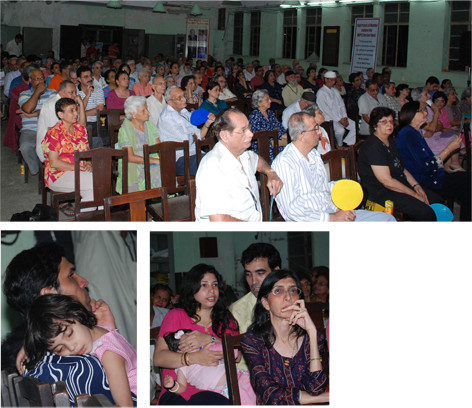
Sections of the audience, old and young (yawn, burp)
Noting the late hour Mehta said he would keep his talk brief but a question from Mehroo Bamboat, a former Khareghat Colony resident created an uproar that lasted almost 30 minutes.
She alleged that she and her husband had been issued duplicate voter certificates and when she inquired what happened to the originals she was reportedly told they were handed to Mehta in December 1992 under a letter of authority. She denied giving such a letter and when she inquired at the BPP office for a copy, they said records were not kept for that length of time. Mehta clarified he was not a trustee in 1992 and that one voted for the anjuman committee then and not the trustees directly as of now.
Dinyar Vajifdar alleged that names of seven of his relatives who were dead appeared on the voter registers. Rustom Vakil termed the polls "a charade.”
Mehta told Bamboat that if she had informed him earlier "I would have investigated.” He had no memory of what occurred to her certificate 16 years ago.
Bamboat persisted and Mehta alleged she had a personal vendetta against him and that members of her family had applied for academic loans and scholarships that had been turned down.
As the charges and counter charges flew fast and thick, Bamboat after disregarding Dotivala’s instructions to sit down or leave, was persuaded to hand over the microphone while Mehta’s three sons and a few others formed a protective banner between the stage and the audience.
Among the few questions asked before the end of the evening Rustom Gotla queried that should Mehta win a third term whether he would change the name of the Bombay Parsi Punchayet to Mumbai Parsi Punchayet. Mehta replied with an emphatic "no.”
◆ ◆ ◆
From the archive