
Health
The cancer challenge
Through its rural and urban outreach programs as also cancer telemedicine service, the Tata Memorial Centre under Dr Ketayun Dinshaw has been able to treat patients in different parts of the country
"Would you have thought this is the Tata Memorial Hospital (TMH)?” enquires Dr Ketayun Dinshaw as she presents us the latest copy of the Tata Memorial Centre (TMC) annual report, its front cover bearing a bird’s eye view of central Bombay with the Hospital in the foreground. On the back cover is a photograph of the 60-acre Advanced Centre for Treatment, Research and Education in Cancer (ACTREC) in Kharghar, New Bombay. These are the two arms of the TMC, India’s premier cancer institute, where during her decade as director of this prestigious facility, Dinshaw has been committed to introducing programs to provide improved service and research opportunities to patients and staff.
Although she may underplay her contribution in the new developments at TMC in this her last year at the Hospital before her retirement (due at the age of 60 years, it was specially extended to 65 in her case), the citation accompanying the Indian Nuclear Society Homi Bhabha Lifetime Achievement Award presented to her on November 21, 2007 gives the internationally renowned radiation oncologist credit for adding "a new page in the long history of TMC by setting up a robust scientific and medical research infrastructure… Under her leadership, pioneering outreach programs… have been initiated… Her advice is keenly sought by several groups and cancer hospitals in India…” While formerly all award winners were atomic scientists "this is the first time they have given it to a medical person,” mentions Dinshaw.
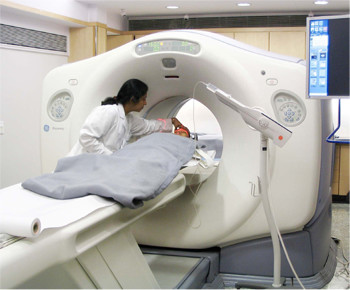
Positron Emission Tomography and Computerized Tomography scanning at Tata Memorial Hospital
Awards for her, recognition for the TMC, have now become a routine affair. Former president of the International Society for Radiation Oncology, she was elected council member of the International Union Against Cancer and the International Agency for Research on Cancer. She is a World Health Organisation advisor and International Atomic Energy Agency consultant for radiotherapy in developing countries. Dismissing the honors she simply says, "It is only thanks to the opportunities that have come my way.” But as she had mentioned in the TMC Scientific Report for 2004-06, "Managing a comprehensive cancer center is a challenging task. There are complex patient issues and 2,800 personnel, each with their own aspirations to realize. The task of the leadership is to focus and to make the systems productive with well defined goals for service, education and research — the well tested mission statement of TMC.”
Presently the TMH attends to over 1,000 outpatients a day and nearly 600 inpatients. "We don’t have space for more,” regrets Dinshaw who, being the de facto director of the Hospital too, points out that 65 percent of the patients are treated free or at very minimal cost. Of the 42,000 patients registered at TMH in 2006 (last year’s figures were not available when Parsiana interviewed her on January 5, 2008), 19,000 were diagnosed as malignant. When she took over as director of the Hospital in 1995 there were 27,000 cases registered of whom 17,000 were proved malignant. "We don’t generate income to run the Hospital but because of the support of the Department of Atomic Energy (DAE) our state-of-the-art equipment is always replenished… Not many hospitals have such generous funding. We are in a unique position where we receive funding for treating and teaching and research,” she appreciates.
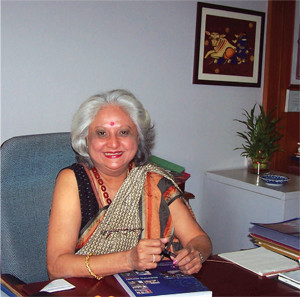
Dr Ketayun Dinshaw
With many upcountry cancer patients coming to TMH in the hope of receiving good medical attention without ascertaining beforehand the availability of beds and doctors, some of them are known to have been camping on the pavements outside, awaiting their turn. Fortunately there has been an increase in the number of NGOs (non-governmental organizations) working here whose "supportive and emotional help” assists such patients. The dharamshalas in this area are able to take the load off the Hospital too, she mentions.
A major breakthrough in the treatment of outstation cancer patients is through Cantelmed (cancer telemedicine service) introduced by TMH in 2002 where patients across the country can send in medical data, radiological and pathology images using a videoconferencing system or a telemedicine software on the basis of which online consultation is given. This has been possible thanks to the collaboration with the Indian Space Research Organization and the DAE.
Among the other accomplishments of TMC, during her tenure as director, Dinshaw refers to the Urban Outreach Program in the slums of Bombay. To facilitate early detection of cancer in women, primary health care workers are trained to physically examine nearly 150,000 women and bring them in for early treatment if a problem is detected. There is neither the economic wherewithal nor resources for routine tests like pap smear and mammography for these poor ladies, points out Dinshaw. The intramural Rural Outreach Program covers a populace of five lakhs in Chiplun where the TMC runs a preventive oncology program for both males and females. Also operational is a home-based Pain and Palliative Care service in Bombay and the Marrow Donor Registry.
With the initiation of the DAE Homi Bhabha National Institute with TMC as one of the nine constituent units, "the PhD programs in ACTREC as also the medical and postgraduate courses have been geared to our needs,” reports Dinshaw. In fact the deemed university status necessitated the appointment of a dean to oversee the teaching programs.
International collaborations with leading world bodies have given a fillip to the activities of TMC over the years. Overseas funding from organizations like the National Institute of Health in Washington or the International Agency for Research on Cancer (based in France) help run some of their projects. Recent recognition for TMC as a "Sister Institute” by the M. D. Anderson Cancer Center, Houston is expected to be mutually beneficial to both the organizations.
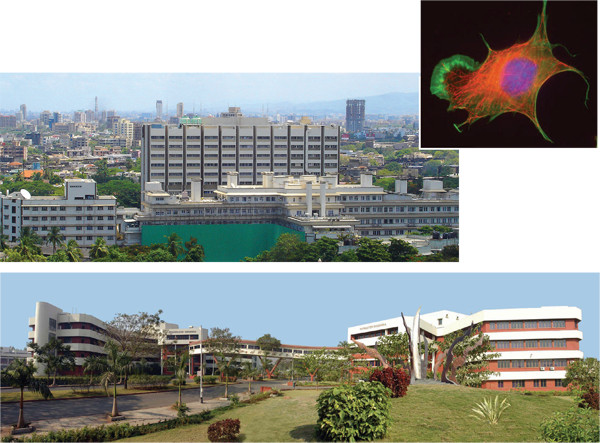
Cellular research (top right) the Tata Memorial Hospital (center) and Advanced Centre for Treatment, Research and Education in Cancer (bottom)
The TMH was initially commissioned by the Sir Dorabji Tata Trust on February 28, 1941. In 1952 the Indian Cancer Research Centre was established, subsequently renamed the Cancer Research Institute (CRI). Five years later the Ministry of Health took over the TMH but soon the administrative control of the TMC was transferred to the DAE. In 2002 the CRI relocated to ACTREC and with the commissioning of the Clinical Research Centre in 2005, the dedicated facility became fully operational in New Bombay with opportunities for basic, translational (from bench to bedside) and clinical research in cancer. The space vacated from the Hospital complex in Parel provided an opportunity to augment clinical services and hence under construction is the 12-storey Tata Clinic and Faculty Block for outpatient services, private patient rooms, postgraduate studies and academic offices.
Patient interests have to be safeguarded and monitored, is the TMC credo. "Systems need to be kept in place. We have to be cautious with our research,” states Dinshaw before explaining the working of the Clinical Research Secretariat, Hospital Ethics Committee chaired by Dr Rustom Soonawala, the Scientific Review Committee, the Scientific Advisory Committee… She refers to international pharmaceutical companies "discovering India as a hub to test the clinical efficacy of their products because of our good institutions, good infrastructure, good professionals… available at a low cost. We have to see that we are not treated like guinea pigs,” she asserts.
Despite her administrative responsibilities Dinshaw ensures that whenever she is in Bombay she spends at least two hours attending to patients in the radiation oncology department with which she has been associated for the last 34 years. "It makes me feel normal,” she admits. While Dinshaw’s "priority will be to finish everything started” she is painfully aware that she is the last of the Parsi Zoroastrian medicos serving this institution. "Isn’t it sad?” she asks us. "Parsis don’t want to come into an academic institution. Private practice is so much more rewarding to them…” From the general population however she observes "no shortage of good applicants who at the peak of their career want to pursue academic research. We are very choosy about who we accept…very strict on standards.”
Just as the TMC’s Department of Preventive Oncology believes in spreading education on cancer prevention, early detection and cancer screening, the Government of India’s health ministry is very conscious of its responsibility, believes Dinshaw valuing the research funding received from central agencies and giving credit to the health minister for introducing the anti-tobacco legislation in Parliament. Tobacco related cancers generally attack the head, neck, lung and oesophagus, details Dinshaw. "He is doing his job. Our problem is implementing the policies.” Since 1975 the government has introduced a National Cancer Control Program and is currently pursuing its 11th five-year plan for the period 2007-2011.
According to her estimates India sees eight lakh new cancer patients each year, 70 percent of whom come in the advanced stages on their first visit. When Parsiana had interviewed Dinshaw 11 years ago (see "Early prevention, early detection,” July-August 1996) we had been told that there were an estimated nine million cancer patients in the world of whom 1.5 million were in India. When we ask her for an update on the figures she enquires in jest if we are conducting an audit of her statements before amplifying that in 2000 there were globally 11 million cancer patients of whom 55 percent were in the developing world. Within a decade or so this percentage may rise to 72 as the developing countries have an increasing graying popula-tion, high consumption of tobacco and alcohol, rising infections, pollution and malnutrition. In the Parsi community, cancer of the breast and uterus continue to be the most common among females, while colorectal cancer, lymphoma and lung cancer have a high preponderance among males.
Concern for the future of the Parsi community makes her comment, "It’s a tragedy that this talented community allows itself to remain in a time warp. The rest of the world is moving on…science, medicine, education, art. We are going to be fast left behind. I just despair. It’s time for the young in the community to get real. Who is stimulating them to move forward?” The doctor whose early education was in Calcutta after which she graduated in medicine from the Christian Medical College, Vellore and then received her training in radiation oncology from Cambridge, UK, urges, "Let’s be on board with everything. There is nothing permanent about customs except change.” To those not willing to consider intermarriage, cremation, adoption…the unmarried professional exhorts, "Adoption is a personal need and a child is a child… Circumstances have changed. We have to stay on par if not ahead. Individuals are making a mark but not to the extent the community is capable of…”
Classical music, both Indian and western, visual arts and reading help Dinshaw unwind when she needs a break from cancer care. She delights in telling us how she accidentally discovered a Jamini Roy painting in her office, got it restored, framed and hung on the wall behind her desk. "I need all these things around me,” her manicured hands point to the artifacts in her spacious office. Between her administrative and medical workload she has found time to author 264 publications, her byline appearing in national and international journals as also books on medicine. "I don’t know when I last sat and read a novel,” she muses but feels reassured that "there is a whole stack of books” she can explore when she has the time.
But that may take a while for, even before her commitments end at the Tata Memorial Centre, Dinshaw’s help has been solicited for the planning and commissioning of the upcoming Tata Medical Centre in Calcutta...
◆ ◆ ◆
From the archive