
Cover Story
A grant for Tehmi
Ruby Hall Clinic’s state of the art Cancer Centre provides patients the latest in radiotherapy procedures, superspecialty oncology OPDs and surgical and chemotherapy day care
The plants and the paintings, the tall columns and sleek, glass-fronted exterior lend it the air of a corporation or a hotel rather than a hospital. Emblazoned in bold letters on the seven-storied front is its raison d’être: Tehmi Grant Memorial Cancer Institute, and below it, Zavaray Poonawalla Cancer Building.
The pulsating force behind the Rs 45 crore project is Poona’s octogenarian Dr Keki B. Grant, founder, chairman and managing trustee of the Grant Medical Foundation which runs the Ruby Hall Clinic (RHC), of which the cancer center is a part. At 86, Grant’s body is bent, his frame is frail, but the spirit remains resilient. He greets us warmly as we enter his office-cum-consulting room, old world etiquette in place, the handshake firm, the gaze strong and steady.
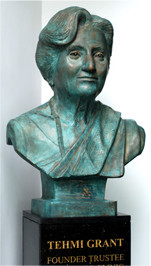
"The only thing as relentless as cancer is our commitment to fight it,” states the motto of the state of the art cancer center which provides comprehensive care for what is still a diabolic disease. "The Cancer Institute came about as a result of the illness of my wife Tehmi,” he explains. "It was a very torturous time for me, particularly the last three months when the cancer was spreading. I told Tehmi I would build, God willing, a cancer center, the best in India, comparable to the best in the world.” Tehmi passed away in February 2003, just two months short of her 76th birthday. Extroverted and efficient, intelligent and charming, Tehmi had been his life partner at home and at work for 53 years. "I have an obsessive personality. My only hobby is medicine,” Grant had told this writer in an interview eight years ago. From the founding of RHC as a three-bedded nursing home in 1959, through its prescriptions of progress to a 550-bed, multispecialty hospital for tertiary care, Tehmi had been the tonic and therapy of the good doctor’s life (see "What the doctor ordered,” Parsiana, June 1999).
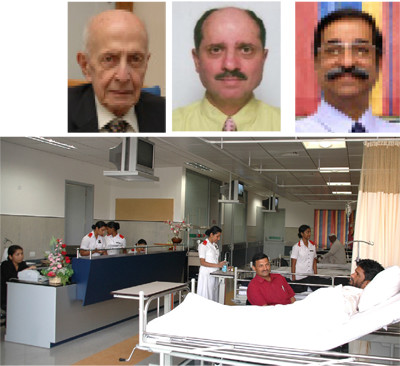
(Top) Bust of Tehmi; (from left, above) Keki and Purvez Grant and Bomi Bhote; oncology day care (alongside)
"My mother was a very kind person, a good housewife and homemaker too,” says their son Purvez, a cardiologist at RHC who returned to India some years ago after a longish stint in the UK. "When we started planning the cancer center, we wrote to several industrialists in Poona. Zavaray Poonawalla (of the Poonawalla Stud Farms) was among the first to respond, stating that he liked the project and would be interested in donating towards it.” Besides Poonawalla, a munificent donation came from noted industrialist Rahul Bajaj and from the Tata Power Company Limited, Purvez voices his appreciation.
The new center, named the Kamalnayan Bajaj Cancer Centre, is the first in India and south and south-east Asia to install the Dual Energy Linear Accelerator made by Siemens which provides Image Guided Radio Therapy (IGRT), say hospital sources. IGRT targets more precisely the problems caused by the complex circuitry of cells gone haywire (tumors) while saving adjoining normal tissues. Radiation therapy can be used alone or in concert with surgery and/or chemotherapy. "In some cases tiny gold markers are implanted in or near the tumor to pinpoint it for IGRT…which is by far the most advanced form of radiotherapy today,” their brochure explains. The unit also specializes in Stereotactic Radio Surgery (or X-knife) and Stereotactic Radio Therapy to treat brain tumors without surgery.
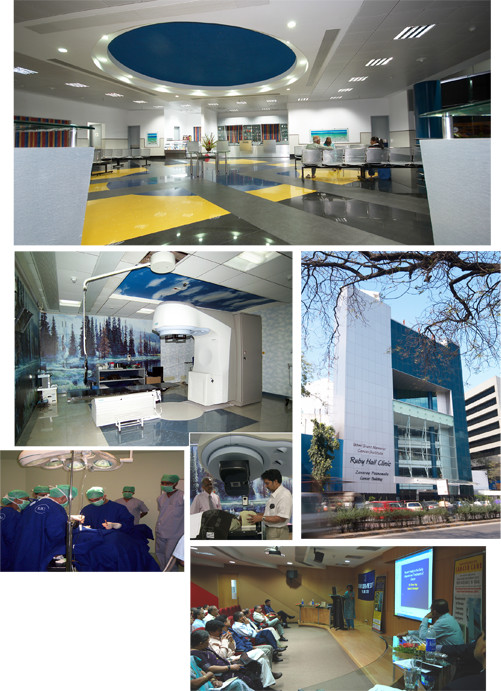
Spaciousness at the Centre (top); linear accelerator (second row, left) and IGRT procedure (center, inset); side view of building; auditorium (alongside) and surgery in progress (above)
"Brachytherapy, also known as internal radiation, involves placing radioactive material into a tumor itself or into its surrounding tissue…During the entire treatment the radioactive source does not come in contact with the patient’s body or the organs,” their literature states. "RHC is one of the few hospitals using 3-D (three dimensional) planning…and has the highest resolution micro MLC (multi leaf collimator, used for delivery of radiation) in India today.”
In the basement of the building, solid concrete walls ranging in thickness from 1.3 m to 2.4 m ensure that the radiation beam does not leak outside. The Atomic Energy Regulatory Board grants approvals and monitors compliance with rules and regulations. "Siemens has identified RHC as a beta (reference) site, its first in Asia and the fifth in the world,” chief executive officer (CEO) Bomi Bhote informs us. "We have been presented a certificate of appreciation which commends Ruby Hall for the ‘early adoption of cutting edge radiotherapy technologies’ and for ‘delivering highest standards of radiation oncology.’”
A shot in the arm is the unique 10-year collaboration with Siemens which ensures that new innovations, developments and protocols will be tested here. Khush F. Mehta, global head, Siemens oncology, was the coordinator, says Bhote. The Centre is also a site for international and indigenous drug research.
Construction to commissioning took a speedy 15 months. "I am more than satisfied with what we have achieved in a little more than a year of functioning,” asserts Bhote. "IGRT is particularly successful in the treatment of brain, breast, prostate and lung cancers. Our tumor board meets every Wednesday. It’s a cross functional team consisting of surgeon, oncologist, radiotherapist and other experts who sit together and discuss and debate the line of treatment. Six new state of the art operation theaters (OT) opened on Jamshedi Navroz this year. A bone marrow transplant facility is to begin soon.”
Situated on the busy Sassoon Road not far from Poona railway station, the noise and pollution of heavy trundling trucks and other traffic is somewhat diminished by the wide, airy corridors and glass front of the structure designed by well-known Poona architect Iqbal Chaney. Housed on the higher floors are the super-specialty oncology OPDs (outpatient departments) as well as the surgical and chemotherapy day care centers. "Cancer treatment expenses are tax deductible. Please check with your CA (chartered accountant),” a board informs patients. Radiotherapy procedures are expensive and can cost anything from Rs 20,000 to one lakh forty thousand, says Bhote, "but no one is turned away for want of money. We have lower income group patients where costs are subsidized. We have expended over two crore rupees (in the last financial year) towards treatment of poor patients.” Donations to RHC and the Grant Medical Foundation qualify for tax exemptions under the relevant sections of the Income-Tax Act, states the CEO who joined RHC in 1997 after a 15-year stint with Telco (now known as Tata Motors) and eight years with General Electric, states the RHC website www.rubyhall.com
A special feature is the plush 200-seater auditorium which has facilities to conduct live workshops via satellite communication. "The audience can view and talk to the surgeons in the OT,” Bhote elaborates.
"Parsis have stopped producing doctors (and cricketers)!” he quips. "We have no Parsi interns. It’s a tough call becoming a doctor these days. The malaise of capitation fees (which can be in the range of Rs 40-50 lakhs for an MBBS seat in a private college) means young doctors look to earning back the money quickly, so medical ethics get sacrificed.”
"In my time there were so many Parsi doctors we even had a Parsi mess,” Grant recalls. His dream to build a medical college, with some seats reserved for Zoroastrians, remains in the realm of prognosis. "We can’t find the land,” he says. RHC’s talks with the Poona Parsee Panchayat (PPP) to exploit its vacant land at Lullanagar for a hospital (which would provide free or concessional treatment to members of the community) awaits the injection of approval from the PPP’s general body.
Operating salubriously however is the Tehmi Grant School of Nursing Education situated at nearby Tadiwalla Road (see "Granting care centers,” Parsiana, January 2005). "Obtaining first to fifth rank in Maharashtra (at the university exams) were girls from our institute. It’s a matter of real pride,” Bhote says, at the same time bemoaning the fact that it is very difficult to find and retain good nurses. "We provide all facilities — food, laundry, play areas, movies…everything possible for their comfort. Our nursing school is in collaboration with the University of Illinois at Chicago for the advanced (masters level) nursing training program. We are grateful to the Tata Memorial Centre in Bombay for imparting special training in cancer care to our nurses,” he adds.
On the board of trustees with Keki Grant are Purvez Grant and Dr Ravindra Gulati, among the seniormost of cardiologists at the RHC. Poona’s leading citizens — industrialists Rahul Bajaj, Dr Neelkanth Kalyani, Dr Naushad Forbes, Dara Damania, Kantilal Sanghvi — are also on the board. Among Ruby Hall’s staff and consultants are Drs Rustom Wadia, neurophysician, Noshirwan Edul, physician, Roda Irani, general medicine, Russi Marolia, anesthetist and his son Gayo, dentist, Firdaus Master, psychiatrist, Soli Mehta, financial controller, Grant’s secretaries Jaloo Kanga (aged 90+ and hard at work!) and Nargis Pallonji, Turan Mehta, Purvez’s secretary, Mehernavaz Vakil, patient coordinator, Wadia’s wife Manek of the blood bank, Bapsy Gandevia of the cancer center, Kamal Palia, dietician, Shirin Mehta, housekeeping…
With hospital doors wide open in India for medical tourism with its advantage of low costs, prompt and high-tech treatment compared to long delays and high costs in western countries, Parsiana was introduced to a French couple who had been treated at RHC’s advanced IVF and Endoscopy Centre, and are now happily awaiting twins. With young India living life by the clock and the calendar in the fast lane, maladies like infertility and obesity are increasingly seen on patient charts, alongside existing pressure points like diabetes and heart problems. "Parsi health is certainly not declining, no more than society’s as a whole. Longevity is still good,” Grant maintains. Looking into the crystal ball of cures, he diagnoses that cancer can become fully curable: "Leprosy, smallpox, polio, tuberculosis were deadly diseases too. In time we will be able to cure malignancies in man.”
Popularly known as the "grand young man of Poona” with his spartan lifestyle, the RHC patriarch still walks home from hospital every evening, a good eight to nine kilometers, notwithstanding the collateral damage of noise and air pollution! "To tell you the truth, I love my city in spite of all its drawbacks. Sure, it’s indisciplined, could do with more cleanliness, but the future like that of India is bright,” he asserts. Is the community’s future bright too? we query. "We are certainly not going to die out. Most Parsis think of nation first, then community and that is how it should be.” What we should not do is skirmish among ourselves, he continues. "Take in the children of males and females married out,” he prescribes the healing touch. Dakhmas should no longer be used, he maintains, adding with a wry smile: "The community will blow me away for saying this!”
Glancing at a picture of Ratan Tata (post the Corus acquisition) on the cover of Businessworld lying on his table, Grant asserts: "This is my kind of person… what I like (about people). If you don’t take risks you get nowhere. I have taken risks all my life!”
◆ ◆ ◆
From the archive