
Medicine/Health
Succour at Snehaanchal
An anonymous Zoroastrian donor has funded a hospice in Nagpur where terminally ill cancer patients are care for free of cost
Without family support or financial means, to whom can a terminally ill cancer patient turn? After harrowing rounds of government hospitals and long, tiring waits for treatment in overcrowded conditions, it was a relief to learn of the existence of Snehaanchal, Nagpur’s first hospice set up by a philanthropic Zoroastrian.
He insists on remaining anonymous. "Who am I? We all work through HIM,” he expresses his sentiments. Inaugurated just a year ago, in August 2006, the hospice, a registered public charitable trust, welcomes any terminally ill and dying cancer patient regardless of caste, creed, gender or color. Here the dying are respected and allowed to end their lives in harmony with themselves.
The hospice philosophy believes that concern for the quality of life following treatment of a serious disease is important but it is also necessary to look at the quality of death if it becomes imminent. Unfortunately conventional medical treatment is unequipped, untrained and even unwilling to deal with death when the doctor declares, "There is no further treatment possible. Please take the patient home.” With hopes of recovery fading fast one can only offer relief from pain and comfort during the remaining period.
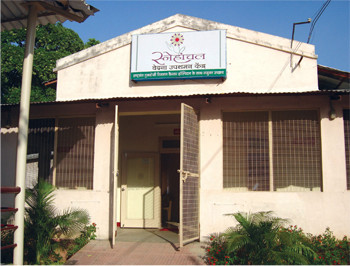
Front entrance of Snehaanchal in Nagpur
A visit to Snehaanchal is an eye opener and a far cry from the unhygienic conditions and indifferent treatment offered at many other institutions. The care, attention and love that have gone into designing and setting up this hospice is unique, not evident even at expensive private nursing homes in Delhi.
Set up on an acre-and-a-half plot close to the Nagpur Medical Hospital, the TB hospital and the Tukdoji Regional Cancer Hospital which provided technical collaboration, it is well placed to receive assistance and guidance from other medical and cancer centers. Used once as a TB ward and later as a police station, the premises were in a hopelessly run down condition when offered to Snehaanchal after the credentials of the founder and the project were established.
With only the outer and inner walls to start with, a neat, well-painted hospice was created. There are two separate wards (18 beds in all) for men and women patients, in a warm beige décor, with each bed separated with a partition to give both privacy and yet a feeling of togetherness with others. This was considered necessary as segregation was the last thing a dying patient desired. Pink striped bed linen and pink clothes for the inmates created a cheerful atmosphere. A large nicely tiled bathroom accompanied each ward. A broad running corridor encircled the wards for easy movement of patients on stretchers, etc. There was a small office, a large conference hall and a very modern, well equipped kitchen. For the sisters from the Providential Order who were on the staff, there was a two-room accommodation with an adjoining peaceful chapel for private prayers. There was also a separate room where the patient could be taken during his/her final hours to be with close family or friends and have the last religious rites performed.
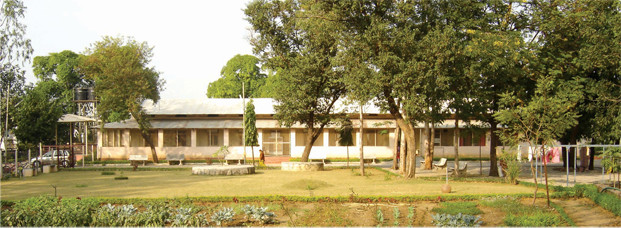
Outside there was a well kept lawn, hedges and flowering plants, a vegetable patch and a separate large hall for family members of outstation patients to stay.
The hospice concept was formulated by Dame Cicely Saunders, a nurse by profession in London in the 1960s. The idea germinated when she befriended a 40-year-old survivor of the Warsaw ghetto named David Tasma who was dying of cancer. They talked about the care patients need at the end of their lives and he offered to leave behind some money to help set up a home for the dying. "I’ll be a window in your home” is how he put it, recollected Saunders in an interview.
It took her 20 years, during which she became a doctor after a physician friend told her that doctors wouldn’t listen to a nurse’s ideas on pain management, to open St Christopher Hospice, the first of its kind, in London. Saunders’ message to her patients read: "You matter because you are you/ You matter to the last moment of your life,/ And we will do all we can/ Not only to help you die peacefully,/ But also to LIVE until you die.”
The hospice movement came to India, with the setting up of Shanti Avedna, at a beautiful and peaceful location facing the Mount Mary’s Church atop a hill in Bandra, thanks to the tireless efforts of the well known cancer specialist Dr Luzito J. de Souza in 1986. Two more, in Goa and Delhi, started thereafter.
The disease of cancer can take a very heavy toll on a patient and the caregiver’s physical and mental reserves. Ideally a patient should spend the last days in the midst of family and dear ones if he/she can be made comfortable at home with the assistance of visiting nurses and counselors from the hospice. In many cases the illness can be excruciatingly painful during the last stages. There may be ugly, foul smelling sores and oozing parts, both painful to see and treat except by expert nursing, which makes home care by family members difficult. Along with the terminal nature of the illness is the mental stress of family responsibilities and unresolved matters which lead to depression and despair.
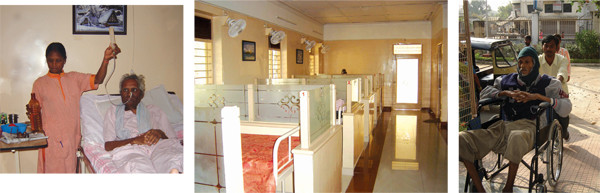
Top (left): The male ward; (right): arrival of a new patient Alongside: Patient care at the institution. Below: View of hospice
Care giving involves treating these patients as living human beings until the moment they die. Often they are buried alive by loved ones who withhold information from them or omit them from conversations, do not share their thoughts and, without realizing it rob them of their dignity. We forget that the dying still have memories and stories to tell, to share their lives.
A busy nurse in the London Hospice had little time to talk to a frail old woman, but when she did take the time to do so was surprised and delighted to learn that the old lady had once won an Olympic gold medal for distance running. "I never saw her the same way again,” she said.
Doctors, nurses and counselors at Snehaanchal explained that it takes some time before the patient is able to accept that no cure is possible and death is approaching. Thus counseling plays an integral part where efforts are made to bring family members close and help resolve conflicts. At Snehaanchal, a female patient whose husband had deserted her was deeply troubled about the future of her daughter. However, on her deathbed, the staff were able to trace and bring back the repentant husband who promised to care for his daughter and arrange for her marriage. The end was peaceful.
Snehaanchal, which is now running mainly on the munificence of one man, needs support to grow. Already eight more rooms have been added on one of the verandas. While currently the land is on a 10-year lease, the managing body is proposing to apply to the Tukdoji Cancer Hospital authorities for a 99-year lease so that they may make this hospice facility a much larger one. This is likely to come through. In the pipeline are plans to build another structure on the land available for 50 or more beds. As information about Snehaanchal spreads, patients from not only Nagpur but from surrounding towns and rural areas are being recommended for occupancy. But for this vision to fructify, support by way of funds from grant giving bodies will be required. It is a laudable cause towards which a lot of sincere commitment has been invested and is worthy of support (Snehaanchal may be contacted at their e-mail snehaanchal @gmail.com).
All treatment at Snehaanchal is absolutely free and no restrictions are put on the patients. As we were leaving Snehaanchal, a throat cancer patient waved to us as he enjoyed a cigarette in the garden, the very habit that gave him the disease. The terminally ill patients are secure at this hospice during "the unique period when the long defeat of living can be gradually converted into a positive achievement of dying.”
◆ ◆ ◆
From the archive