
Heritage
The Esplanade effect
Sections of Esplanade House undergo restoration
Since December 1, 2007, employees of the noted advertising agency R. K. Swamy BBDO have been working out of Esplanade House, a heritage mansion which was once the residence of the Tatas, India’s first family of business. On November 10, 2007 the Hindustan Times quoted Shailen Sohoni, chief operating officer, R. K. Swamy BBDO as saying: "We will work out of Jamsetji Tata’s Indian and European dining rooms and the main courtyard.” He added that transforming the neo-classical European mansion located near Bombay Gymkhana in the Fort area into a spacious 6,700 square ft office involved a great deal of restoration. "The mansion is in bad shape, but we restored the rooms we leased… Restoring (them) as per heritage standards has cost us less than what it would have if we hired commercial space,” he added. The space has been leased from the R. D. Sethna Trust, to whom it was willed.
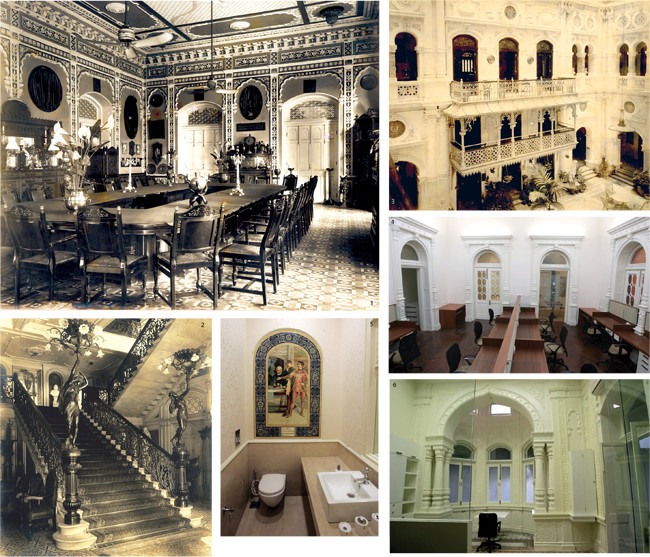
1.The Indian dining room in its heyday. 2. Main staircase in entrance hall. 3. Archival picture of balconies of 1st and 2nd landings. 4. Restored European dining room. 5. Murals from Shakespeare’s plays adorn walls. 6. Restored Indian dining room.
Photos 1 to 3 from the collection of the Tata Central Archives. Photos 4 to 7 courtesy the Hindustan Times
Sohoni informed Parsiana that the agency had been working out of Elphinstone House in the same precinct for many years and with expansion of its activities had been seeking additional space to house a larger number of people. While on the lookout for premises close by it came in contact with the R. D. Sethna Trust, saw Esplanade House, realized its potential and found it to be within its budget, including the restoration work. The agency’s main concern "has been to create a fine office which would promote creative thinking among its staff,” Sohoni informed.
Freny J. Shroff, assistant archivist at the Tata Central Archives, in a write-up to Parsiana, sketches the history of Esplanade House. With the growing prosperity of Jamsetji Tata’s textile ventures he and his father Nusserwanji thought of building a mansion in keeping with their status. By the mid 1880s, a plot of land was acquired near Alexandra School from the Government on lease for 999 years. Facing the plot was a maidan, the low houses at new Marine Lines, the railway line and beyond, the Arabian Sea.
Though the foundations of Esplanade House were laid in Nusserwanji’s time, the work was completed after his death. Jamsetji occupied it in 1887. Esplanade House was regarded as one of the finest buildings in the city with its large rooms, a central courtyard (after the fashion of Spanish patios) and a marble staircase.
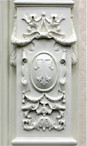
7. Tata family insignia with ‘T’ on ornate Corinthian pillar
Jamsetji and his sons after him had a taste for objets de art and filled their new residence with things of beauty. Chandeliers in the rooms added magnificence to the interior. Jamsetji, who had a passion for reading, also had a well-stocked library. A billiard room was an important part of the mansion, as also a banquet hall. It was one of the first houses to be lit with electricity and to have an elevator.
Although a private residence, Esplanade House was a hub of considerable social activity where Jamsetji entertained a large number of distinguished guests, including the first English cricket team to arrive from Britain. His major projects of iron and steel, electricity, the Taj Mahal Hotel and the Institute of Science were discussed and given shape here. Jamsetji’s famous letter to Swami Vivekananda dated November 23, 1898 was also written from Esplanade House.
Maintenance of the grand house required time and effort and Jamsetji had a large number of domestic servants, including some Chinese hands who were a novelty in those days. At the rear were the staff quarters and the stables. Jamsetji was one of the first Indians to own a motor-car, employing an English chauffeur.
From the year 1887, Esplanade House became the centre of Jamsetji’s family life. For many years a younger sister lived under his roof, and around 1898 a second sister joined the family. His younger son Sir Ratan married Navajbai Sett in 1892 and resided with Jamsetji until his death. Six years later, the elder son Dorab married Meherbai Bhabha, and set up house on Malabar Hill. Dorab moved into Esplanade House after Sir Ratan and Lady Navajbai moved to Tata Palace, where the Deutsche Bank is now housed.
◆ ◆ ◆
From the archive