
Cover Story
Spring-cleaning at the Punchayet
Youngest member of the Bombay Parsi Punchayet board of trustees, Jimmy Mistry aims at clarity of thought and transparency in the working of the Punchayet
"As of now there is no plan to go on any cost cutting. What I am doing for the mobeds… is my commitment to the community. I will continue to spend one crore rupees on them (annually).” Bombay Parsi Punchayet (BPP) trustee elect and founder trustee of the Parsi Resource Group (PRG) Jimmy Mistry responds positively to Parsiana’s query on the effect of the current economic meltdown on his PRG programs.
Nor does he display any hesitation about being able to fulfill the program of action he had chalked out in his manifesto, though "priorities will change.” He says he will need to live with the ongoing programs of the BPP. "There will be a period of transition. I have been advised to do a lot of spring-cleaning there, starting with the toilets and including the boardroom and the offices — all at my cost,” he notes with a straight face. Then he tells us why he has taken on the onus: "The BPP office should have a nice atmosphere. It should not look like a PWD (public works department of the municipality) office!” And he reiterates what he had said during his election campaign: "People should be made comfortable when they visit the BPP office.” He also wants to create a new logo for the Punchayet, "change everything that needs to change, except the religion!”
Sitting in the boardroom of his exquisitely furnished airconditioned head office at Della House, one can understand the squeamishness of a meticulous designer. It is past 10 p.m. and we hear the booming of guns, grenades and bombs in the distance — yet loud enough for us to mistake it initially for thunder — on November 26, 2008. An obviously tired Mistry has just returned from a long drawn out meeting of the BPP trustees with Nusli Wadia regarding the Wadia Baugs but hospitality is both practiced and inculcated in the staff.
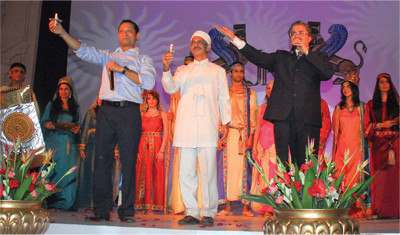
(L to R): Jimmy Mistry, Ervad (Dr) Ramiyar Karanjia and Mahiyar Dastoor at the electioneering finale at the Dadar Parsi Colony Gymkhana
In contrast to the strained relationships that prevailed between the members of the old board of trustees, Mistry describes the present atmosphere as "a honeymoon period,” adding, "The current seven have realized the need to be logical because it won’t work otherwise. All of us have strong beliefs and an appreciable record of work with the community. All of us have extensive experience with community members. We are not new to community problems.” Accepting that it is his first experience of working with other board members, he notes the need for balance between various factors. While portfolios have not yet been assigned/assumed, he says the board is willing to go along with Khojeste Mistree’s lead on Doongerwadi. Mistry himself wants to be involved with youth and educational issues and the first education committee meeting has been planned already. Also, he expects any questions of design, development, repair to come his way. High on the agenda is to settle the water problem at Panthaky Baug, he tells us. On most issues, Parsiana found as the interview progressed, that Mistry had done his homework and was acquainted with the Punchayet’s discussions. His responses are crisp, unhesitating.
Development of property is one of Mistry’s businesses and he had stated at the hustings that the BPP needs more professional builders/developers on its board. He now notes that he would be happy to help redevelop the baugs but not on an off-the-cuff basis. "I’m one to do 90 percent planning before starting on any execution.” He says he will not interfere with the proposed new ownership building coming up at Godrej Baug as it is a part of the inherited agenda. But he wants to "dwell on housing in depth, set a plan of action for three years and put it forth to the community.” Housing being a prime need of our community and the Punchayet properties being meant for charity, he feels the need for a "master plan. If 300 flats are to be built for the poor and 50 for selling, there must be a (consolidated) plan. For example, Spenta money had no time line! [When the Committee for Electoral Reforms (CER) trustees had initially joined the Punchayet the ‘Robin Hood’ concept of building elite apartments for the wealthy of the community, the proceeds of which would finance housing for the poor, had been enunciated. Spenta on Malabar Hill had been the first such venture — editors]. We need to work out a blueprint for the BPP to function in its entirety. It’ll take a few months. We must have clarity in our minds and in that of the community. There must be flagstones/milestones to check at each stage… And it must not remain behind closed doors. We must share with the community how much money will be generated, how it will be used. We should be able to justify the end result.” Mistry says the "entire board is in consonance” with this idea.
Chairman Dinshaw Mehta had already told Parsiana that a meeting of the Federation of Parsi Zoroastrian Anjumans of India was slated for January 2009. Mistry now assured us, "It will no longer be a stormy meeting. We will make sure the chair is respected. This lalagiri (rowdyism) in the community has to stop. We will go to any extent to see this is implemented.” Mistry was referring to the indiscipline and blatant anarchy that had scuttled the working of the Federation some years ago and left it in limbo.
As for his comments on the proposed World Body of Zoroastrians that had led to the dysfunctioning of the Federation, Mistry said, "We have had no discussion whatsoever about it. I am quite aware of what has happened. But I would rather keep my view to myself until the board decides on the issue. Individual opinions are what cause friction and raise issues of ego. I’ll be the last to initiate it.”
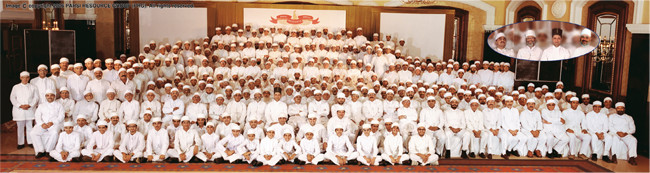
Appreciating mobeds (top) and (above) audience at ITC Grand Central Sheraton Hotel and Towers
Mistry is looking forward to participating in the Ninth World Zoroastrian Congress in Dubai next year. But "it doesn’t have religion on its agenda at all. A Zoroastrian congress without religion raises questions. After eight years we will have massive doses of religion on it as also a socioeconomic package for Parsi/Irani Zoroastrians in India and internationally,” Mistry states, alluding to Mehta’s letter to the Dubai Congress organizers proposing Bombay as the next venue for the world congress in 2014.
The developer-designer-builder says he is a member of the World Zarathushti Chamber of Commerce (WZCC) which he considers "a very good vehicle for economic change in the community,” adding, "Perhaps it needs more aggressive implementation.”
Mistry says his decision to stand for BPP trusteeship "started with the Cama Athornan issue” where he crossed swords with another community activist, the redoubtable Yezdi Bhagwagar. Mistry tells us that he opposed the Parsi property being alienated in the guise of a lease to an international school. "That is when I felt the need for an official position rather than the PRG alone…I am committed to fighting for any and every Parsi property. If I rub some people up the wrong way, I’ll rub some people. But I won’t allow Parsi properties to be alienated even if it means fighting with friends,” he tells us. But he is thankful to Bhagwagar for the truce during the election campaign. "He said the Jamé won’t go against us and he kept his word and I appreciate his gesture.”
All seven trustees have taken up the Doongerwadi issue and are "working on every aspect of it, from improving the environment to stopping encroachment there.” He says he is working on a structural design for lightweight screens to be installed outside the dakhmas to obstruct viewing of their contents from the highrises around. "All seven of us had meetings with the Doongerwadi staff for more than two hours…regarding the functioning of the dakhmas and we will have such meetings on a monthly basis.” Mistry is categorical: "The dakhmas are working.”
And he says "No. Absolutely no!” to the question of a cremateni bungli. "I will go to any extent that it does not happen,” he asserts. What if the High Court of Bombay sees no objection to providing such a facility? we ask him. "Even the High Court will respect the will of the people. Will the judiciary overrule Moslem/Hindu rituals? It gave a ruling against Diksha (enforcing renunciation on a child) but the practice continues amongst the Jain community,” he counters. "Only a minuscule number of Parsis want a cremateni bungli. I would like to take a referendum to put the issue to sleep. But I am not against it being established outside Doongerwadi. There is lots of money in the community. Just not at Doongerwadi or on any BPP property. We have to be consistent throughout. The BPP cannot, should not, endorse it by giving space. We should not go contrary to our leanings.”
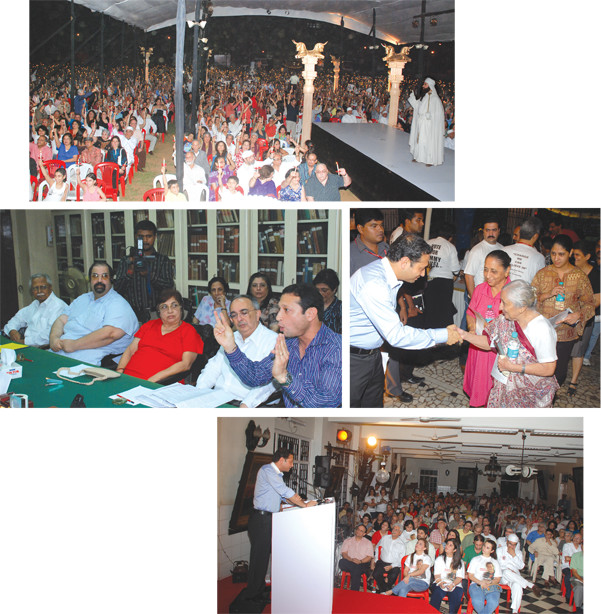
Clockwise from top left: Massive audience and Persian extravaganza at the Dadar Gymkhana; greeting and addressing voters at the Dadar election meet at Palamkote Hall; meeting in the BPP board room to discuss modalities for the election (from left) Rustom Hormuzdiyar, Muncherji Cama, Mithoo Jesia, Berjis Desai and Mistry
He is equally vehement against accepting Parsi women in India married outside the fold. "I don’t want a Mrs Rao or a Mrs Kulkarni next to me in the agiary. Because after a time they will be followed by Miss Rao and Master Rao, Miss Kulkarni and Master Kulkarni. It’s diluting the community. We are such a minuscule community. Nothing will remain. We need desperate measures to preserve and grow. So, within India, it’s no. But when you look at the diaspora, you are talking about Zoroastrians. Then anything is possible. And it is internationally that intermarriage is hitting us much more. Every family has a mixed marriage. There we cannot not accept. Internationally you have to accept. That is why you have dare mehrs and not agiaries there. Even in India, the children of Parsi mothers can follow the Zoroastrian way of life so long as they don’t enter agiaries.”
Mistry is gung-ho about the quality and capacity of Parsi youth. "They are very capable. They need more opportunities and more platforms, more exposure and more support which is sadly missing. We need to reach out to youngsters. Entrepreneurs can’t be created by magic or default. We need programs like the Holiday Programme for Youth (a star BPP program for children who have just finished school, now into its 21st year) for college going youths and for post college youths. Then they can take the umbrella of the WZCC. Then we can hope to create entrepreneurs. The youth program has to be vociferously and aggressively implemented,” Mistry is positive.
Parsiana sought to tap his acquaintance with community ailments because of the mediclaim program he has implemented for mobed families. However, he feels that mobeds would not be a good barometer for the community at large as the ailments that beset them are largely occupational hazards: cataracts and asthma because of the constant smoke; knee replacements and hydrocil because of long hours spent sitting on the floor, unable to get up. But Mistry says "PRG will implement its commitment to create a consolidated data base of the community. We can then extend mediclaim to the poor and needy at a subsidized rate and to the rest of the community at cost. It would be the best thing for the community to be insured.”
Mistry’s community commitment has been fuelled by his connection to Dadar’s Rustom Framna Agiary which he restored at his own cost — a hefty 27 lakh rupees according to that doyenne of Dadar Parsi Colony, Mithoo Jesia — and which subsequently won the heritage award. He has since become a trustee there. But the fate of an agiary, according to him, depends on the manager. "At Rustom Framna where the managers are my co-trustees, they are dong a fantastic job. They are actively involved in the running of the agiary unlike many others where the trustees are not at all involved in running the agiary, and its management is left entirely to the panthaky. The trustees behave like owners of the property!” Mistry tables his concern. Some years ago when he had been invited as a guest speaker at a Federation meeting, he had urged the assembled audience to adopt agiaries, oversee their maintenance. He has noticed a similar situation in Parsi trusts. "Certain trustees are doing a great job,” says Mistry. Citing the involvement of Rustom Jejeebhoy in the Jejeebhoy schools he notes, "The man is personally involved. But there are so many other trusts which are just languishing and the trustees are not a wee bit interested in anything. I would rather such trustee resign and let others, more interested, take over.”
In his professional sphere Mistry says he has been "designing townships, masterminding fairly large mixed-use townships like the one in Indore (3.7 million sq ft), Poona (one million sq ft).” He is also said to be involved in the creation of a five-star hotel and gaming resort in Daman, designing corporate interiors in Noida where he has to deliver on a 200,000 sq ft office in 12 weeks. "It’s a high pressure job — like a pressure cooker,” he notes. "We work for the government of Daman, masterplan for them and as honorary consultants for Bagha Beach (in Goa).” He is thrilled with his assignment to do industrialist Vijay Mallya’s headquarters in Bangalore, a 17-storey building including his private quarters where Mistry says, "I am lucky to play around with things I like…On the 33 ft high ceiling is mounted a 1:10 model of the A380 aircraft. There are seamless high tech walls and a Force One car as part of the décor…For me, work is pleasure!” The prior week Mistry was "in Las Vegas to learn about casinos and the casino industry.” In Lonavla he is building second home villas and bungalows with racing car and riding tracks. "If recession hits, the fun will reduce, but what goes down has to come up!” states the optimist.
As of now Mistry’s businesses are "still running full throttle with orders from the last quarter,” but the youthful magnate anticipates that his "real estate business will take a beating like everybody else. One has to be prepared for the worst in any line of business and industry.” Addressing the current bleak economic scenario he notes, "I personally feel that most business houses are in denial mode. But by mid January-February they will hit bottom. Then recovery can be anybody’s guess. It worries me, but it has to be faced and being an opportunist, I look for opportunity in every calamity.” Mistry says he currently employs close to 1,600 people all across India, approximately 67 Parsis among them. He plans to reduce his staff by100 because of the current economic slowdown, "then take it month by month. If the markets shrink, we will become lean and mean.”
Born in Ahmedabad 37 years ago to Lily and Rusi Mistry whose job in Sarabhai Chemicals entailed many transfers of residence, Jimmy and his sister Jasmine (Daruwalla) have known how to adjust. He says he has been through six schools, lived with the family in a 260 sq ft accommodation ("one room and kitchen — the kitchen was my bedroom”) in Dahisar. "In Indore I learnt higher Hindi; spent three years in Italy so I speak Italian; in Bombay I learnt Marathi; I gave Sanskrit as a subject in SSC.” He refers to his college years in Nagpur’s Anjuman-e-Islam where he says he lived in a hostel and acquired a diploma in Mechanical Engineering. "It was a pure Bihari college. I have seen enough violence, from murders to heinous crimes…committed on the college campus. Shouting and threats don’t mean anything…I laugh when people threaten me. They don’t know what they are talking about!”
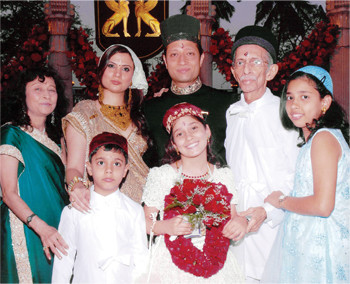
At daughter Natalia’s navjote (from left): mother Lily, wife Delna, Jimmy, father Rusi and children Pearl and Farhan
With that background, what could have induced Mistry’s passion for the community? we wonder. "Perhaps my mother’s prayers? Perhaps the Rustom Framna Agiary and my love for it? I spend 50 percent of my working time on the community. It is suicidal for business. But I have taken up the responsibility so I have to shoulder the responsibility. I am mentally prepared it’s going to continue forever. I feel destined to do it — there is no precise reason. I have a passion for the community and accept it.” Calling himself a "mechanical engineer by qualification and an architect by practice,” Mistry gleefully shows us a glimpse of the blueprint for a two-storey-high statue of Shah Lohrasp that will grace his Della Towers in Dadar Parsi Colony.
Married to Delna (née Jamaji), the Mistrys have three young children: Pearl, Natalia and Farhan. The opulence of the setting for their daughters’ navjote set Jimmy Mistry apart — for adulation or aversion. His subsequent use of those sets for showcasing the community and its ancient past has given people a more favorable concept of how his mind ticks. But brickbats have been as numerous as bouquets, if not more. We ask him, why? The rogue in Mistry smiles: "I give them things to talk about. I own the fastest bike, I jet ski…But it’s flamboyance paid for by my own hard work. In college days I had participated in motocross racing. If you are hooked on speed, you are hooked on speed. I am not doing it at the cost of others. It’s not a crime!” He also notes, trying not to sound triumphant, that he has won the case against all those who made allegations against him and his constructions at the City Civil Court. And he is awaiting retired Justice Srikrishna’s arbitration verdict in his tussle against Dinyar Jamshedji of Noble Paints.
Mistry admits to being inspired by "a couple of people at various parts of my life.” One of the earliest is Rustomjee, father of second cousin and builder Boman Irani whose enterprise Rustomjee Come Home commemorates the man. "I have seen him take care of an entire, huge family,” says Mistry. Another who touched him was Nariman Nallaseth who made a name for himself in the plumbing industry in India and the Middle East. "He inspired me to do things at the initial stage,” Mistry says of the gentle Nallaseth who is now totally visually impaired. "Rustom Tirandaz started my involvement with the community and Dinshaw Tamboly gave me a10 lakh rupees loan to start my business because Mithoo Jesia told him to. Mithoo’s love for Doongerwadi got me interested. She has done a lot of work there by winning the love and respect of workers and staff. All this is silent learning,” says Mistry who is also enamored of the Swaminarayan Sanstha. "What they are doing for the community and the country!” Mistry, whose acquaintance with that community grew from a chance meeting with a senior member on an aircraft, expresses his appreciation. The four years he had spent with the late Meher Contractor at her Darpana Academy in Ahmedabad, honing his love for art and culture, is another contact that has shaped his life. "My loyal ties continue with anyone who has helped me. But it does not mean I will agree to their ideologies,” he qualifies.
As for the board of trustees of the BPP, "We are a seven-piece orchestra, currently fine tuning our instruments. Quite possibly, we’ll deliver good music…”
◆ ◆ ◆
From the archive