
Cover Story
Compassion for the community
Trustee elect Arnavaz Mistry brings to the board 22 years of experience in working with the dispossessed of the community
"Why did people spend 50-60 lakh rupees [on the Bombay Parsi Punchayet (BPP) trusteeship elections]? What did they expect to gain?” wonders trustee elect Arnavaz Mistry. Though she eschewed the practice of dishing out dinner boxes to prospective voters (she says she told her daughter who helped plan her campaign that she didn’t want to "waste money on feeding people”), Mistry won the election with a thumping majority of over 10,000 votes — 3,000 more than her nearest rival, BPP trustee and now chairman Dinshaw Mehta — from the over 13,000 total votes cast.
To build a shamiana cost Rs 60,000, says Mistry analyzing some of the election costs. So she says she spent Rs 2,000-4,000 on small enclosures with chairs wherein to meet voters at different places. "I went to all the buildings, spent on a few advertisements, banners, posters and on volunteers on the voting days…I was 110 percent confident I’ll come in.” Even so, she says she had to spend between six and seven lakh rupees. Moreover, five of the seven trustees shared the cost of the community gahanbar they hosted on November 1, 2008 at the Dadar Parsee Colony Gymkhana grounds.
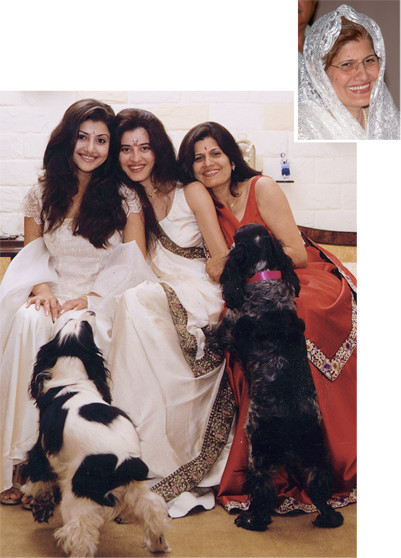
(L ro R): Yasmin Mistry and Mehroo Turel with mother Arnavaz Mistry (also inset) and pets Romeo and Juliet
Mistry’s pleasant personality, elegant bearing, muted charm could have classified her as a socialite. But the lady prefers to spend her time attending to the creature comforts of the old and infirm members of the community, be it at the F.S. Parukh Dharamshalla or J. J. Hospital’s Parsi Ward where Parsiana found her discharging housekeeping duties with total concentration on November 21, 2008. Supervising the maids, speaking to the inmates, ordering rags and occasional litter off the floor, maintaining fixtures, keeping accounts… she could be at her own home. And so she is. "This is my second home!” she tells us.
It is about 14 years since Parsiana last visited the Parsi Ward. It is brighter, more cheerful than anything we remembered. An avenue of plants leads to the entrance. The four rooms have grown to eight. In place of the lone TV there is one in every room and a music system with speakers everywhere so that everyone – 27 men and 18 ladies – can avail of it. All of them are either unmarried or have no children. The story that children don’t care what happens to their parents is not true, Mistry tells us.
In 1994, at the time of the J. J. Hospital’s 150th anniversary celebration, the J. J. Trust had been trying to get the Hospital to sanction use of two rooms below and one above so that more old people could be accommodated. It is now a fait accompli. The latest addition has been an adjoining shed used by the Public Works Department to house its stores. Mistry has got it cleaned and painted, added a trolley, pedestal fan and shelf for a diva and cordoned it off from the rest of the Ward. This is now the morgue, dedicated to the memory of her husband Jal, where family members can come and sit with the deceased without disturbing the other inmates until the formalities for the removal of the body are complete. Open spaces around the Ward have been cleaned and a small garden created where the mobile ones can stroll with assistance from the staff and sit out in the morning and evening.
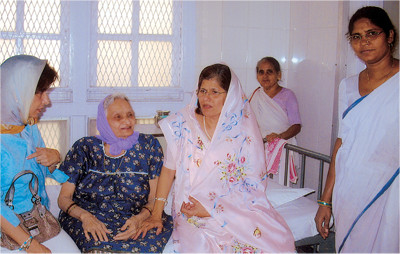
Mistry (center) with an inmate at the J. J. Parsi Ward
Food for the inmates now comes from the Elphinstone Club. The cost is shared by the J. J. Trust, the Jal Minocher Mistry Memorial Foundation which Arnavaz has set up in memory of her husband and other donors. She organizes entertainment for them, takes them to Aslaji Agiary, the Banaji and Wadia Atash Bahrams. Of course, only 12 of the inmates are mobile enough to avail of the opportunity and she says she needs to be very careful about their blood pressure and other problems. Each time she needs to take the permission of the dean or RMO, as she did before taking three of them, who wanted to vote for her, for the polling. The event was blown out of proportion in the national Press, thanks to envious rivals, Mistry notes, adding with a laugh that the results spoke for themselves.
This passionate attachment to the care of the old and infirm on the part of this good-looking, relatively affluent lady has its genesis in her mother’s tears. The daughter of Mehroo and Ardeshir Khambatta grew up in a lower middle class family watching her mother going for 10 rupee doles, reduced to tears by insensitive remarks from the dispensers of charity who questioned her bonafides. "Why do poor people have to go round and round, from pillar to post?” she asks. Married to her cousin on completing her SSC from the Cowasji Jehangir High School, Arnavaz helped her father-in-law in his transport business. The firm then had two tankers. It has now grown to 45 and is managed by Arnavaz’s elder daughter Yasmin. Much later she says she got her BA degree by correspondence and her Master’s in Social Work from Nirmala Niketan. "My children — Yasmin and Mehroo — are my world.” When the girls had completed their SSC they suggested to their mother to take on activity beyond the home and Jal wanted to start a hair dressing salon for her as she had completed a beautician’s course. But Arnavaz wanted to do something for other less fortunate people.
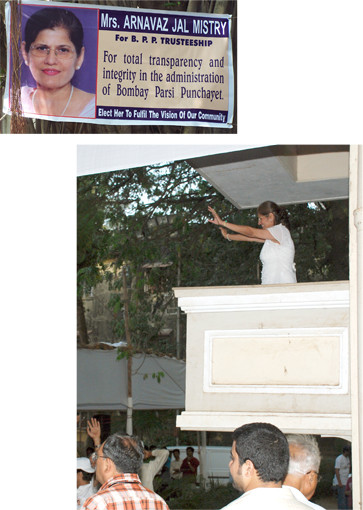
Mistry greeting supporters after voting hours at the Dadar Parsee Colony Gymkhana
In 1986 she began with the National Association for the Blind (NAB) in an informal way, writing letters for blind people. She wanted to help the patients in the wards of the B. D. Petit Parsee General Hospital (PGH) but felt dissuaded by its then CEO Dr Hormasji Mehta. When she met renowned social worker Silloo Kavarana, the latter put Arnavaz on to the Parsi Ward where she started coming once a week. Giving the inmates a hair-cut, trimming their nails, looking after some of their needs came readily to her as Parsiana had learnt in 1994 from Aspy Parakh, another dedicated worker there. Over the years the connection has grown stronger, so that she now spends two to three days a week working at the facility. Her commitment has led to increasing donations coming in for the Ward’s maintenance and beautification and for its sundry expenses.
Mistry’s hands-on experience of working with the rank and file of the community has given her some insight into the psychology of the people. Of the 45 inmates at the J.J., 43 are mentally challenged, she notes sadly when we ask. And, almost all are senile. Occasional bouts of aggressiveness between them have to be sorted out — she has herself been slapped — and followed up with treatment in the Hospital’s psychiatric ward. "It is the only home for the community where immobile people are welcomed,” she notes, adding that a physiotherapist comes in three times a week to attend to them and when there is a major medical problem, Dr Rushad Udwadia is summoned from the Hospital where he attends to one of the units.
Most of the families Mistry has dealt with have been appreciative and cooperative, she maintains. Only about 10 percent comprise the bad eggs, she notes and when she senses an ulterior motive behind the desire to hospitalize the patient, she turns to the Liaison Committee to check their bonafides. "Silloo was more strict than me,” Mistry smiles indulgently. "Trusts say "éni passé mobile chè, TV chè (these people own a mobile, TV). But these are necessities of life today,” she contends.
"I go to the PGH, Masina Hospital, work with the Young Rathestars. Whenever a problem cropped up, I would turn to the BPP trustees for help,” says Mistry until it dawned on her that "if I am a trustee, I can help directly…Also, people talk ké Punchayetma chori thaaich (there is financial misappropriation at the Punchayet). So I decided, let’s see what chori (misappropriation).”
Hitherto, that is three weeks into the trusteeship term, the tempo is "very slow, according to me,” says Mistry. All seven of them had to go together to the Small Causes Court to sign the power of attorney traditionally given to select BPP executives to enable them to pursue the various activities of the Punchayet. With some of the trustees actively involved in their careers, the unity of seven requires some planning. Though all the old committees have been dissolved, no portfolios have been allotted to the new trustees. "We thought all seven will be on everything,” says Mistry. Given a choice, Mistry says she would like to take on the Parukh Dharamshalla where she is already president of the committee, education and sports. Housing is mandatorily the responsibility of all seven trustees.
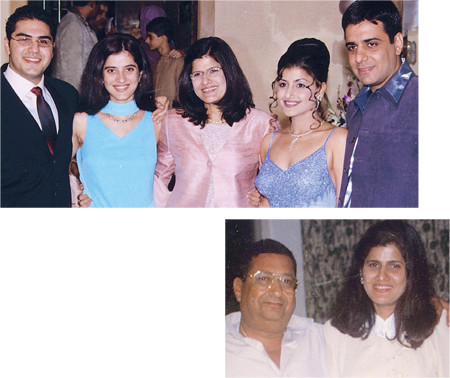
Above (L to R): Kaiwan and Mehroo Turel, Arnavaz Mistry, Yasmin Mistry and Masood Shahnazian. Bottom: with husband Jal
The huge mandate Mistry has received from the community is not reflected in any special position on the BPP board. She would have liked to be seniormost trustee, next to the chairman, but that position has been allocated to Rustom Tirandaz and endorsed by the rest of the team, on the strength of his being BPP trustee for a second term, albeit with a substantial break between terms. Mistry is at number three position behind him, she informs us. Nor has she been offered or interested in special assignments as the only lady on board. "I would prefer to be involved in everything,” she says, adding, "Finally we are all working for the good of the people.”
Mistry wants the BPP to implement more crèches, arrange get-togethers for the youth, ensure sufficient funds for education so the children do not have to run from trust to trust to get the money they need. "But I don’t get a chance to speak at the weekly trustee meetings,” even though these take up five hours, from 4 to 9 p.m. She has been told to frame her thoughts and get them included on the agenda. In response to Parsiana’s questions she admits that the BPP office is "not up-to-date,” that the pace of work is "laasaryu (sluggish).” So far the proverbial BPP dispatch box has yet to make its appearance at Mistry’s place. Indeed, she was unaware of its existence.
According to Mistry there are 77 flats available for allotment. "The Charity Commissioner (CC) wanted to see us. All seven of us went to him…He wants 110 allotments to be made…His intention is good. He said, ‘people want to get married so give them the flats.’” Mistry herself feels that those who have been scrutinized by the older trustees and the Alert Zoroastrians’ Association (AZA) should be given the flats. But she also conveys chairman Dinshaw Mehta’s point of view that not all those who answered AZA’s summons and went to the CC are the most deserving from the many on the waiting list.
A traditionalist by upbringing and inclination, Mistry believes that the Doongerwadi should continue as is: "We must keep people united. The priests understand the commands of the religion better.” She is averse to accommodating a cremateni bungli there. Nor is she willing that the children of Parsi mothers and non-Parsi fathers be accepted into the community fold, though she tolerates intermarriage. "I don’t like it. I would prefer that the children marry within the community. But they have their own views. We can’t force them, even the girls, after a certain age. Let them enjoy their life. Their happiness is the main purpose of our life,” says Mistry, one of whose daughters is married out but maintains her Parsi surname.
Mistry has a lot to learn about the community beyond the city of Bombay. She is still to find her bearings regarding the Federation of Parsi Zoroastrian Anjumans of India whose only activity she is aware of is the defunct anjumans subcommittee. She feels an international conglomeration of Zoroastrian federations as envisaged in a world body is a good idea but is totally unaware of the nitty-gritties that make up its checkered history. "Legal matters go over my head,” she admits candidly, simultaneously voicing her resolve to peruse the BPP trust deeds. As of now Mistry goes to the BPP office two to three times a week, giving up her attendance at NAB and the Jai Vakeel School to find the time to do so.
Mistry is yet to learn how the BPP finances are structured, among many other things. But as she proved at the J. J. Parsi Ward where she has learned to work successfully with government officials and haughty nurses without losing her cool, that given time she is well able to work towards her goal.
◆ ◆ ◆
From the archive