
Politics and Policy
“An icon of youth”
Godrej Baug residents heap praise on Bombay Parsi Punchayet trusteeship candidate Jimmy Mistry
"Laat khaavaani shauk chhè… Khaa havé laat (You are fond of brickbats… now enjoy the criticisms).” Supposedly addressing Jimmy Mistry, thespian Jehangir Karkaria’s intermittent, humorous delivery from the stage was aimed to disperse the clouds of rumors encircling the founder of the Parsi Resource Group (PRG). This strategy succeeded in endearing the candidate to the voters at Godrej Baug on Sunday, September 7, 2008. There were other speakers too, starting with noted ophthalmic surgeon Dr Keiki Mehta, Ervad Yezdi Panthaki, Maneck Dastur, Nutash Kotwal, Zubin Pardiwalla, Rustom Tirandaz and Mithoo Jesia who reinforced that Mistry’s youthfulness and cheerfulness, drive and vigor would make him an ideal trustee of the Bombay Parsi Punchayet (BPP).
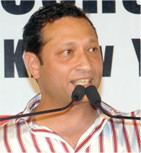
Jimmy Mistry: would not "change the tenets”
Describing him as a "doer and achiever,” Mehta continued, "Here is a man…with will and determination… who promises and delivers… A successful leader (with) a big legion of followers he leaves behind in other people the will to carry on.” Panthaki, also a candidate for the trusteeship elections, considered Mistry "immensely mature, result-oriented, (who) can achieve what he wants for the benefit of the community. All his schemes are action-oriented.” He was particularly impressed with PRG’s ability to gather data on 700 mobeds when as CEO (chief executive officer) of the Athornan Mandal, he could collect information on maximum 200 mobeds in Bombay. Although Jimmy Mistry may well be Jimmy ‘Mystery,’ "with his dynamic thinking he will give a new avatar to the BPP,” added Pan-thaki.
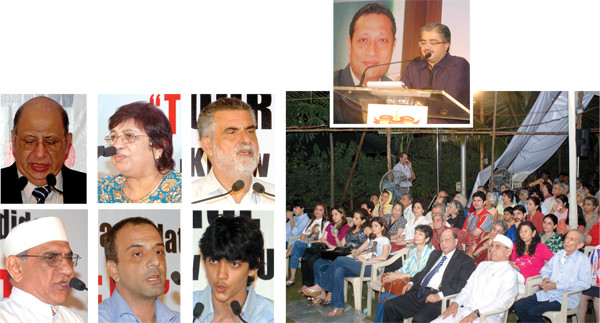
At Godrej Baug (clockwise from top left): Dr Keiki Mehta, Mithoo Jesia, Rustom Tirandaz, Mahiyar Dastoor, section of the audience, Nutash Kotwal, Zubin Pardiwalla and Ervad Yezdi Panthaki
"We want you Jimmy, we want you immediately,” declared Dastur, former president of the Godrej Baug Association, who was impressed with the ambience for the function particularly created that evening. "Did we ever have anything like this before?” he asked. On the dais was a backdrop of Mistry with his philosophy prominently legible: "I believe that given an opportunity together we will be able to lead our community to its most glorious phase through active participation, not silent spectatorship.” Devoid of any chairs or tables, lending a Zoroastrian touch to the stage décor was the traditional sés with an oil lamp which Mistry lit at the start of the function that commenced 15 minutes after the scheduled 7.30 announcement. The side panels alternately served to project the video images of speakers like Ervad (Dr) Ramiyar Karanjia and Boman Irani of Rustomjee builders who paid glowing tributes to Mistry or glimpses of the audience when questions were being fired at Mistry. Dastur also recalled his meeting with Mistry in connection with introducing mediclaim for mobeds when neither did he discuss the costs that he would have to bear nor make any request to lower the premium. Mistry only sought that better benefits be provided to the clergy.
To young Kotwal who is studying science in grade XII, Mistry symbolized "an icon of youth,” who organizes peace and friendship rallies to promote unity within the community. "His reputation precedes him…his passion for work extends…” Mistry’s election slogan reading "Change we can believe in,” Kotwal added, "Give this man a chance to serve the community…He is the only known cure to an ailing community.” Godrej Baug resident Pardiwalla was sanguine Mistry would be able to introduce transparency and accountability in the Punchayet.
"It’s immoral to call him dynamic. He is dynamite with a very short fuse,” summed up Tirandaz, adding, "God help those who come in his way.” Mistry’s confidence and ability to get along with everyone were his major strengths, according to Tirandaz. "He has the rare quality of head and heart which inspires people to come to him… to follow him like the Pied Piper of Hamlin. When I was young I wanted to be a legislator, a Member of Parliament (MP). Finally I became a municipal councilor. But I’m sure Mistry will become an MP in times to come,” noted Tirandaz, beseeching the audience to vote for Mistry even if they don’t vote for Tirandaz.
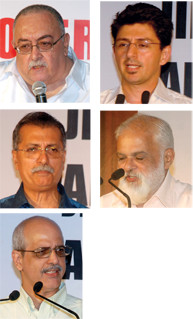
Speakers at Allbless Baug (clockwise from top left): Rusi Jassawalla, Boman Irani, Faredoon Ka-padia, Fershogar Guard and Navroze Siganporia
"There is a passion behind what he undertakes,” observed Jesia, adding, "flamboyance, bravado — that’s his style… He has already earned his place up there (among the seven trustees)…In you I see the dedication, the commitment to the community, my almost faded youth…”
Acknowledging the support of his seniors, particularly Jesia and Tirandaz, Mistry’s two-minute speech before the question-answer session started referred to most of the elders, barring these two stalwarts, advising him not to contest the elections this time because they were apprehensive of the negativity being directed at him. "I assure you I will never let you down,” he addressed them. To the audience he said, "If I have the right to ask for your vote you have double the right to shoot questions… on myself, my thoughts, my work, my personal and professional life.”
What were his views on conversion, acceptance, dakhmenashini? "I am a liberal and forward-looking,” declared Mistry but "that does not mean I would change the tenets of the community. Change does not mean you do away with what you don’t understand…We should continue to live life as we have for the last thousands of years. Dakhmenashini should continue… However a lot needs to change at Doongerwadi — uplift khandhias, salute them for the work that you and I would never do.” Realizing that vultures have disappeared across the world and being a mechanical engineer himself, he would try to "enhance the effectiveness of the solar panels for the dakhmenashini system has to continue.”
However he was sufficiently orthodox and admitted, "If my son or daughter were to consider marriage outside the community I would go to any extent to try and convince them to come back to the community.” Parsi properties too "should remain with us for now and forever,” said the builder who was earlier faulted for contesting the elections because of his alleged interest in usurping Punchayet properties.
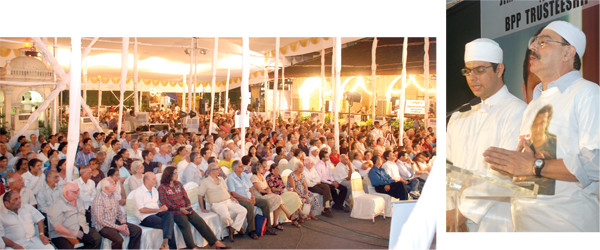
Audience at Allbless Baug; Ervads Kaizad Karkaria (left) and Homie Gowadia
When his views were sought on the development of Udvada, Mistry spoke at length, "If we dream of attracting the youth to Udvada we will need to change so that our next generation feels proud of our heritage and culture. Besides the Iranshah, there is nothing in Udvada to make us feel proud.” He has envisaged a Queen’s Palace on the seashore, a three-storey Zoroastrian heritage center to symbolize our pristine glory and make us proud to be Zoroastrians. Something along the lines of the Akshardham temple that the Swaminarayan sect has created in Delhi. Another question pertaining to the pilgrimage town was veering towards attacking the Foundation for Development of Udvada but Mistry tactfully reminded the audience that they did not wish to use the PRG platform to malign any individual or organization.
The next question from a gentleman residing in Khareghat Colony took even the affable Mistry by surprise: "Can I come up and hug you?” Happily inviting his new admirer to the stage, Mistry revealed that he had been forewarned of the negativism towards him but was happy to receive such warmth and acceptance.
One of the priests highlighted the travails of the profession where the only returns they are assured after years of service are cataracts in the eyes, pain in the back, stiffness in the knees… "Mobedni soo haalat chhè, mobedaj jaané (only a priest knows his own living conditions)… You are like a faréshta (saint) to us,” he concluded. For the priest cadre Mistry would like to do much more — standardize the prayer rates for ceremonies, ensure that no priest earns paltry sums like daily wages of Rs 110, train them to be polite and professional, promote education programs for children of mobeds…
On the subject of reservation of seats for minorities Mistry firmly believes a referendum on this issue is a must because he feels "the elephant-headed ego” of certain persons who think the community should not ask for privileges is depriving our youth of better opportunities. His name has apparently been recommended as the Parsi representative on the State Minorities Commission.
The session having continued for over two hours, Mistry felt that the audience under the shamiana and those seated on the lawns of Eco Park be permitted to disperse with their dinner boxes although he would stay back to answer questions from individuals interested in approaching him.
PARINAZ M. GANDHI
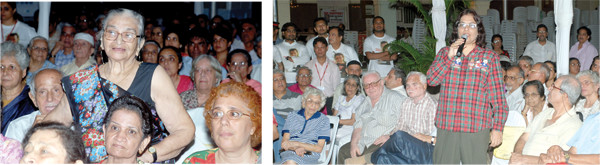
Lady speakers in favor of Doongerwadi (left) and a crematorium (right)
The good, the bad and...
A white shamiana covered more than half the grounds of Allbless Baug. The canopy proved fortuitous as heavy rains poured down on the evening of September 13, 2008 as crowds thronged to hear Bombay Parsi Punchayet (BPP) trusteeship candidate Jimmy Mistry.
Stepping onto the podium to the strains of the Superman movie theme the 37-year-old self- made millionaire invited the 3,000 strong audience to ask him questions as there was no time left for speeches. The microphones have to be switched off by 10 p.m. The program started at 7.50 p.m.
A grey haired lady in a sari from Captain Colony said non-Parsis should not be allowed in the fire temples. She was concerned this might happen. Mistry stressed that all the traditional "reet-rivajs” would be observed. "There will be no change.”
Lady: "Hoo khooshi chèv (I’m happy). And no crematorium at Doongerwadi, please, please, please.” Mistry: "I personally believe there should be no change in dakhmenashini.” Referring to his slogan "Change we can believe in,” borrowed from U.S. Democratic presidential candidate Barack Obama, he clarified, "Change does not mean we change our religion. I will stand as the biggest enemy” of anyone advocating change in our religious customs, he averred.
He reiterated his aversion to selling community property. Regarding transfer of flats, as the homes are "built for charitable purposes, we cannot sell (them) for money.”
Another woman from Captain Colony lamented that dehydrated corpses were being taken out of the dakhmas and buried in an undignified manner in a mass grave. "Why can’t we have a crematorium at Doongerwadi?” she asked.
Mistry: "My body, my parents’ bodies will go to (the dakhma). We will never change the dakhmenashini system” (applause from audience).
A man asked the candidate his views on reservations for the community.
Mistry: "It’s very, very badly required… (by not having reservations) we are the suffering party.”
Soli Mistry from Tata Colony spoke about the housing shortage in the community.
Jimmy Mistry: "Housing is a very complex issue. We must do an analysis of the merit rating system...We must formulate a new rating system in consultation with the community… How many locked houses are lying with the BPP” we must find out, he remarked. He recommended that contentious issues "be resolved out of court. We must reduce litigation. Resort to dialog and debate… not litigation.”
When one gentleman complained that invitations were sent only to Parsis/Iranis residing in colonies and that generally people living outside the baugs were given stepmotherly treatment, Mistry noted, "We try to reach out to as many people as we can… We don’t have a (community wide) data base.” He pointed out that 32,000 copies of his manifesto had been printed for distribution.
Pallonji Nargolwalla, a retired Tata Steel employee said he had learned on the job that three major ingredients were required for leadership: integrity, quick decisions and the quality of mercy.
Mistry: "One thing is missing — the capability to execute.” One also needed "strategy and vision.”
When a man asked Mistry what he intended to do for senior citizens, Mistry replied he would attempt to "involve youngsters with senior citizens… there are two things I want to do. (Build) senior citizens’ homes and crèches” for children of working mothers.
He also envisioned a cashless mediclaim scheme for the community.
When a lady stated that candidates meet voters at the time of the elections but subsequently they are not available, Mistry promised to hold meetings with voters every six months, even if his co-trustees did not.
Management consultant Professor Faredoon Kapadia referred to the "three criminal Cs” people resort to: "complain, condemn and criticize.” Instead of indulging in any of these Mistry states what he is going to do and what he has done, noted Kapadia, praising the "passion with which he (Mistry) works.”
Managing trustee of Rustom Framna Agiary at Dadar Rusi Jassawalla said six years ago when the fire temple was to celebrate its diamond jubilee, the trustees "wondered where we would get the funds” to renovate the structure. The amount required was over 25 lakh rupees.
Co-trustee Jesia told him "there is a young man 30-32 years old who came to me and said I would like to do something for the Agiary.” He had "fire in his eyes,” recalled Jassawalla. Only eight weeks were left for the celebration. "Uncle fikar naa karo (don’t worry),” reassured Mistry. "This is our Agiary… any work for the Agiary you tell me and in my lifetime I’ll do it.”
"He is like a son to me,” said Jassa-walla.
Dadar social worker and head of the applied arts section at Sophia College, Navroze Siganporia noted that people often complain about their lot in life but don’t realize that those who succeed in life are the hard workers. "It took Jimmy 15 long years to achieve what he has achieved today.”
Referring to the allegations made against Mistry he noted Abraham Lincoln’s dictum: you can fool some of the people some of the time, and all the people some of the time but not all the people all the time.
Tata trust executive Fershogar Guard said there were three apparent Jimmys in the public’s perception: a good Jimmy, a bad Jimmy and an ugly Jimmy. "When he does good” people refer to him as bad and ugly. It’s the Indian crab mentality. If one good Parsi rises, three pull him down. People say Jimmy wants publicity but Jimmy does not need publicity.”
Builder Boman Irani said, "No one man makes an institution (it requires a team). Jimmy has leadership ability.” He has organizational ability, he "listens to every speaker and then he says ‘this is what we will do.’”
Former BPP trustee Tirandaz recalled that under the old election scheme though he was a trustee of the BPP he could not vote in the trusteeship elections. "Universal adult franchise is here to stay,” he stated.
In Mistry, Tirandaz saw a leader of people. "Every enemy (of Jimmy) has become a friend.” Noting Mistry’s humble beginnings, running a pest control business from a shed in Wadala, Tirandaz prophesied he would become "another Dhirubhai Ambani.”
Dadar Colony leading social activist Jesia noted that Mistry "has proved himself time and again…I believe in him. My faith will not be misplaced.”
◆ ◆ ◆
From the archive