
Politics and Policy
A trustee for all reasons?
The youthful Jimmy Mistry is hoping to change the face of the Bombay Parsi Punchayet and the community
"Give me any six people and I will work with them.” Bombay Parsi Punchayet (BPP) trusteeship candidate Jimmy Mistry, an interior designer and builder by profession, was responding to an audience comment that he would have had a better chance to see his schemes to fruition had he gathered a likeminded panel to stand for the elections along with him.
Mistry’s responses to the questions thrown at him by the enormous congregation at the Dadar Parsi Colony Gymkhana grounds on September 28, 2008 (4,757 people at the last count, as announced by the evening’s compère Mahiyar Dastoor) came without hesitation, with much candor and all the confidence of youth.
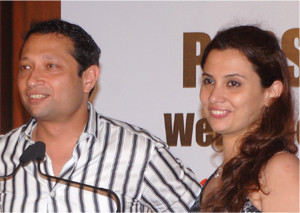
Jimmy and Delna Mistry
He assured this massive audience that he had personally paid the premium on the group mediclaim policy for members of his Mobed’s Association where claims amounting to 40 lakh rupees had already been honored. When someone questioned, "The premium on the mobed insurance is not paid?” Mistry turned to the audience, "I am asking you, what do you think?” The response from the crowd that included many volunteers of his Parsi Resource Group (PRG) was the affirmation Mistry sought.
At the meet on September 26 at the Sophia Bhabha Auditorium too someone had pointed out his potential vulnerability on the BPP board: "You’ll be one among seven. Unless they come together, what will you do? When they want to get elected people say anything.” Dismissing the myth of a "unanimous majority” Mistry answered, "Where there’s a will there’s a way…In business I am alone. In life I am alone. You start convincing people.” Evoking the scenario of the company boards he has faced in his professional life, he says there may be a couple of people smiling your way and a couple of hard core opponents and three or four others who are undecided. "Garaj chhé. Kaam karvanu chhé (You need the job; you have to work). You have to convince them.”
But there is a rider here: "There are lighter issues when you can convince or be convinced.” On the serious issues, he says he "will only refuse help if the six go against the tenets of the religion.” Mistry’s commitment to the Zoroastrian religion as practiced today is hard core. "Dakhmenashini must continue as long as the Parsi Zoroastrian kom (community) continues. We are supposed to change what we understand. We have no right to change what we do not understand. Crematorium ni bungli bi nathi aapvi (There will be no bungli at Doongerwadi for the funerary prayers of those who have opted for cremation).” And renegade priests who perform such prayers are excluded from his group mediclaim for mobeds, he declared.
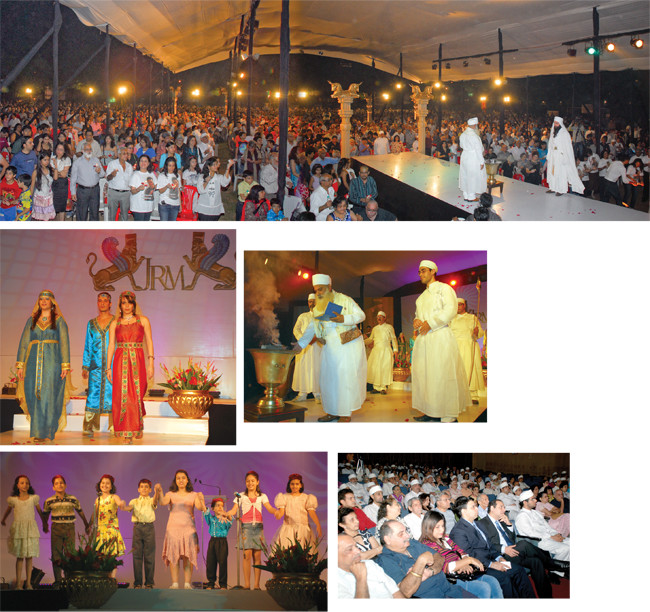
Top row: A view of the audience from the stage. Center (left): Achemenian regalia and (below) Homage to the atash padshah; Bottom: An item by the Mancherji Joshi Dharmagyan class; (alongside) a view of the audience
Having "refrained from talking ill of any other candidate,” a policy that will continue, he said, Mistry dilated on his theme of "igniting the passion” because he believes "the community needs to come together, to stand united once again.” And for that he says we need to sow the seeds of community service in childhood which hasn’t been done since the past few generations. "We need to be involved. Enough of silent spectatorship!” is a constant refrain. But Mistry has backed it up with action like his bike rallies and the spectacular Persian extravaganza he presented at Dadar as a campaign closure: eye-filling young Parsi models gliding over the ramp in colorful garbs straight out of an Achemenian epic, the tableau brought to a climax by Zarathushtra presented the way he has been visualized by Parsi artists, followed by a retinue of mobeds carrying the holy fire. Candles had been distributed to the audience, lit on cue, and fireworks sparkled on both sides of the stage as the congregation sang Chhaiyé Hamé Zarathoshti and the national anthem.
Mistry says he has restored the Langrana Agiary in Fort and used the opportunity to create two flats for resident mobeds. There had been some unpleasantness and Mistry tendered a public apology if he had "hurt anyone’s feelings.”
Referring to the J. J. School which is in need of the space the BPP office is occupying in its building, Mistry observed, "Doesn't it speak volumes that the BPP, the second biggest landlord in Bombay, does not have an office of its own? Many sets of trustees have come and gone!” He depicted his vision of the BPP office: It will have a place for humdins to wait in comfort, where they will be provided with a glass of water, a cup of tea to lighten their distress. "You don’t need budgets for this — just the desire to do it.” And he promised, "I will not encroach on housing space. Give me time to research…
"Housing is a very complex issue” but according to Mistry it has been blown out of proportion. If there are 900 applicants on the waiting list for housing, it would amount to less than 4,000 people — a fraction of the Parsi population of Bombay, he noted at the Sophia meet. "None of us understand the merit rating system (on the basis of which the BPP is said to allot flats). Has the community chosen to remain ignorant? Or have people kept the community ignorant? The trustees have done a good job but they have not been able to explain it to the community. Can we spend two or four Sundays to understand it, then have healthy, educated debates?” At Dadar he noted, "The community has to decide the priorities (on which flats are allotted).” He assured the audience he will "never touch a single BPP property as business. You can’t mix charity and business.” He suggested the construction of old age homes, crèches, mobed homes on the M. F. Cama Athornan Institute grounds in Andheri "but not do anything that loses the property to other communities.” He said he had fought that Institute’s trustees when they had proposed an international school on the premises as such a scheme would open the land for the use of other communities.
In answer to a question on repairs to old buildings Mistry declared it to be the "BPP’s moral responsibility to coordinate with trustees of other trusts — they are supposed to have a plethora of resources on financial and legal fronts.” Mistry says he wants to have "an active housing committee to go into the problems of those who have a house. It is the legal and moral responsibility of the BPP to run these colonies properly.”
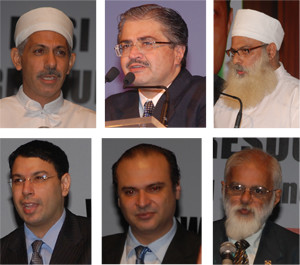
L to R (1st row): Ervad (Dr) Ramiyar Karanjia, Mahiyar Dastoor and Ervad Dinyar Vajifdar. (2nd row): Dr Cyres Mehta, Marzin Shroff and Prof Faredoon Kapadia
Someone from out of Bombay complained about people in sanatoriums and dharamshalas who do not vacate, making it difficult for out-of-towners to get a booking.
"If a person does not have a house, where does he live?” countered Mistry.
What does he feel about intermarriage? Mistry said he wants to create a data bank of Parsi youths in order to "avoid intercaste marriages.” In this context he noted, "ARZ (Association for Revival of Zoroastrianism) has done some work. They can set up their own institutions. So long as Zoroastrianism is not superimposed on Parsis (sic) they can build their own agiaries.”
Someone mentioned that Parsi property in Calicut is being occupied by non-Parsis and asked for Mistry’s response. He pledged to pursue issues to their legal end, provide "manpower, resources, whatever is needed to protect Parsi properties all over India.”
Can he reach out to Parsi children who do not live in the colonies? "It is up to us to inculcate Parsi values, have events where the young come together, make sure we get them back into the community.” To another person concerned about physically and mentally handicapped children in the community, he assured support and care for the "less privileged.”
Apart from Mithoo and Jimi Jesia, two of the most adored people in the Dadar Parsi Colony, former BPP trustee and current candidate Rustom Tirandaz has also supported and spoken on behalf of Mistry. Shouldn’t he be speaking on his own behalf? noted a member of the audience. "Rustom Tirandaz is a father figure for me… a true example of a mentor. He helped me in troubled times in 1996…I salute and respect him.”
Earlier, in the course of his address, Dadar Athornan Madressa principal Ervad (Dr) Ramiyar Karanjia had noted, "The BPP election is just a platform for Jimmy to have a wider canvas. But our man can do nothing unless we as a community support him. A community without a passion for survival does not survive long. When Swami Vivekananda died he was only 39. But see how he transformed India in the eyes of the world!”
At Sophia Mistry had observed, "We have covered the length and breadth of Bombay. We have the smallest crowd today…The upper strata of the community is never emotionally involved with the rest of the community…If I become a trustee, I would like to awaken them.” It is also his intention, if he succeeds in his bid for BPP trusteeship, to get the "entire community (below a stipulated level of income) covered” under group mediclaim insurance to ensure that the aged can enjoy life free of the tension of medical expenses. But first he wants to "make a list of people who need help because people who want to help do not know who to help…Get data on the community poor.”
Keen to acquire reserved seats for Parsi children in educational institutions, Mistry mentioned to Parsiana in the aisles of the Sophia meet that Dr Mehroo Bengalee, member of the National Commission for Minorities, had proposed his name for the Maharashtra State Minorities Commission.
The Dadar event, marking the close of the election campaign, had been planned and executed in considerable detail. A red and white checkerboard arrangement of chairs covered the ground: 3,500 initially, Parsiana was told, with 500 chairs in reserve if the numbers warranted them. A huge stage set under a tall shamiana was flanked with pillars and friezes replicated from Persepolis. A PRG member mentioned that the work had been going on for the past two days because "Jimmy is a perfectionist.” Though the show was slated to begin at 6.30 p.m. it started three-quarters of an hour later. A splendid selection of music however relieved the tedium as bus loads from every colony began arriving from 6 o'clock to find Mistry in his avatar as a hands-on impresario supervising the rehearsal being conducted by Hutoxi Doodhwalla, a PRG member from Rustom Baug. PRG volunteers sporting "Vote for Jimmy Rusi Mistry” T-shirts helped the audience settle quietly. The organization only took a beating at the end of the show when an obviously larger crowd than expected swarmed with the usual Parsi enthusiasm on the food counters. It must be said however, that more boxes on short call were being delivered even as some of the buses readied to leave.
On a "humble note, not over confident,” Mistry closed his campaign. "Vote for me if you believe in me.”
◆ ◆ ◆
From the archive