
Comment
‘Beyond personal grief’
A relationship of mutual caring remains between the departed and the surviving
At the prayers for my deceased son, Behram, I asked the priest what was the significance of the prayers for the living, as all knew they were meant to be prayers for the dead. I got no coherent reply. So, I sought my own answers from Dr J. J. Modi’s The Religious Ceremonies and Customs of the Parsees and Erach Sohrab Kuka’s Essential Ceremonies, Death and After. I thought some readers of Parsiana may wish to share my own interpretations, and possibly arrive at their own re-interpretations. All ancient religions and customs need interpretation in each age, if they are to be understood and survive meaningfully.
The first significance seems to be the ritualistic emphasis on physical purity, sanitation and health. This may be appreciated better in the context of earlier ages, before modern medicine, when exposure to what was conceived as physical impurities, especially associated with the dead, took a heavy toll in infectious diseases, sometimes in epidemic Black Plagues. Hence the four kinds of purification ceremonies, padyab, nahn, bareshnun and riman referred to by Modi. He explains, "Every precaution is enjoined, so that, in disposing of the dead body, no contamination or injury may result to the living.”
The second is the extension of the concept of purity to the mind and soul, both of the departed and the living. Purity in man’s mind and behavior, summed up in the three basic tenets of good thoughts, words and deeds, is at the heart of the Zoroastrian ethic, beyond the physical.
The third implication for the living conveyed by Modi, at least in earlier times, was charity at the end of the three-day uthamna ceremony, in the maiyat, or in memory of the deceased. In Modi’s time he records, "Of this sum, charitable donations, a large part was announced at these funeral gatherings on the third day after death.” Apparently, and unfortunately, this good custom may have fallen into disuse, perhaps when the social ties of the village community were lost in the anonymous city. It needs to be revived by priests and anjumans, and in the most meaningful way. The world has moved from private charity to public philanthropy. Our priests should remind our laity of this old custom and obligation. Modi tells us that this custom went back to old Avestan times, confirmed in the Fravordin Yasht, and later in the Afrin-i-Rapithwin written in the Pazand language.
The fourth implication is the accountability of the dead after the third day following death for his/her performance in life; and, in my view, a reminder to the living of that final accountability after life. The Gathas of Zarathushtra himself, Kuka reminds us, have a clear reference to "Chinvat,” that bridge between life and the post-death fate of the soul. Both Modi and Kuka tell us what most of us do not know, that the concept of such a bridge was also known to early Christians (St Michael), the ancient Egyptians, the Chinese, the Arabs and the Scandinavians. The simile is apt.
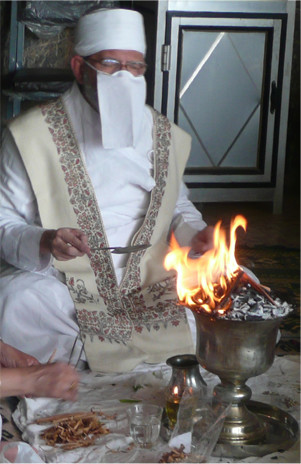
Dastur (Dr) Peshotan Mirza performing a prayer ceremony. Photo credit: Benaifer J. Mirza
Modi also tells us that the relationship of the dead and living continues after death. The living remember the dead gratefully and think of the dead in righteous thought. The "Holy Spirit” of the dead "takes an interest in the welfare of the living” to "assist them with an invisible helping hand.” Post-death thoughts and prayers then become a kind of dialog of mutual caring between the departed and the surviving. The living are fortunate to have that most precious thing in all the universe, human life and consciousness, which no other species can match. So the death of a dear one should enhance the virtuous life of the living.
Kuka makes some unique and interesting observations, especially for modern scientific minds in the chapter on "Ravan.” He refers to probably the most important verse in the Gathas, 30-2, to decide with "Vohuman” for oneself, and to awake to the higher message. Kuka interprets from Gathas and Vendidad three planes "with a death of a person.” First, "material constituents,” dust returning to dust in the Semitic tradition. Second, "kehsapa-usthan and tevishi,” which he regards as a mix of the material (scientific now) and spiritual. The third is purely spiritual and immortal, and consists of "boodh-urvan” and "fravashi.”
Somewhere in this misty area between the material — now scientific and the postEinstein atomic and sub-atomic universe — and the old spiritual, I may be permitted to relate a personal experience in the prayers immediately after my son’s death. It was in a spacious glass house overlooking the Arabian Sea; a scene and consciousness referred to by Kuka as the "semi-spiritual mixes with nature.” My son’s son was sitting beside me during the prayers, a modern, America-educated youth. My thoughts humbly went to Einstein "to know the way God’s mind works,” beyond personal calamity and grief in death, in the limitless universe beyond; and its making since the Big Bang. Here we were, grandfather to grandson, trying to bridge the gap to understand one personal death, and the wider meaning of life and death in this scientific age.
I gave Jehan two paragraphs to read from my pamphlet, "Gathic Concepts: Explorations in our time.” I showed him a paragraph comparing Zarathushtra’s "Frasho-Kereti” or the regeneration of life in the universe with respect for its elements on earth; and the thoughts of the scientist, Brian Swimme, in The Universe Story. We were trying to understand life, death, evolution, the creative process in the universe. In my essay, I had referred to Swimme’s observation: "What is interesting is that the initial conditions were capable of creating protons and neutrons; yet incapable of creating daffodils. Daffodils and humans came at the end of that long road of billions of years. Divine creativity was slow to evolve and produce, that is why you cannot jump from protons to daffodils.” It left a mark on Jehan’s face.
I then turned Jehan’s eyes to the flowers, fruits, water and fire, Zoroastrian links with nature, to my son, Behram’s picture, and the invisible protons and neutrons around, to try to visualize the thought. In that time of grief and prayer, while the priests were chanting and ritualizing, we were trying to touch the meaning of life and death, and the great scientific truths of Einstein’s God beyond personal grief, where science and spirituality meet in cloudy monsoon weather. The insight was humbling. It relieved grief.
It has been such a long perceptual road from Zarathushtra to Einstein. How I wished Dr Homi Bhabha, the nuclear scientist, had been there to enlighten us, to take us across that new "Chinvat” bridge of understanding between ancient prophet and the world’s most daring scientific-spiritual, Vohumanic mind, Einstein. What could be more spiritual than his desire to "want to know the way God’s mind works,” a quantum jump from ancient ritual, and yet an extension of that long human seeking.
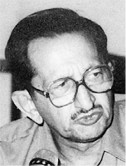
A management consultant, Aspi Moddie is a former Indian Administrative Service officer who early in his career opted for the private sector. His voice was evident at the Fourth and Fifth World Zoroastrian Congresses. His book, Zarthushtra’s "Frasho-Kereti”: Renewal in Our Time was published in 1996.
◆ ◆ ◆
From the archive