
Bawa Musings
Praying matters
Parsis ought to, but are not praying enough
The Prophet is supposed to have termed priests as babblers for money. Perhaps he was only urging every Zoroastrian to pray himself and not contract it out for a fee. If so, the Prophet’s commandment appears to be largely ignored by his followers today.
Few believing Parsis pray at all, and even those, not regularly. Apart from the perfunctory tying of the kusti, perhaps. A candidate for navar or maratab or a mobed readying himself to conduct a Vendidad or other ritual prayer, is required to cleanse himself by undergoing a nahan or seclusion period for nine days (during which he cannot use water to gargle or brush his teeth or for cleaning any part of his body). During this nahan period he is required to do farajiyaat (mandatory) prayers in different gahs. The purist will rise at dawn to recite Hoshbaam (which is one of our most beautiful prayers). In each of the five gahs, he will do his kusti prayers, followed by Srosh Baj, the relevant gah, Khorshed and Meher Neyayesh in the sunrise to sunset gahs, being invocations to the sun, the Vispa Humata (declaration of the faith), Doa Nam Setayeshne along with the homage for the four directions.
Apart from this capsule of prayers five times a day, the devout are expected to retie the kusti after every visit to the toilet (presumably, not after a dialysis). At night, you should pray to the moon, particularly on new moon, full moon and no moon day (chaandraat, poonam and amas). It is mandatory to recite the most beneficial Atash Neyayesh to the holy fire at least once a day. Add to this, the yasht dedicated to the presiding angel of the day (like Khordad or Behram or Ardibehesht).
On the Avan Parav (roz Avan, mah Avan), many attend the traditional function at Radio Club only after spending a goodly 60 minutes intoning one of the longest prayers, the most boon granting Avan Yasht. If you manage, year after year, without a break, to recite this Yasht on the Parav, whether you are in the hospital or in Havana, it is said to give the most amazing results.
On the last day of the Parsi New Year, you wipe your balance sheet clean by begging forgiveness for your sins through the prayer Patet Pashemani. The Patet has a laundry list of the various gunah (sins) which you could have wittingly or unwittingly committed. A day before the five Gathas, one recites the preparatory prayer contained in the Framarot no Ha, and then of course, the recitation of the poetic Gathas.
Few believing Parsis pray at all, and even those, not regularly. Apart from the perfunctory tying of the kusti, perhaps. A candidate for navar or maratab or a mobed readying himself to conduct a Vendidad or other ritual prayer, is required to cleanse himself by undergoing a nahan or seclusion period for nine days (during which he cannot use water to gargle or brush his teeth or for cleaning any part of his body). During this nahan period he is required to do farajiyaat (mandatory) prayers in different gahs. The purist will rise at dawn to recite Hoshbaam (which is one of our most beautiful prayers). In each of the five gahs, he will do his kusti prayers, followed by Srosh Baj, the relevant gah, Khorshed and Meher Neyayesh in the sunrise to sunset gahs, being invocations to the sun, the Vispa Humata (declaration of the faith), Doa Nam Setayeshne along with the homage for the four directions.
Apart from this capsule of prayers five times a day, the devout are expected to retie the kusti after every visit to the toilet (presumably, not after a dialysis). At night, you should pray to the moon, particularly on new moon, full moon and no moon day (chaandraat, poonam and amas). It is mandatory to recite the most beneficial Atash Neyayesh to the holy fire at least once a day. Add to this, the yasht dedicated to the presiding angel of the day (like Khordad or Behram or Ardibehesht).
On the Avan Parav (roz Avan, mah Avan), many attend the traditional function at Radio Club only after spending a goodly 60 minutes intoning one of the longest prayers, the most boon granting Avan Yasht. If you manage, year after year, without a break, to recite this Yasht on the Parav, whether you are in the hospital or in Havana, it is said to give the most amazing results.
On the last day of the Parsi New Year, you wipe your balance sheet clean by begging forgiveness for your sins through the prayer Patet Pashemani. The Patet has a laundry list of the various gunah (sins) which you could have wittingly or unwittingly committed. A day before the five Gathas, one recites the preparatory prayer contained in the Framarot no Ha, and then of course, the recitation of the poetic Gathas.
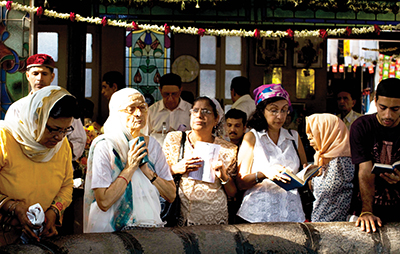
Devotees praying at Bhikha Behram well in Bombay Photo: Kainaz Amaria
The behdins visit agiaries to either doze or gossip when the retained mobed is zipping through the afringaan, farokhshi and baaj prayers like the Dehradun Express, often missing a few stations, deliberately or otherwise. The sensible prefer to themselves pray the Stum no Kardo for their deceased. During the muktad days, in bustling agiaries, part-time priests have to almost continuously pray for nearly five hours for the departed clients of the panthaky, in quick succession, and could be pardoned for a few short cuts (cutely termed, "Dasturji gaapchu maarech”). Some behdins bitterly complain to the panthaky about the voice of the mobed not being sonorous enough ("My late Tehmaas loved to hear prayers loudly recited”), as others irately protest at the out-of-turn allotment of the prayer slot to some favored client ("my cousins and I entered the agiary much before that stout lady!”). The chaasni (partaking of the prayed upon food) not being edible or the apples being rather small, are other frequent grouses. Tempers are frayed inter se the attending behdins, if the ‘name list’ (given to the mobed) of the deceased family members omits a particular name or about its placement in the order of priority ("Look at her temerity! My father was the eldest brother but his name was listed third! Now, I too will cancel her grandmother’s name from our name list”). All this and more happens with amazing frequency much to the consternation of the harassed panthaky. The prayer charges are most reasonable yet a few behdins negotiate a discount ("Now don’t you charge separately for the baaj”).
A free flowing Gujarati or English translation from Avesta or Pazend may appear simplistic and uninspiring. However, the vibratory effects of our manthric prayers, when recited with devotion and concentration, are claimed to be highly effective. Decades ago, Dame Meher Master-Moos, in her Mazdayasnie Monasterie and its affiliated University, claimed to break window panes by intoning the Yatha Ahu Vairyo to a particular high pitch. When Zoroastrian teacher/preacher Khojeste Mistree first descended upon Bombay in the late 1970s with his lectures on religion, he would often round off by reciting the Ahunavar in a highly accented but sonorous baritone, endearing himself to many middle aged ladies.
Apart from Moos and Mistree’s vocal experiments, the Yatha Ahu Vairyo is the cornerstone capsule prayer [Ahuném vairim tanum pāti (Ahunavar saves body and soul) is a powerful manthra by itself]. So are the words, Nemascha yā armaitish izha-chā, recited thrice at the end of the geh sarna prayers, obliterating the worldly memories of the deceased and severing his mortal ties. The lost word, believed by many to be a powerhouse — Māāthrém — is also from the Avesta. If you cannot spare time for the longer prayers, at least recite these manthras for temporal and spiritual protection, say our scholars.
A micro minority prays daily with great fervor, while observing ritualistic purity. We knew of a very fine gentleman, who would visit every fire temple on its founding day, and in addition pray at home for nearly four hours. If his foot accidentally touched the wire of his old gramophone upon which his ganga (maidservant) happened to simultaneously lean while cleaning the floor, he would redo the kusti and start praying afresh, to purge the juddin contact and the possible impurity.
Prayers, our wise ones say, are like the umbrella. They won’t prevent the rain from falling but at least you will get less wet.
Berjis M. Desai, managing partner of J. Sagar Associates, advocates and solicitors, is a writer and community activist.
◆ ◆ ◆
From the archive