
Business
Slowing down
With the global economic meltdown affecting developed and developing countries all over the world, Ratan Tata, chairman of the Tata Group, has sounded a word of caution. "No more acquisitions, Tata tells his firms,” states the Hindustan Times (HT) of November 12, 2008. In a front-page report, HT quotes from Ratan Tata’s reported e-mail to the top management of the Group’s 98 companies, advocating fiscal prudence and predicting a tough year ahead. "Liquidity will continue to remain a major problem, accompanied by a depression in consumer demand…Failure to manage this crisis could result in irretrievable positions,” the paper quotes Tata.
With car sales stuttering, group stalwart Tata Motors finds itself burdened with additional costs in moving the Nano plant from West Bengal to Gujarat. The October deadline for Nano’s launch has already passed. The rumors doing the rounds are that the world’s cheapest car will be rolled out in late December to coincide with Ratan’s birthday. The first cars will be assembled from Tata Motors’ existing facilities in Poona and Pantnagar.
Nano’s integrated project, comprising the mother plant and vendor park, will now come up on 1,100 acres at Sanand, around 30 km from Ahmedabad. "The site in Gujarat, already under the possession of the state government, will help Tata Motors establish a new dedicated mother plant with the shortest possible time lag and least possible incremental project cost. This is Tata Motors’ maiden venture in Gujarat… we are happy to contribute to Gujarat’s strong industrial progress by creating an auto cluster, which will have a cascading impact on the state’s economy,” Ratan Tata said. With a planned capacity of 250,000 cars per annum, expandable to 500,000 a year, the industrial venture is expected to generate over 10,000 direct and indirect jobs.
"I think what made a difference was the fact that Gujarat has been able to define the land and give us the possession…Gujarat has done it in an unbelievably fast manner and given all approval and permissions with great speed. You know if it were possible to transport or move the plant in a day, we could have been in business the next day at this location … With other states, despite all their good intentions, there were many things yet to be settled…I think as far as we are concerned, whatever we needed and were getting in West Bengal, it has been matched here,” Tata told The Times of India in an exclusive interview entitled "Singur to Sanand in 10 days,” carried in their edition of October 8, 2008. "I don’t know how much of the problem that we faced was really that of farmers. What about the people who had aspirations for jobs? The people who have made this issue of land-for-land — will they prosper? Has anything been done to increase their yields, their income levels? Many of them are below subsistence levels — they say so themselves. On the one hand they talk of drinking their money away or not having money, and on the other they talk of having their land back. I mean, are we doing anything to improve their lot? These are the questions that come to my mind.”
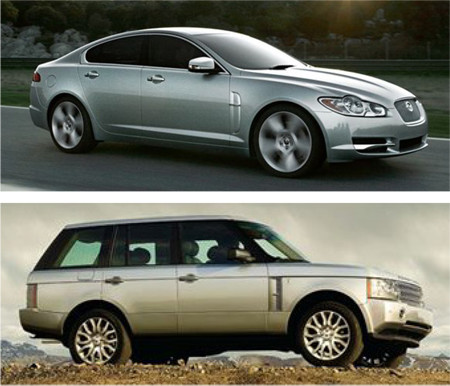
Jaguar (top) and Land Rover cars, brands acquired by Tata Motors
The land on which the project is situated was once part of about 2,200 acres owned by the Gujarat Agricultural University for running a cattle farm and experimental crop cultivation and cattle breeding center, reports The Hindu, October 8. The land was transferred to the state government and allocated to Tata Motors "at the prevailing market price,” the paper quotes Narendra Modi, chief minister of Gujarat. The Mumbai Mirror (October 8) carried a story on how, during the great Indian famine of 1900 Jamsetji Tata, the Group founder, had donated the then handsome sum of Rs 1,000 to save the cattle housed on the same land now offered to the Tatas and that a plaque at the site records his contribution and that of donors like Jehangir and Nowroji Pestonji Vakil and N. M. Wadia among others.
After months of agitation, acrimony, violence, lawlessness and politicians pulling in different directions, Ratan Tata’s drive into West Bengal had finally reached a dead end. A visibly upset Tata Group chairman made the announcement from Calcutta on October 3, 2008 that Tata Motors was pulling the Nano project (see "Value Added Tata,” Parsiana, February 7, 2008) lock, stock and barrel, out of Singur.
"If someone puts a gun to my head, I say either you remove the gun or pull the trigger. Mamata Banerjee (leader of Bengal’s opposition party, the Trinamool Congress whose disruptive policies and political brinkmanship on the farmers’ land acquisition issue had rocked Singur for almost two years) has pulled the trigger,” Tata stated. "You cannot run a plant when bombs are being thrown at the site. You cannot run a plant when workers are being intimidated. A factory can’t be run with police protection.” The spacious car plant was ready and close to the start-up phase, local youth had been trained and offered jobs, but heightened hostility and blockades had compelled the company to suspend work on site. What caused Tata particular anguish were the allegations of ‘exploitation’ and the deleterious effect on the reputation and integrity of the Tata Group as a responsible corporate citizen.
Over a month-and-a-half earlier on August 22, Tata had fired his ultimatum to the people and politicians of West Bengal (for many of whom the Nano project was a herald of change and progress in a state where industry had stagnated for three decades): "We came to West Bengal at a time when many people considered us to be mad…If anybody is under the impression that because we have made this large investment of Rs 1,500 crore, we will not move, then they are wrong… We would move whatever is the cost of protecting our people,” the chairman stated. The ultimatum galvanized into action the chief ministers of states like Andhra Pradesh, Karnataka, Maharashtra and Gujarat to lay out the red carpet for Nano in the form of land offers and incentives. It was Modi, infamous for his alleged role in Gujarat’s communal violence and famous for his investment-friendly policies, who shot past the chequered flag and brought the Nano to Gujarat.
On June 2, 2008, Tata Motors had completed the acquisition of luxury brands Jaguar and Land Rover in Great Britain from US carmaker Ford for a purchase price of USD 2.3 billion. At the handing over ceremony at the headquarters of Jaguar Land Rover at Gaydon in the UK, Ratan Tata stated: "This is a momentous time… Jaguar Land Rover are two iconic British brands with worldwide growth prospects…(they) will retain their distinctive identities and continue to pursue their respective business plans as before.” The deal, on a cash free, debt free basis, includes the ownership by Jaguar and Land Rover or perpetual royalty-free licenses of all necessary Intellectual Property Rights, as well as the manufacturing plants, two advanced design centers in the UK and worldwide network of national sales companies. "It is our intention to work closely to support the Jaguar Land Rover team in building the success and preeminence of the two brands,” the Group head stated.
◆ ◆ ◆
From the archive