
Dance
“Goodness quotient”
The dance-drama And then they came to India, sponsored by Avesthagen and choreographed by Mallika Sarabhai, interweaves Zoroastrian history and mythology
They kept coming…too many of them. Those who came well ahead of time got good seats, those who came a little ahead of time had to settle for the seats available, and those who came at the scheduled time of 6.30 p.m. had to be content with standing place. Many of the latecomers could not be accommodated inside the Nehru Centre auditorium on September 19, 2008 for it was packed to capacity with Zoroastrians who had overwhelmingly responded to Avesthagen’s invitation to attend a free dance-theater performance And then they came to India choreographed by the well-known danseuse Mallika Sarabhai, director of Darpana Academy.
Touring 15 cities through the length and breadth of India, Bombay was the 13th halt for the troupe. With the shows, sponsored by Avesthagen, serving as an anchor, the Bangalore based life sciences company sought to promote itself as an institution "bringing science to life... threading research and humanity.” It was an effective medium to familiarize the community with the company that is proposing, subject to requisite approvals, market conditions and other considerations, a public issue of its equity shares and to file a draft Red Herring Prospectus with SEBI (Securities and Exchange Board of India).
The barely 50-minute dance-drama And then they came to India was able to highlight some little known and other oft recounted historical/mythological episodes concerning the community. Sarabhai had assumed the role of a dynamic narrator. With her clear diction and flawless delivery interspersed with appropriate dramatization by the 14 members of the cast, the time flew past too soon, leaving the audience thirsting for more action, more dances from the Darpana artistes.
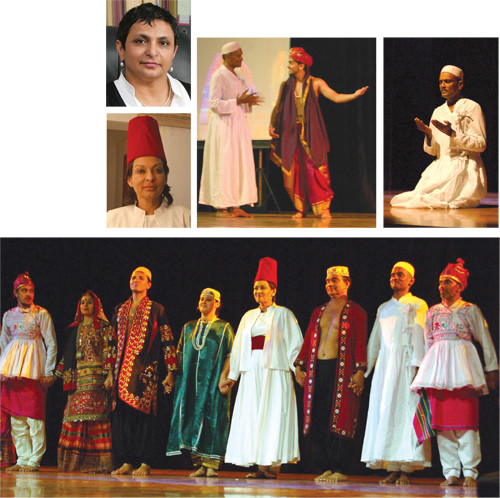
(First row) Dr Villoo Morawala-Patell (top) and Mallika Sarabhai; scenes from And then they came to India; (Alongside) lineup of cast members Photos of the dance-drama courtesy Afternoon Despatch and Courier
Darpana Academy under its director Sarabhai is today "a center for artists committed to excellence, innovation and the excitement of using the arts for change. Darpana’s vision is a contemporary symbiosis affirming the role of creativity in culture, researching into our origins and reaching out to the unsaid or unthought of with a language that is universal…” noted a leaflet distributed at the venue.
The dance-drama started by referring to the rule of the Peshdadians. It was reportedly in King Jamshid’s rule that the fondness for grapes led to the discovery of wine as an elixir and panacea for certain ills. The king introduced many positive changes for the agrarian society, including a calendar that started with the spring equinox. But when filled with pride he decreed "Why worship God? People must worship me as God!” it soon brought to an ignoble end the reign of the mighty emperor.
Narratives from the Shah Nameh were culled to depict the rule of the evil Zohak when flesh eating was introduced in a civilized world. The people had to bear with his torture until Faredun rescued them from his clutches and emerged savior.
References to the birth of Prophet Zarathushtra, the many miracles associated with his life, never fail to thrill a Zoroastrian audience. With minimal props and simple costumes, effective sound (provided by Jayan Nair, Darpana Musicians and Eero Hameenniemi) and lights (by Yadavan Chandran), the Prophet’s life sketch was portrayed until he comes to the realization that "wisdom lies in the symmetry of the physical world and harmony of the universe.”
The benevolent King Cyrus who proclaimed the Charter of Human Rights and the accursed Alexander who ruthlessly attacked the sacred texts, the Parthian rule when Zoroastrianism became the state religion and the golden period of the Sassanian rule all earned a mention from the narrator. "The doctrines of Christianity and Judaism owe much to Zoroastrianism,” conveyed Sarabhai before referring to the Arab invasion in the seventh century when the guerilla army of Islam destroyed the royal Persian army, shown through a synchronized dance of the tyrants and the vanquished.
The evening program had commenced with an introduction to Avesthagen, a company that was founded in 1998, initiated business operations in 2001 and within a decade has grown into one of India’s leading systems biology companies with four main strategic business units: science and innovation, biopharmaceuticals, bionutrition and bioagriculture. The company aims to bring about a "convergence of food, pharma and population genetics leading to predictive, preventive, personalized healthcare.” As a research based life sciences company dedicated to solving the people-health-food imbalance problem in society, Avesthagen provides innovative solutions for global challenges in agriculture and health.

Avesthagen promoted nutritional products
The founder of Avesthagen, Dr Villoo Morawala-Patell, was hailed as "a new star…changing the character of research and development.” Two screens on the stage flashed an image of the successful lady impressing on the audience how "Avesthagen harbors new minds (that) think ‘let’s do something else this year’” instead of dwelling on a project which may not have succeeded in the preceding year. With strategic alliances it will be Avesthagen’s mission to bring "safe medicine faster to the world.”
To familiarize the audience with the Avestagenome Project [see "Gen(e) next,” Parsiana, March 7, 2008], a genetic study of the largely inbred Parsi community started last year to determine the genetic basis of longevity and its related disorders, Perviz Bhot told the gathering, "By allowing themselves to be studied scientifically, the community could provide a healing touch to humankind.” A comprehensive effort is underway to compile the medical database of the Parsi community (blood samples from Zoroastrians have already been collected in Hyderabad-Secunderabad, Poona, Navsari, Surat) and also record its sociological history. A study of the community’s health, lifestyle, professional preferences and migration patterns "will provide invaluable linkages for all mankind and not the Parsi community alone,” explained Bhot to counter the reservations of certain sections of the community.
At the end of the show, each member of the audience was presented a bag of complimentary Good Earth goodies that included muesli breakfast cereal and whole wheat crackers with Teestar (a special plant based ingredient which reportedly has excellent blood sugar modulating properties) as also literature on Avesthagen and its associated companies. In the promotional handouts Avesta Good Earth Foods is described as "the health and wellness consumer goods initiative of Avesthagen that manufactures a range of cereals, crackers and muesli bars.” Their "goodness quotient” products meant to boost energy levels and provide enhanced nutrition so that "good health and good taste can come together” are marketed under the Good Earth brand name.
In the course of her speech Bhot had summed up, "To understand people we have to go back to the roots.” It was thus apt that the picturesque depiction of three boatloads leaving the shores of Persia, the landing on the shores of India in the 10th century, the lighting of the fire to remind them of their king (Iranshah), and of course the story of Jadav Rana and the bowl of milk which Parsis delight in hearing repeatedly, rekindled the Zoroastrian fervor. The moral of the story was marginally altered: Just as our predecessors promised to sweeten the life of every Indian, Avesthagen will continue to fulfil its science related mission in this country. As noted their handout, "We believe in drawing science out of the confines of the laboratory and setting it free in the real world. Innovating progress through a knowledge-driven, systems biology approach.”
◆ ◆ ◆
From the archive