
Books
The status of sources
Zarathushtra and the Religion of Ancient Iran The Greek and Latin Sources in Translation edited by Phiroze Vasunia. Published in 2007 by The K. R. Cama Oriental Institute, 136, Bombay Samachar Marg, Bombay 400023. Pp: 367 + 76. Price: Rs 800.
"It sometimes seems as if no two scholars of Zoroastrianism can agree on general propositions about their subject, much less about so vexed a problem as Greek and Latin sources,” writes Dr Phiroze Vasunia in the Introduction to his book Zarathushtra and the Religion of Ancient Iran The Greek and Latin Sources in Translation. Noting that Greek and Latin texts are "special in the sense that they form the largest corpus of non-Iranian textual sources to survive from antiquity on the subject of Zoroastrianism,” Vasunia believes that one needs to acknowledge both the mass and the diversity of these materials.
"The Christian sources remind us that many of the Greek and Latin representations of Zoroastrianism occur in texts composed by authors who were often unsympathetic to Persia, whether because they were from regions at war with Persia, or opposed to Persian rule, or subjects of Persian power. The Achaemenids and the Sasanians, among others, were regularly described in critical or hostile terms by Greek and Latin writers. For the Achaemenid era in particular, which has left behind relatively few indigenous texts, this situation means that much of the political history of Persia is dependent on sources who were in conflict with the empire,” writes Vasunia.
It was as a junior research fellow of The K. R. Cama Oriental Institute (KRCOI) in Bombay that Vasunia compiled and edited this book. He is presently reader in the department of classics at the University of Reading and lives in London. The book was published by the KRCOI last year through a munificent donation from the trustees of the Erach and Roshan Sadri Foundation and was released by Tony Mango, honorary consul general of Greece in Bombay at a function at the KRCOI on December 20, 2007 during Vasunia’s visit to the city.
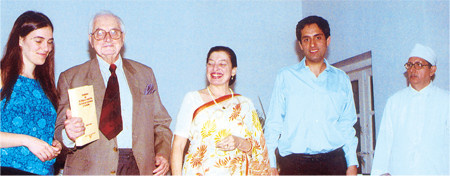
At the launch (from left): Miriam Leonard, Tony Mango, Homai Modi, Phiroze Vasunia and Rooyintan Peer
"This is a very useful and important step in the study of Zoroastrianism. If one discounts the unreliable claims of the Denkard, the book of Arda Viraf, given that many of the Denkard ’s statements have been established as untrue, these texts for centuries were the only written records of the religion preached by Zoroaster,” stated Mango, who has translated from French to English Volume III of The Parsis by Delphine Menant which was published in 1996 by his wife Jeroo Mango. "I had read Herodotus’ Histories before coming to India 69 years ago and found that everything he wrote about the Achaemenid Persians was a fitting description of the way the Parsis behaved after over nine centuries of living in India. The sanctity of birthdays, the ease with which they adopt foreign customs, their devotion to truth and charity were all there. However they differed most in the profusion of statues they erected of their leaders and the beauty of the many temples they erected to their faith,” said Mango.
A reprint of Dr Farhang Mehr’s book Zoroastrian Tradition — An Introduction to the Ancient Wisdom of Zarathushtra was also released on the occasion, thanks to a grant from the Zartoshty Brothers (Faridoon and Mehraban) Fund. Mehr’s book is meant for free circulation to libraries and organizations in India only.
Vasunia has dedicated his book to his mother Dinoo and to the memory of his late father Hosi, a well-known stage personality. "I wish Phiroze’s father had been present (at the launch) today,” Homai Modi, trustee and joint honorary secretary of the KRCOI, stated. "This work of reference comprises within its covers a great deal of valuable material... The thoroughness and meticulousness of the investigation lays before the interested reader names and marks of the classical writers who have so far been cited sketchily or just ignored,” writes Institute president Muncherji Cama in his Preface.
Educated in India and the US, Vasunia had earlier authored The Gift of the Nile: Hellenizing Egypt from Aeschylus to Alexander and is currently completing a monograph on Greece, Rome and the British Empire and is the co-editor of two forthcoming volumes — the Oxford Handbook of Hellenic Studies and Classics and National Cultures. Among other projects is a commentary on Book Two of Herodotus’ History.
The time frame for the Greek and Latin sources covered in Vasunia’s book ranges from the fifth century BCE to the Byzantine era, give or take a little on either side. The book also contains translations/additions/revisions that have not appeared in earlier collections, such as the Fontes historiae religionis Persicae by Carl Clemen (1920); Les mages hellenises. Zoroastre, Ostanes et Hystaspe d’apres la tradition grecque by Joseph Bidez and Frank Cumont (1938) and Passages in Greek and Latin Literature relating to Zoroaster and Zoroastrianism by W. Sherwood Fox and R. E. K. Pemberton (a long study published as a number of the Journal by the KRCOI way back in 1929). By and large, Vasunia makes available in translation excerpted passages from all the Greek and Latin texts that have been a part of the studies of Zoroastrianism for the last century, used by scholars such as Anquetil du Perron, Mary Boyce, Albert de Jong, R. C. Zaehner, S. Shaked, A. S. Shahbazi...
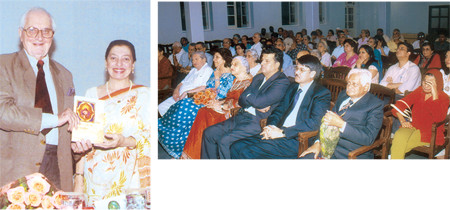
Releasing Farhang Mehr’s book (left): Tony Mango and Homai Modi; the audience
Vasunia notes that earlier collections typically printed only texts that referred explicitly to Zoroaster or to the Magi but he has cast the net wider by including many that make no direct mention of these figures. Several of the texts in the book come not just from literary sources or texts with good manuscript traditions but also from inscriptions on stone or on papyrus. The inclusion of pictures/illustrations would have lent further luster to the book and Vasunia regrets he was unable to "incorporate visual evidence.”
With a vast amount of research poured into the compilation of the book, the Bibliography alone covers 21 pages! An Index of Sources takes a further 23 pages. Figuring prominently are quotations from legendary figures like Plato, Pliny the Elder, Plutarch, Strabo, Xenophon, Herodotus, Aristotle, Cicero, Laertius Diogenes, Rufus Curtius, Diodorus... covering a gamut of topics like magic and astronomy, doctrine and belief, ritual, behavior and custom, disposal of the dead, divinity, fire, etc.
"In a book such as this, particular care needs to be applied in the interpretation of sources, since they often appear as deracinated, disembedded and decontextualized fragments... we are dealing... with how an ancient religion is represented by other people with their own particular cultural, geographical and temporal locations. Obviously interpretation has to proceed with care in this scenario,” Vasunia cautions. Likely to kick up dust are the passages regarding incest, the alleged cruelty of monarchs, etc. Because of the shared histories of Greeks, Romans and Persians, issues are complicated by the fact that Persian kings ruled over several Greek communities in the region of Asia Minor, including the home cities of Ionian intellectuals such as Herodotus. "The Persians of all the barbarians became the most famous among the Greeks, because none of the other barbarians who ruled Asia ruled Greeks,” wrote Strabo, who was born around 64 BCE, educated in Rome and was known chiefly as the author of Geography, a Greek work. The Romans fought a series of wars with the Persians in the Sasanian period and by no means was there a stable or peaceful relationship between Roman and Persian rulers, Vasunia analyses.
Herodotus’ description of Persian customs is one of the earliest accounts of Achaemenid practices, which scholars interpret to be Zoroastrian. "They (the Persians) instruct their sons between the ages of five and 20 in three subjects only, horsemanship, archery and truth-telling. Before he is five years old, the son is not shown to his father, but lives with the women. This is done so that in case the son should die while he is being reared, he avoids causing distress to his father... They are accustomed to think of telling lies as the most disgraceful thing and of owing money as the next, for many reasons but especially, they say, for the reason that a man who is in debt will inevitably tell lies as well...” described Herodotus (born around 485 BCE) in his History.
Vasunia also brings in the cross-cultural interaction and receptivity: "Such things as Greek luxury toreutic, textiles, clothing, jewelry, seals and even court ceremonial and court settings show recognizable marks of Iranian influence. On the other hand, Greek and Ionian culture left an impact on Persian sculpture and statuary at the same time that Greeks themselves also fought for the Persian king.”
Reading out passages from Vasunia’s book was his wife Dr Miriam Leonard who is a lecturer in the department of Greek and Latin at University College, London. With several publications to her credit, she is currently working on a project on Greeks, Jews and the Enlightenment and editing a collection of essays.
In his vote of thanks, Ervad (Dr) Rooyintan Peer commended Vasunia for the "tremendous labor” that had gone into the book which had taken a long time for publication due to the "considerable nature of work involved.”
"I do not propose to enter here into a discussion of the disputes and disagreements that have marked the study of the Persian religion... the analysis of sources occurs in a context of controversy, some of which is fuelled, in turn, precisely by the status of sources... On questions of religion, as with questions of politics, nothing can be taken at face value,” Vasunia notes.
◆ ◆ ◆
From the archive