
Zoroastrians Abroad
“Why are women not being nominated?"
Despite the wealth of talents and achievements, not enough people are being nominated for WZCC awards, feels Phil Madon
"When I came to Australia with two kids, a heavily pregnant wife and three suitcases, I found I had got 99.9 percent of my assets — my family — out of Iran,” Phil Madon relates his walk on the razor’s edge in 1980 as the family fled Iran’s mullah rule after 18 happy, successful years in the land that he prizes beyond any, including his native India. Having worked once more to re-build what had been left behind, Madon feels his 28 years in Sydney have been propitious.
Madon was visiting India again after 10 years. He had come earlier after a spell of 18 years. This time around he was here to participate in the World Zarathushti Chamber of Commerce (WZCC) AGM in Poona on January 13, 2008 and the gala evening of the WZCC awards presentations that preceded the AGM. Since the past two years he has been officiating as WZCC chapter chair, Australia, as well as the chair of its international awards committee. Sydney itself has 24 members, he notes.
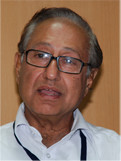
Phil Madon: "Life is an adventure”
Among the problems he faces in the latter position is that "our icons do not want praise. They are silent achievers. Nor is there a strong motivation in the community to give accolades… Entrepreneurship is an area of the youth. There are many boys I’d like to see recognized,” he told Parsiana in the course of an interview on January 18, 2008. This time, he noted, there were 19 nominations including the rollover from the previous year. At one stage he felt the nominations were insufficient. "Why are women not being nominated?” he asks. A source of unhappiness is that the nominations are not put up properly and sometimes need to be rejected. "When a nomination is not put up correctly, it is an insult to the organization,” he feels.
The international judges on the panel work anonymously and unknown to each other. They assess the achievements of the candidate in his home country as well as in the global context, weigh his academic qualifications, the awards he has garnered, the expanse of his career in the field, says Madon.
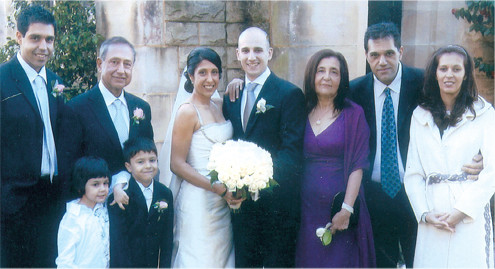
On Feryal’s wedding to David Trofa (L to R): Danesh, Phil, Casey and Jamie, the couple, Firouzeh, Fred and Janet
Entrepreneurship has been the Madon family’s forte over a lifetime. In Australia he says he worked six days a week and had built himself up to own two McDonald outlets in Sydney. He has now sold one and given one to his elder son Fred. "But we’ll acquire more outlets,” he notes confidently. He already owns real estate in Australia. He and his son also own the Southern Cross Sporting Group which makes sporting gear like cricket bats and Fred is the agent for MRF tyres in Australasia. A coup of sorts was getting Australian captain Steve Waugh to sign up with MRF. Waugh has been involved with Mother Teresa and India’s leprosy colonies, Madon tells us, adding that it was Fred who organized the event and was involved in the "historic moment” which cost them A$ 85,000. "I gave the money,” he notes casually.
Madon’s younger son Danesh looks after Eaternal Health and Organic Foods, a closely held limited company which imports organic foods from India to Australia. They deal in grain, specifically rice, spices, herbs grown without chemical fertilizer from all over India, especially Uttaranchal. Danesh’s latest baby he says is soapnuts (areetha) — both forest grown and horticulturally. Forest grown products are not considered organic, he tells us. A natural product is only considered organic if it is grown under supervision and has a certification to that effect, we learn. Madon tells us that Danesh, who has relocated to Bombay to look after the Indian end of the business while Phil maintains the Sydney base, buys and grinds the soapnuts and packs them in sachets to throw into washing machines. They have a significant order from Australia and Canada, says Phil.
Phil credits his wife Firouzeh as "instrumental in whatever I’ve achieved…Even in Australia she did accounting and book-keeping.” The daughter of Rustom Aspandiar Irani of Kasnavia, Iran and Motibai, an India-born Irani who spoke fluent Dari, Firouzeh was working as secretary to Madon’s paternal uncle Firoze Sorab Madon and his partners the Kamanis of India when Phil landed in Iran. Firoze had gone to Iran as a train driver in the 1940s and by the early 1950s had made enough money to buy one of the Shah’s palaces during the uneasy time when Dr Mohammad Mossadegh was the prime minister (1951-53) trying to nationalize Iran’s oil reserves and the Shah had briefly sought asylum outside Iran. Firoze had held the agency for prime US pharmaceutical companies like Parke Davis and Elilly. "Of course, it all ended when the Shah left,” says Phil noting that Firoze relocated in London and eventually was buried there.
The son of Homi Sorab Madon, owner of the Gujarati publications Mumbai Vartman and Rast Rahbar ("Dad was a journalist and always a fighter. He was anti-dakhma in those days!”) and Dolly (née Balaporia) of Poona, Phil was the export manager for J. N. Marshall (JNM) and Company, working under Darius Forbes, when they sent him to start an agency for them in Iran. He did so, then left JNM to found his own business which eventually included a film company and a construction company, he tells us. "I love Iran very much…I respect India but Iran is far too special in my heart,” he notes even though his 18 years there ended in a traumatic separation.
The film company which produced 16 mm versions of well-known films, had American and Israeli directors. "The royal palace would take all our films free. They had details about us in their offices, our names were on the record.” When the Islamic revolutionaries got hold of this information, Phil was a marked man. He was called to answer questions such as why did he work with Americans, was taunted and made fun of. He spent a few days in the corridors of the court which was housed in a former school building. "Convicted people were shot on the terrace…My wife was pregnant. I was nervous because of the family.” Fortunately the mullahs hadn’t taken away his passport, so they decided to leave quietly. "The day we were to fly, Iraq bombed the airport and all baggage was destroyed.” (The Iran-Iraq war had begun.) Phil says he continued attending court as he was supposed to do, carrying a little food from home, seeking permission to go to the toilet.
Then one evening they decided to take a bus to Turkey with seven-year-old Fred, three-year-old Feryal and a heavily pregnant Firouzeh. They expected to go to Ankara. There were a few hundred buses waiting to go when the Kurds attacked the Islamic guards and Turkey imposed a curfew and closed the border. They also found that no child over seven years could leave without an exit pass for which payment was required — in the bank. When the Turkish border opened for two hours, Phil says he sent off Feryal and Firouzeh in the bus with a Parsi couple they knew, promising to catch up with them at a town 700 km from the border. While father and son waited uncertainly — a police inspector suggested they sleep in a nearby mosque — a Zoroastrian on a passing bus whom Phil remembers as Rabani "called out and took Fred and me on.”
Reunited with wife and daughter in Tabriz they rented a mini bus to go on to Ankara and thence to Istanbul over the tortuous mountain terrain. For a fortnight they searched Istanbul in vain for a flight to Bombay, eventually being forced to go to Zurich to be able to do so. After eight days in Bombay they had set off to build their nest in Australia.
Fred, now 35, is married to Janet, a Portuguese girl who used to work for Phil as store manager. They have two sons, Jamie, six, and Casey, four, who go to the International Grammar School. Phil is teaching them to pray by playing a prayer cassette in the car whenever he drives them around. Apart from his business activities, Fred works for Computershare, a firm Phil describes as the largest share registry in the world. Janet is now doing her MBA.
Feryal, 30, has a degree in communications. She recently married David Trofa, an Italian by birth. Danesh, 27, has a degree in computer science from Australia and is not married so far.
Bombay born Phil is fond of pets. He is nostalgic about a sulphur crested cockatoo who used to call him "dad!” Devoted to Phil, the bird would wake up the neighborhood with his chatter whenever he caught sight of the man and Phil says he had to make his arrivals and departures as inconspicuous as possible to avoid being detected as the bird sat on the verandah and kept constant vigil.
On the Madons’ first return to India after 18 years, the family went on a holiday to Kodaikanal. His mother Dolly suddenly died there and they had to drive her to Madras where Phil’s brother Hosi, a lawyer by profession, joined them. She lies buried in the Madras aramgah. "A large Parsi crowd came for the funeral though they never knew us,” says Phil. "Life itself is an adventure. Different things happen to us…” he smiles.
◆ ◆ ◆
From the archive