
Business
Communication between chapters - II
On the second day of the World Zarathushti Chamber of Commerce global meet entrepreneurs spoke of the pros and cons of doing business in India
"To reach higher, faster, further” the one who succeeds is "no longer the one who works harder but the one who is changeable, works smarter,” stated Dr Mehran Sepehri when delivering his address on "Competing with Innovative Business Models” on January 8, 2012, the day following the annual general meeting of the global World Zarathushti Chamber of Commerce (WZCC) at Bombay’s West End Hotel. Professor of management at the Sharif University of Technology in Iran and vice president of the Tehran Zarathushti Anjuman, Sepehri was co-founder of the Persian Zoroastrian Organization in USA.
"In a rapidly changing business environment, there is a shift of emphasis from a decadent industrial economy to a knowledge based entrepreneurial economy,” observed Sepehri. According to him, the businessmen who succeeded in the decade starting 1970 were those who could reduce costs, in 1980, those who stressed on quality, in 1990, those who were customer oriented, in 2000, those who showed speed, and in 2010, those with innovative business management practices.
He cited the case of Michael Dell, a college dropout, who in 1980 was able to compete with IBM when operating from a garage, taking online orders, assembling computers and delivering them the next day. By changing the supply chain, avoiding middle men, using direct selling methods he became the number one computer maker. The key message that Sepehri sought to impart was "visionaries don’t play harder or faster. They change the game.”
For those aspiring to be entrepreneurs he recommended: have a dream, inspire your team, focus on the customer, be different, question everything, synergize, establish the process, take risk, lead change.
"In a rapidly changing business environment, there is a shift of emphasis from a decadent industrial economy to a knowledge based entrepreneurial economy,” observed Sepehri. According to him, the businessmen who succeeded in the decade starting 1970 were those who could reduce costs, in 1980, those who stressed on quality, in 1990, those who were customer oriented, in 2000, those who showed speed, and in 2010, those with innovative business management practices.
He cited the case of Michael Dell, a college dropout, who in 1980 was able to compete with IBM when operating from a garage, taking online orders, assembling computers and delivering them the next day. By changing the supply chain, avoiding middle men, using direct selling methods he became the number one computer maker. The key message that Sepehri sought to impart was "visionaries don’t play harder or faster. They change the game.”
For those aspiring to be entrepreneurs he recommended: have a dream, inspire your team, focus on the customer, be different, question everything, synergize, establish the process, take risk, lead change.
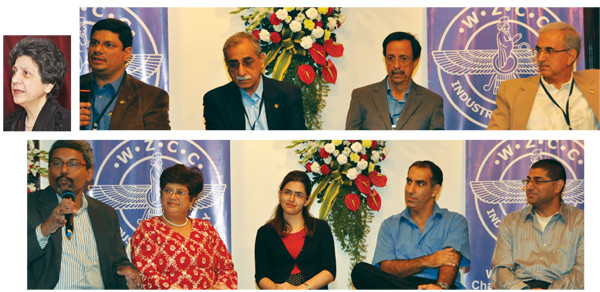
From left (first row): panel chaired by Zareen Karani Araoz with Xerxes Dastur, Rohinton Rivetna, Cyrus Bagwadia and Kersi Limathwalla; (second row) Raj Bhat, Piloo Aga, Lara Balsara, Khurshed Daruvala, Umeed Kothavala
Seeking trade partners
Representing a consortium of companies in Germany that are "ready to invest 50-200 million euros per project,” announced Darius Sethna, an engineer who has been residing in Europe for the last 50 years. "My aim in India is to identify Indian target companies.” These German companies with production facilities are seeking to "extend footprints into India. They would like equity participation,” he added listing the sectors in which these industries are involved: automobile and ancillary, life sciences, chemical technology, renewable energy, construction, engineering.
When WZCC founder director Alayar Dabestani enquired whether they were stock market or venture capital firms, Sethna responded that whilst some are private limited, others are public limited but they "don’t have much market knowledge” of India. Seeking to collaborate and invest capital on long-term projects, "we don’t want to get out once we are in,” he clarified.
"The highways and byways of trade in Iran are not easy,” pointed out Dr Baharam Partovi, WZCC vice president, Iran region. "Many nations have decided to bring Iran to its knees by imposing sanctions,” he added referring to Iran as "a major player in the Middle East.” Convinced that "India needs Iran as a trade partner,” he urged the Parsi and Irani members of WZCC to "tell us your areas of interest and we will try and match from Iran. Trust us to be trustworthy.”
Representing a consortium of companies in Germany that are "ready to invest 50-200 million euros per project,” announced Darius Sethna, an engineer who has been residing in Europe for the last 50 years. "My aim in India is to identify Indian target companies.” These German companies with production facilities are seeking to "extend footprints into India. They would like equity participation,” he added listing the sectors in which these industries are involved: automobile and ancillary, life sciences, chemical technology, renewable energy, construction, engineering.
When WZCC founder director Alayar Dabestani enquired whether they were stock market or venture capital firms, Sethna responded that whilst some are private limited, others are public limited but they "don’t have much market knowledge” of India. Seeking to collaborate and invest capital on long-term projects, "we don’t want to get out once we are in,” he clarified.
"The highways and byways of trade in Iran are not easy,” pointed out Dr Baharam Partovi, WZCC vice president, Iran region. "Many nations have decided to bring Iran to its knees by imposing sanctions,” he added referring to Iran as "a major player in the Middle East.” Convinced that "India needs Iran as a trade partner,” he urged the Parsi and Irani members of WZCC to "tell us your areas of interest and we will try and match from Iran. Trust us to be trustworthy.”
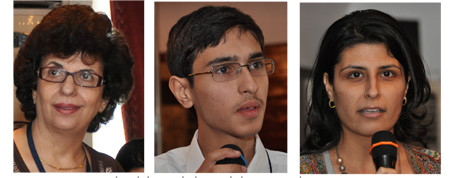
(From left) Zarine Commissariat, Jamsheed Master, Delzeen Watcha
Bedrock of business
"Building business in emerging India” was the subject of the panel discussion that evoked participation from Piloo Aga of Gold Seal, Lara Balsara of Madison, Khurshed Daruvala of Sterling and Wilson, and Umeed Kothavala of Extentia. The anchor for the session was Raj Bhat, chief mentor at the National Entrepreneurship Network who invited the panellists to share stories of how their business was started, what was the secret to their third vision, how they were able to spot trends and make quantum leaps and thrive when the business climate was not conducive, how much they expected to grow in the next five years, challenges that may deter their growth, the kind of workforce they are seeking, advice for upcoming entrepreneurs.
Gold Seal was started in a garage in 1958 by Piloo’s late father-in-law Hoshang Aga who first manufactured rubber seals only for Fiat and Ambassador cars and "now we will be on every single four-wheeler,” said Aga. With honesty and integrity, and a passion to give customers "more than what he wants,” Gold Seal has been able to succeed. When the automotive industry is growing at seven to eight percent, Gold Seal’s targeted growth rate is 15-20 percent. Employing people in the 25-35 age group is more comfortable because their talent can be honed. Entrepreneurs should be willing to work hard and put in 20-hour days to follow their dream because the first few years are extremely important. "If you work hard and smart, success has to follow. India and the world are big enough if you are willing to leave your comfort zone,” she noted.
When Madison was started around 23 years ago by Lara’s father Sam Balsara, he initially "focussed on only a few clients” and after spotting opportunities grew to encompass "23 specialized units across 10 functions.” By making the brand meaningful to the customer, and taking risks with guts, they were able to rise to a higher level. With a three-pronged approach of "ideation, automation and digitization” they expect to better reach out to their clients. Whilst margins are coming down each year, the resource cost is going up. Further, attracting and retaining talent is a problem when competitors are willing to pay double and triple the salary. The third challenge is media fragmentation (print, television, web, outdoor advertising) whereby the cost of reaching out to a customer becomes exponentially higher. Those who join Madison are "young, overambitious, impatient, seeking fancy designations…” Once they are trained in media planning, they leave Madison to join competitors who are willing to pay double the salary. "Honesty and humility, consistency and transparency” should help any entrepreneur to succeed once he has made the right choice of a product or service, Balsara was sanguine.
"Building business in emerging India” was the subject of the panel discussion that evoked participation from Piloo Aga of Gold Seal, Lara Balsara of Madison, Khurshed Daruvala of Sterling and Wilson, and Umeed Kothavala of Extentia. The anchor for the session was Raj Bhat, chief mentor at the National Entrepreneurship Network who invited the panellists to share stories of how their business was started, what was the secret to their third vision, how they were able to spot trends and make quantum leaps and thrive when the business climate was not conducive, how much they expected to grow in the next five years, challenges that may deter their growth, the kind of workforce they are seeking, advice for upcoming entrepreneurs.
Gold Seal was started in a garage in 1958 by Piloo’s late father-in-law Hoshang Aga who first manufactured rubber seals only for Fiat and Ambassador cars and "now we will be on every single four-wheeler,” said Aga. With honesty and integrity, and a passion to give customers "more than what he wants,” Gold Seal has been able to succeed. When the automotive industry is growing at seven to eight percent, Gold Seal’s targeted growth rate is 15-20 percent. Employing people in the 25-35 age group is more comfortable because their talent can be honed. Entrepreneurs should be willing to work hard and put in 20-hour days to follow their dream because the first few years are extremely important. "If you work hard and smart, success has to follow. India and the world are big enough if you are willing to leave your comfort zone,” she noted.
When Madison was started around 23 years ago by Lara’s father Sam Balsara, he initially "focussed on only a few clients” and after spotting opportunities grew to encompass "23 specialized units across 10 functions.” By making the brand meaningful to the customer, and taking risks with guts, they were able to rise to a higher level. With a three-pronged approach of "ideation, automation and digitization” they expect to better reach out to their clients. Whilst margins are coming down each year, the resource cost is going up. Further, attracting and retaining talent is a problem when competitors are willing to pay double and triple the salary. The third challenge is media fragmentation (print, television, web, outdoor advertising) whereby the cost of reaching out to a customer becomes exponentially higher. Those who join Madison are "young, overambitious, impatient, seeking fancy designations…” Once they are trained in media planning, they leave Madison to join competitors who are willing to pay double the salary. "Honesty and humility, consistency and transparency” should help any entrepreneur to succeed once he has made the right choice of a product or service, Balsara was sanguine.
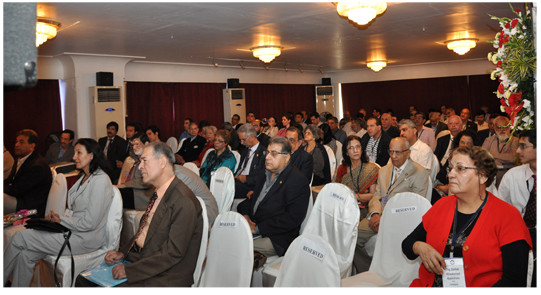
Delegates attending the WZCC global meet
Sterling and Wilson was started by Khurshed’s grandfather Meherwan Daruvala with the support of Shapoorji Pallonji. Until 1997 it remained a very small company in India, "no risk taking, not ambitious.” By extending its customer base nationally and expanding its services from electricals to air conditioning, plumbing, firefighting and setting up of gas based power plants, it has now made its presence felt in Saudi Arabia, Qatar and Africa. When opportunities came their way they ensured they picked them up if they were related to their customers or their business, realizing that if they did not, someone else would.
Having grown from a seven crore to a 2,000 crore rupee business, Sterling and Wilson would like to sustain that growth for some years. They expect the business to grow internationally, more than in India. In the electrical servicing sector they are the largest; in air conditioning they are the third largest after Blue Star and Voltas. They are fortunate that they have loyal staff, many of whom have been there since he was in school. "We trust our business heads blindly, encourage them to procure their own teams. Many of the employees do not know who the owner is and assume the branch manager is the owner,” says Daruvala.
About 12 years ago Extentia was started as a software technology business in India. With its focus on technology and international customers and "greater sensitivity to what is happening in India” it has also involved itself with Green Tokri that seeks to bring exotic vegetables to the Indian market. "We don’t predict the future but create it. Being willing to make a wrong investment” shows a willingness to go one step further. They have invested in New Zealand and Australia because those are extremely vast markets. "Attrition is a problem. Getting good people is a big problem. Getting good people to stay long term is a bigger challenge,” declares Kothavala. An entrepreneur should be willing to work out a path with patience and perseverance so that he can rise up and run if he were to fall, he believes. "After 12 years, I am still putting in eight days of work and 25-hour days!”
When panellists’ views were sought on emerging businesses in the next five years, it was mentioned that the government is offering subsidies to solar power plants, buying solar power at Rs 17 a unit as versus coal generated power at four rupees a unit. Besides biotech and pharmaceutical industries, logistics and education also have a huge market. Factory maintenance whereby smooth running of machines is ensured for 24 hours is another potential business opportunity.
Other queries concerned viability for international companies seeking to invest in India or expatriates seeking to return to their homeland. Foreign direct investment is allowed for most industries; individual and foreign taxes are fair, assured a panellist. Many Indians who went to the Middle East for job opportunities now want to return because the market there is not growing. On their return they find that their peers have made more strides technologically.
Widen WZCC
Taking forward the previous day’s panel discussion on "WZCC — going forward,” Zareen Karani Araoz, director, global and external relations, on the international WZCC board enquired, "What specifically can we do to serve the youth?” Shavak Bhamgara from the audience responded, "Eighty percent of the members here are over 40 years old so discussions should not be only for the youth. Everyone is not here for social service.”
As facilitators WZCC can create awareness, opined immediate past president of WZCC Kersi Limathwalla. He referred to the offer from the Godrej Group to make available desk space as also their infrastructure facilities to an upcoming entrepreneur at their Vikhroli premises. Since those approached felt that operating from Vikhroli would be inconvenient, Limathwalla added, "We don’t need to change but tweak this offer to make it more convenient.” He wondered whether WZCC Mumbai chapter premises could be offered to an entrepreneur who does not have his/her own office.
WZCC founder Rohinton Rivetna suggested that as soon as the youth complete their education they should be "encouraged to become WZCC members on payment of half the membership fees and paired with one senior member who could serve as mentor.” He referred to reenergizing the efforts of Eric Engineer, youth director on the WZCC international board by "adding more value.” "Can we have a youth director for every chapter?” enquired Jamsheed Master, a member of the Mumbai chapter’s organizing committee.
Just as the Bombay Parsi Punchayet conducts the Holiday Programme for Youth for students who have appeared for their school leaving examination, WZCC should conduct a program once students have appeared for their graduation examination, recommended Adil Irani of Bombay.
"We subcontract a huge amount of business — cabling, mechanical — to the tune of 40-50 crore rupees but there is no Parsi coming forward,” mentioned Daruvala. "Ask for good business plans and we will fund them. Maybe we can get hundreds of entrepreneurs interested in such plans.”
Success stories of first generation entrepreneurs should be publicized to give confidence to those who want to venture on their own, recommended Cyrus Driver of Calorie Care. He also felt that a list of volunteer mentors should be made available on the WZCC website as also a list of scholarships that Zoroastrian students can avail of. WZCC activities should get coverage week after week in Parsi publications to generate and sustain interest, recommended Farokh Irani of Poona’s Donut Magic. Whilst Parsi Times has offered them a free column every week, on behalf of Mickey Mehta’s eight fitness centers in Bombay, CEO Delzeen Watcha offered to put up posters to publicize WZCC activities amongst their Parsi clients. Urging all WZCC members to "go through our newsletters,” WZCC Mumbai chapter chair Pheroze Kharas stated that "in the last three years we have got three feedback. We don’t know whether it is having the right effect.” Dolly Dham-odiwala, managing committee member of the Mumbai chapter, sought an "inter-chapter vehicle to interact internationally.”
The Zoroastrian Youth Organization in Iran has been active for the last 30-40 years and they promote business among themselves, reported Khodayar Attaie of Iran. They also have a youth director on board.
In Dubai, most youth are either at school or holding job appointments. Since switching of jobs is not permitted due to sponsorship problems, only occasionally is Rumi Sarkari who is chair of the Middle East chapter approached by people seeking employment.
Referring to the successful mentorship program in Houston, WZCC vice president Rustom Engineer observed, "The youth have fire in their belly and go for it.” Added WZCC corporate secretary Behroze Daruwalla, "Here in India they have so much more. You have the platform and everything is ready. The youth have to go for it.” It is necessary to "focus on paying members” instead of trying to get new ones into the fold, believed active WZCC youth member Freyaz Shroff.
To see more first generation entrepreneurs in the community, "parental counselling is necessary,” declared Farrokh Rustomji, director on the WZCC global board. It is very common to see a father telling his son that his hard earned money is not to be frittered away on mindless plans that he wants to pursue. "WZCC is not only for prospective entrepreneurs but also professionals, job seekers and employees,” reminded Murad Currawalla, member of the Mumbai chapter organizing committee.
"We have spent the last 20 minutes talking about funding, publicizing, mentoring. But who do we give it to?…Younger people need to take advantage. Is there a perception that WZCC is only for the older members? An organization needs to be balanced between different ages and capabilities,” stressed WZCC India chamber president Cyrus Bagwadia. Limathwalla referred to one WZCC meeting when he was told that 10 youth attended but not a single one came for the meet thereafter.
Taking forward the previous day’s panel discussion on "WZCC — going forward,” Zareen Karani Araoz, director, global and external relations, on the international WZCC board enquired, "What specifically can we do to serve the youth?” Shavak Bhamgara from the audience responded, "Eighty percent of the members here are over 40 years old so discussions should not be only for the youth. Everyone is not here for social service.”
As facilitators WZCC can create awareness, opined immediate past president of WZCC Kersi Limathwalla. He referred to the offer from the Godrej Group to make available desk space as also their infrastructure facilities to an upcoming entrepreneur at their Vikhroli premises. Since those approached felt that operating from Vikhroli would be inconvenient, Limathwalla added, "We don’t need to change but tweak this offer to make it more convenient.” He wondered whether WZCC Mumbai chapter premises could be offered to an entrepreneur who does not have his/her own office.
WZCC founder Rohinton Rivetna suggested that as soon as the youth complete their education they should be "encouraged to become WZCC members on payment of half the membership fees and paired with one senior member who could serve as mentor.” He referred to reenergizing the efforts of Eric Engineer, youth director on the WZCC international board by "adding more value.” "Can we have a youth director for every chapter?” enquired Jamsheed Master, a member of the Mumbai chapter’s organizing committee.
Just as the Bombay Parsi Punchayet conducts the Holiday Programme for Youth for students who have appeared for their school leaving examination, WZCC should conduct a program once students have appeared for their graduation examination, recommended Adil Irani of Bombay.
"We subcontract a huge amount of business — cabling, mechanical — to the tune of 40-50 crore rupees but there is no Parsi coming forward,” mentioned Daruvala. "Ask for good business plans and we will fund them. Maybe we can get hundreds of entrepreneurs interested in such plans.”
Success stories of first generation entrepreneurs should be publicized to give confidence to those who want to venture on their own, recommended Cyrus Driver of Calorie Care. He also felt that a list of volunteer mentors should be made available on the WZCC website as also a list of scholarships that Zoroastrian students can avail of. WZCC activities should get coverage week after week in Parsi publications to generate and sustain interest, recommended Farokh Irani of Poona’s Donut Magic. Whilst Parsi Times has offered them a free column every week, on behalf of Mickey Mehta’s eight fitness centers in Bombay, CEO Delzeen Watcha offered to put up posters to publicize WZCC activities amongst their Parsi clients. Urging all WZCC members to "go through our newsletters,” WZCC Mumbai chapter chair Pheroze Kharas stated that "in the last three years we have got three feedback. We don’t know whether it is having the right effect.” Dolly Dham-odiwala, managing committee member of the Mumbai chapter, sought an "inter-chapter vehicle to interact internationally.”
The Zoroastrian Youth Organization in Iran has been active for the last 30-40 years and they promote business among themselves, reported Khodayar Attaie of Iran. They also have a youth director on board.
In Dubai, most youth are either at school or holding job appointments. Since switching of jobs is not permitted due to sponsorship problems, only occasionally is Rumi Sarkari who is chair of the Middle East chapter approached by people seeking employment.
Referring to the successful mentorship program in Houston, WZCC vice president Rustom Engineer observed, "The youth have fire in their belly and go for it.” Added WZCC corporate secretary Behroze Daruwalla, "Here in India they have so much more. You have the platform and everything is ready. The youth have to go for it.” It is necessary to "focus on paying members” instead of trying to get new ones into the fold, believed active WZCC youth member Freyaz Shroff.
To see more first generation entrepreneurs in the community, "parental counselling is necessary,” declared Farrokh Rustomji, director on the WZCC global board. It is very common to see a father telling his son that his hard earned money is not to be frittered away on mindless plans that he wants to pursue. "WZCC is not only for prospective entrepreneurs but also professionals, job seekers and employees,” reminded Murad Currawalla, member of the Mumbai chapter organizing committee.
"We have spent the last 20 minutes talking about funding, publicizing, mentoring. But who do we give it to?…Younger people need to take advantage. Is there a perception that WZCC is only for the older members? An organization needs to be balanced between different ages and capabilities,” stressed WZCC India chamber president Cyrus Bagwadia. Limathwalla referred to one WZCC meeting when he was told that 10 youth attended but not a single one came for the meet thereafter.
Iran-India connections
For the first time a delegation of over 20 Iranian business people attended the WZCC AGM. An earlier scheduled WZCC international AGM to be held in Tehran in 2011 was cancelled due to the problems of obtaining visas for delegates from the US and other western countries and also because of the political turmoil in that Middle East country.
For the first time a delegation of over 20 Iranian business people attended the WZCC AGM. An earlier scheduled WZCC international AGM to be held in Tehran in 2011 was cancelled due to the problems of obtaining visas for delegates from the US and other western countries and also because of the political turmoil in that Middle East country.
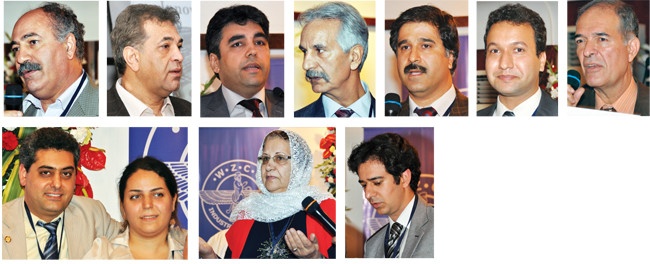
Top row from left: Esfandiar Behzadi, Mehran Sepehri, Dr Baharam Partovi, Toos Dehnadi, Daryoosh Salamatipour, Behroze Sorabi, Khodayar Attaie. 2nd row Dr Farshid Akhtari, Dr Armita Arvin, Taj Koochaki, Farman Kaviani
The group was led by Attaie who along with Sepehri translated from Persian to English the information stated by some of the delegates who were not comfortable with English. But the language of business is a universal one and it soon became apparent the delegates were in search of reliable Zoroastrian business suppliers. The group represented people from mining, pharmaceuticals, locks and anti-theft doors, cosmetic and hygiene products, building and construction, home appliances, dental equipments and other businesses.
Among them was an inventor, Toos Dehnadi, who has designed machines for the food processing industry and energy. One of his creations increases the shelf life of food, while another generates power without the use of coal or oil. Only natural sources such as the sun, sea and wind are required to generate energy, explains Dehnadi. The price of the machines range from US $ 10,000 to US $ 10 million.
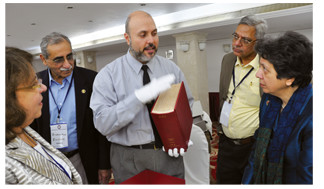
Zoroastrian Trust Funds of Europe president Malcolm Deboo (center) showing to WZCC delegates the Meherjirana Library Yasna Gatha manuscript T54 restored by the Royal Library, Copenhagen
Esfandiar Behzadi is interested in dealing with "Zoroastrian people instead of Chinese people” if possible. He is looking for stainless steel pipe and pipe casings from India. His wife is dealing in hygiene products. Drs Farshid Akhtari and Armita Arvin, both dentists, were keen to import the latest technology for implants, etc into Iran.
Sepehri, who teaches management, said he was "available for mentoring and helping people to write business plans.”
The issue of economic sanctions from the West hindering business transactions between Iran and India was raised, to which Attaie countered that though restrictions had been there for a long time, indirect channels are available.
Taj Gohar Khodadad Koochaki who recited the closing prayer for the two-day meet spoke about her trust in Iran which helps Zoroastrians and non-Zoroastrians and welcomed any assistance that could be rendered (yalzadeh23@ yahoo.com).
◆ ◆ ◆
From the archive