
Zoroastrians Abroad
Valued in Victoria
Living the Zarathushtrian creed without undue stress is the goal of the president of the Zoroastrian Association of Victoria
"We have always remained low key. We like it that way!” says Perviz Dubash, president of the Zoroastrian Association of Victoria (ZAV). Voted in for his fourth term in office last July, Perviz and his wife Nergish, who functions as the ZAV’s honorary secretary, were in Bombay for a brief holiday when Parsiana had the occasion of meeting them. They speak lovingly of Melbourne, which began as an illegal settlement on the banks of the Yarra River in the sheltered cove of Port Phillip Bay and now thrives as the cultural capital of Australia, as "the second most livable city in the world — the first being Vancouver.”
Victoria, the southernmost and smallest state in Australia, was different when these stalwarts moved there 30 years ago, with, maybe, "about 35 Zoroastrian families in the area.” Today they estimate about 350 individuals comprising 137 families, 15 to 20 Zarathushti families being of Iranian extraction, according to Dubash, though the demographic profile prepared by ZAV vice president Arnavaz Chubb notes that about one-third of the population may be Iranian and that there may be at least 40 more individuals who maintain no contact. "As not all migrants make contact with ZAV it is not possible to determine how many more Zarathushtis there may be living in Victoria,” she writes. "On account of the cultural and linguistic difference from Parsis they have gravitated to other Iranian organizations that are not solely for Zarathushtis,” she adds, though some of them attend the Asso-ciation’s religious classes.
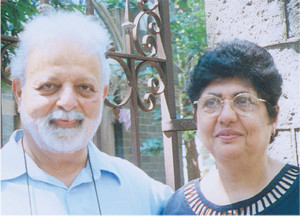
Perviz and Nergish Dubash prefer the low road
Photo: Arnavaz S. Mama
The earliest Zarathushti to arrive in the area was Dossabhoy Cooverji Patell, "the great grandfather of one of our current Melbourne Zarathushtis,” writes Chubb. Stowing away from Aden to escape a hard life serving British soldiers in an Aden bar, he set sail for Australia without even informing his family. Discovered midway, he was made to scrub the decks in payment for his passage. Arriving in 1890, he set up as an ice cream vendor to miners in Broken Hill where he lived with his wife and two daughters, one of whom died at a young age and is buried there, writes Chubb. Do-ssabhoy is said to have left Australia in 1926, returning to Siganpore in Gu-jarat.
The Zarathushti migrants of the 1960s were professionals in the academic, legal and medical fields, writes Chubb. The current Zarathushti population covers a wider range of professions — accounting, administration, banking, engineering, the hospitality and information technology industries and insurance, as well as law and medicine. Some have even set up in business, as per Chubb’s account.
The ZAV committee is elected every year. On board for the year 2004-05 are also honorary treasurer Roda Namdarian and members at large Sarosh Khariwala, Naval Billimoria, Jamshed Bhathawalla, Adil Dubash and Kurush Zaiwala. The community meets socially every two to three months with an annual gahambar for all Parsis, the Jamshedi Navroz celebration with an Iranian theme and Pateti with a Parsi one, says Dubash. The September 2004 edition of their newsletter Rathaeshtar advertised a dinner dance night for mid October titled "Mamaiji ni Vividh Vaani (Grandma’s authentic menu based on the title of a favorite Gujarati cookbook our mothers and grandmothers used called Vividh Vaani)” with asli (authentic) food preparations and a competition of three-minute skits on six aspects of the Parsi grandmother! But Sunday School is a monthly affair with Chubb holding class. (A former editorial member of the Parsiana team, Chubb was fired into pursuing her masters in Avesta-Pahlavi at Bombay University, emerging with a gold medal.)
The organization adopted the "Fra-vashi of light” as its logo a few years back, says Dubash, adding that the Fravashi symbol is sported even by Muslim Iranian commercial establishments like carpet shops in Melbourne. While in Bombay he had had some greeting cards with the symbol printed for the ZAV.
Prof Kaikhosrov Irani, Prof John Hinnells and Khojeste Mistree are among those who have been invited by the committee to address the Zarathushtis in the area, recalls Dubash. There are no plans to build a community center, says Dubash, noting that the community prefers to take it on a "day-to-day basis. But we are basically open-minded about intermarried couples. They come for functions.” As for the world body, Dubash said he was expressing his personal view: "I would welcome any Zoroastrian body.”
An alumnus of St Xavier’s School and College (up to interscience), Perviz went on to Indiana University to acquire his bachelor in electrical engineering degree. Nergish (née Daruwala) was raised and educated in Jabalpur, acquiring her bachelor in arts degree followed by a secretarial course and had worked as a secretary in Bombay and in Melbourne for a few years, initially. Beginning as agents for Nestle’s tea and coffee they now work together on their 25-year-old wholesale coffee and vending machines business, supplying and maintaining these machines in offices. Proud of their three grown up children, son Adil is a physician/general practitioner, elder daughter Ruby, who is married to Zarir Buhariwala, is a music teacher and younger daughter Zarina, an actuary.
As president, Dubash’s easy acceptance of life is reflected in his speech to the community after being elected at the July AGM. As published in Rathaeshtar, he noted, "We the committee of 2004 would like to take the low road. We do not wish to take the high road. We do not want to organize world events. We are not setting out to save the Zoroastrian religion. It survived very nicely for 2,500 years without our help. We are not about educating the youths of the world. How much can you educate on the simplest of dictums...good thoughts, good words, good deeds. The way we are going, maybe the youths can teach us a thing or two...”
The emphasis on core values and doing one’s bit without fanfare is reflected in the ZAV mascot, a soft toy spaniel with droopy ears and sad eyes. Sitting in his "compassion corner” he collects anything the community can afford to give for the old and indigent in Bombay who touched Dubash to tears. And sitting next to the spaniel (named Dorabji Dossaji Doggiebhoy) is a register for the community’s good deeds to be passed on from generation to generation, a source of encouragement, hope and pride.
◆ ◆ ◆
From the archive