
Business
Taking risks
Stories of business and professional achievement marked the WZCC session in London
"I tallied up my paycheck and decided that becoming a millionaire would take a few lifetimes. So I decided to do something. I founded a company,” related Outstanding Young Zarathushti Entrepreneur of the Year 2004 Xerxes Wania of Toronto as he acknowledged the award presented to him by the World Zarathushti Chamber of Commerce (WZCC) at its full day session at the Eighth World Zoroastrian Congress in London in June 2005. An alumnus of the Bai Virbaiji Sopariwalla Parsi School in Karachi, who attended the University of Houston aided by educational grants and loans from community trusts and family members, Wania eventually sold his electronics company, Zentec Incorporated, for 16 million dollars!
Wania’s statement underscored what Congress chair Dorab Mistry had noted at the start of the day: "Are we living on past glory? I disagree…Fire in the belly and hunger for success can lead to another round of achievements.”
The most positive and vibrant session of the week-long Congress, it included an annual general meeting, the presentation of the annual awards and frank recounts by some of the gutsiest Zarathushtis of our times. The whole day slipped almost imperceptibly by as the awardees — beer baron Karan Bilimoria, nuclear physicist Dr Rusy Taleyarkhan, Wania and automobile garage and service station owner Hosi Mehta (in absentia) — responded with word pictures of their respective paths to success. Shoring up the euphoria were chef, gourmet author and maverick extraordinaire Cyrus Todiwala of Café Spice Namaste, former UK businesswoman of the year Shernaz Engineer of Verity and North American entrepreneur who increased his market share from 19 to 40 percent, the affable Edul Daver of AcuPowder, a producer of non-ferrous metal powders.
The presence of the kindly Mehraban Zartoshty, immensely successful entrepreneur of an earlier generation whose vast, quiet philanthropy has been in inverse proportion to his diminutive person, was the icing on the cake. He was called upon to confer the WZCC’s highest award – honorary membership – on Bilimoria whose wealth of activities includes co-chair of the Indo-British Partnership along with Infosys founder Narayanan Murthy, not only for his success with Cobra beer and General Bilimoria wines, but for making his services, charisma and contacts available to the benefit of the UK Zoroastrians, as noted Mistry. Said the nonagenarian, "Last night my family brought Cobra. I drink no alcohol because of my illness but I tasted the wonderfully sweet beer manufactured by a Parsi Zoroastrian who has followed in his forefathers’ footsteps of integrity, honesty, charity…” Responded a visibly moved Bilimoria, "To me the honor is to receive it from you. You are the one who exemplifies the Zoroastrian spirit. I am so humbled and privileged to receive this from you!”
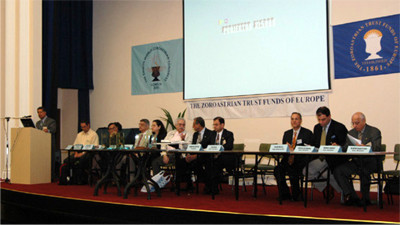
WZCC in session at the Congress
Management doyen and chairman of the Bombay Parsi Punchayet Minoo Shroff, whom Mistry described as "man of corporate India and an authority on corporate governance,” who had been conferred the honorary membership in an earlier year but had not received the trophy then, was now presented with one by Zartoshty. "Equally humbled (and) proud to receive this award from my community,” Shroff noted, "I’m not an entrepreneur. I don’t know how I find myself in this group (the WZCC includes and honors professional men and women too)… Showcasing of what one can do is never adequate. All of us can contribute to the flowering of the community.”
The other past awardee due to receive the trophy was industrialist-poet Nadir Godrej, who had inaugurated the WZCC in verse in Houston at the Seventh World Zoroastrian Congress in 2000 and was billed to preside over the London session. Mistry attributed the happy decision of the House of Godrej to extend its investment in India’s rural areas to this MIT, Stanford and Harvard alumnus. Godrej has diversified into household insecticides, vegetable and fresh fruit marketing with the largest multipurpose trading centers, noted Mistry who represents Godrej in the UK. Nadir Godrej was unfortunately unable to attend for reasons of health. Filling in for him at short notice was the ebullient Farokh Engineer, former celebrity batsman and wicket-keeper, now a TV commentator and public relations man in the UK.
Welcoming the former star cricketer who "now comes on page three of some publications,” Mistry recalled Engineer’s performance in Madras in 1970: "Farokh scored a century in 46 balls against England. (The feat) has never been equaled in test cricket till today.”
"Soo fèka fèk maari (What’s this yarn), Dorab!” demurred Engineer. Acknowledging the presence of Zartoshty, WZCC founder president Rohinton Rivetna and Bilimoria with admiration, Engineer said he was "very honored to be associated with Cobra as its brand ambassador.” Then, plunging into total recall of life at the stumps in his time in the Dadar Parsi Colony maidans with many of the grey heads present in the audience, this "son of a doctor of moderate means” noted that a paternal aunt nearly blew his cricketing career by influencing his father to put him in the Boy Scouts. It meant wasted Sunday mornings for Engineer, away from the stumps. Neither did he have the grades to go into his father’s profession. A guardian angel won him the chance to play cricket at the Cricket Club of India and set him on the path to selection in the all India team. Engineer remembered how he used to hang on for dear life on the footboard of the trains from Dadar to Churchgate, that is until he was selected in the India Eleven. "After that half the third class compartment came out and made me sit and jumped in next to me!” India’s cricket fever is an enduring phenomenon. Even J. R. D. Tata and conductor Zubin Mehta were not immune, as Engineer noted their welcome presence in the players’ enclosure.
"1966 changed my life.” Migrating to the UK as a management trainee, he was invited to play with four counties. He chose Lancashire and was subsequently honored with the vice presidency of the club. "The greatest honor was to be selected for the World Eleven. We were paid one pound a day!” laughed the "first Brilcreem boy,” comparing his earnings in cricket and advertising with current cricket star Sachin Tendulkar’s alleged income of Rs 10 crore per product endorsement.
Returning Engineer’s compliment Bilimoria wondered, "How many reach the top of their profession?” He described the WZCC as "such a great initiative,” and noted, "we are blessed with such inspiration from our forefathers.” When he was about to start his appointment with Ernst and Young – Bilimoria is a qualified chartered accountant and lawyer — he remembered his father, Lt General Faridoon Bilimoria (who retired as commander-in-chief of India’s central command) advising him, "if you are starting at the bottom, you’ll be given lots of tasks. First do them. Then do a little bit extra than what you are asked to do. Go that extra mile.”
The Cobra story
"The essence of a business idea comes from being passionate about something and absolutely hating something else,” said Bilimoria recalling how the gassy British beers failed to harmonize with Indian food. He was determined to produce a smoother, less gassy Indian beer on the lines of lager and make it a global brand. But his proposed venture into beer production upset his family. "I didn’t even get moral support!” he notes. Their objections were rational: He would be contending against giant beer brands with tens of millions of pounds in advertising budgets. "Some of them were founded in the 14th century. Cobra started only 14 years ago!” With £ 295 from his partner Arjun and a bright green battered Citroen that failed the ministry of transport test three times, "the odds were stacked against us… When you are building brands, you initially see obstacles, frustrations, threats. Turn them into opportunities,” Bilimoria advised from experience. He said they crossed the "credibility gap” by their passionate faith in their product and Britain’s "emotional and physical addiction to curry” (as all Indian food is known in British jargon). However, in 1995 when Arjun opted out of the partnership because "he didn’t think we’d make it, (we were) like a jet aircraft zooming down the runway but not taking off. (But) you know you are going to make it when you get reorders from restaurants. When sales grow, the value of the brand grows… And when you win gold medals — last Monday we earned 11 gold medals in Brussels. It made us very proud.”

Bilimoria: "Go that extra mile”
Around the turn of the century, wine consumption began to increase, said Bilimoria. "Wine is a threat because it means less beer.” Bilimoria’s research revealed that 50 percent of all wine consumed in restaurants is unbranded table wine. "House wines are the lowest priced, (but) they are value for money.” Before the year was out, he said he had General Bilimoria wines – named after his father – on the table. There was no trade magazine for Indian restaurants until Bilimoria started Tandoori, the "first and still outstanding” publication supplied free of charge to Indian restaurants.
Every Cobra employee is a member of its share offer scheme. They are all passionately proud of the product. "It’s not what you do but how you do it. It’s ingrained in us,” noted Bilimoria. "There’s no point in having an efficient team. It must be a happy and efficient team,” he stressed. "The trick is to get the best of people to work together… In a small company you tend to cut corners. But you need the best advisers and you get what you pay for…There’s no stopping anyone from copying Cobra but what they can never copy is our culture.” Capitalizing on the community’s renown for kindness, fairness, sense of justice and putting back in the wider community, he noted, "Big companies write big cheques. We donate our products. And we get the benefit, because people drink our products.”
Small companies have an edge when battling commercial Goliaths as they can afford to do things differently. Bilimoria recalled that when he introduced glasses with a map of India, bottles and glasses with the Cobra story in icons on them, it had a positive impact on the company. Unable to afford spending a million dollars in the making of TV commercials, he outsourced them to India whence he says he got a world class product for a fraction of a million.
To make Cobra a million dollar retail brand is Bilimoria’s goal. Along the way he has learnt a few lessons which he now shared with his audience: research and understand your market; take the lead, never copy; be innovative and creative; have pride in your product; invest in people; balance growth with responsibility; have moral vision; never go ahead with ideas without checking with the consumer. The last was a lesson he learnt when his partner’s father stated that retailers didn’t like the original name ‘Panther:’ "The change to Cobra was the best decision we made.”
Fusion, IT and automobiles
Physicist Dr Rusi Taleyarkhan, whose work on nuclear fusion has stirred the scientific world of the 21st century, was conferred the WZCC Professional of 2004 award. Receiving the trophy from Bilimoria "with deep humility,” the soft spoken Arden L. Bement Jr Professor of Nuclear Engineering at Purdue University acknowledged "the selfless service of Roshan and Rohinton Rivetna [Rohinton was a long time president of the Chicago community, designed and built its darbe mehr, wrote the constitution that brought the Federation of Zoroastrian Associations of North America (FEZANA) into being and was its founding president as well as that of the WZCC. Roshan’s long-term commitment to the FEZANA Journal built its reputation and popularity]” and recalled other well known figures from his own family — popular sports commentator Ardeshir ("Bobby”) Taleyarkhan and equally famous politician Homi Taleyarkhan — who had impressed him. "‘Every problem is someone’s opportunity,’ is what Homi Uncle used to say,” reminisced the scientist and told the audience, "If you are looking for opportunities, go for the problems, go to the adversities.”
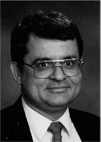
Taleyarkhan: "look for problems”
Speaking of scientific disasters like steam explosions and "nuclear reactors going crazy” as for example the infamous Chernobyl, Taleyarkhan noted that the challenge lay in transferring pure research achievements into functioning technology. He gave the example of the "self-insured aluminum industry which has explosions by the dozens. Someone risked his life to make the beer can and came up with the solution…There is enough energy in a cup of sea water…a million times that of coal or TNT… It will be the ultimate solution to the world’s energy problems.” Though he stressed, we are also talking of big money, he felt that sonoluminescence, which converts sound to light, could provide unlimited fuel supply in future. As an aside he noted that Hollywood is toying with a movie, Chain Reaction, based on their experiment.
After the spate of criticism following the initial publication of his team’s findings in Science and even after the subsequent article in Physical ReviewE, he noted that just a week ago the report by the Nuclear Engineering and Design Commission had accepted their conclusions. Terming technology a "universal marriage of sorts” between science and social use, Taleyarkhan said the experiments of his team could lead to use in videography and in cancer therapy in terms of radiation on a controlled basis. "We have the means to do in a fraction of a second what nature does in thousands of years. But until we’ve done it, we haven’t done it.”
The professor, who was due to address the Imperial College of Science the following day, spoke of a renaissance in the nuclear area thanks to the national and international security issues triggered by the 9/11 bombing of New York’s World Trade Center.
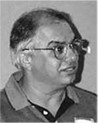
Mehta: "anyone can win”
Hosi Mehta was judged the Outstanding Zarathushti Entrepreneur of 2004. Having studied automobile engineering in India and the US he had started a garage in India and now owned Mehta Motors, an automobile business and gas station in the Chicago area. All this he had accomplished without any business schooling and has been contributing much time to the Zarathushti community as former president of the Zoroastrian Association of Metropolitan Chicago and on the FEZANA Welfare Committee.
Collecting the award on behalf of Mehta and reading out his response, Sarosh Collector recalled their first meeting 17 years ago while Mehta was the "lone ranger looking after kids at a youth congress.” Accepting the award "on behalf of all entrepreneurs,” Mehta’s message read, "Honoring a person like me and a business like ours, all you judges have sent out a message that anyone can win…We have learnt and grown. With confidence and faith one cannot go wrong.” Recalling how his wife Kim was 19 and he was 23 when they got married, Mehta wrote, "Who I am, my mother Freni taught me by the way she lived her life.”
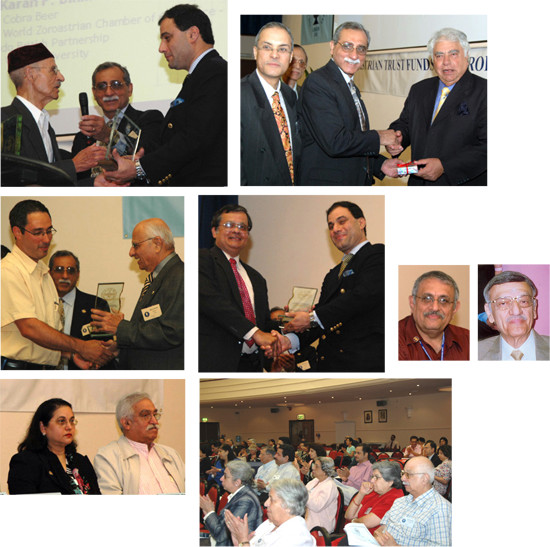
;
Ext Left: Mehraban Zartoshty, Rohinton Rivetna and Karan Bilimoria Left: Dorab Mistry, Rivetna, Farokh Engineer ; Center row (L to R): Xerxes Vania receiving award from Minoo Shroff; Rusy Taleyarkhan receiving award from Bilimoria; Below: Sarosh ollector (left) and Bomi Boyce ; Above: Meher Bhesania of Dubai and Dadi Mistry of Delhi Right: section of the audience
Wania, who received the award from Shroff, had made his name in electronics and was vice president of Sigma Business dealing in Silicon Valley products before he founded Zentec. Noting how surprised and honored he felt when he received an e-mail informing him of the WZCC decision, Wania said he did not know who had nominated him but was doubly delighted to share the stage with Bilimoria. Stating that he had started another company, Sidense, after selling Zentec, Wania provided a glimpse into his way of working: "I always looked for profits, not revenues; made sure that the employees were paid.” While every employee had a share of the profits and enjoyed stock options – Wania said when the company made less that 40 percent profit in 2000, he gave away 60 percent of it to his employees – he said he raised no false expectations, it being a part of the culture he had inherited. "To my mind it was a way of keeping employees happy… If everyone is getting compensated the same way, it builds a happy culture,” he said, acknowledging the support of his wife.
There were those who thought he had been laid off. "Not everybody is going to say ‘You are doing the right thing,’” he shrugged. Setting himself a brisk pace, Wania, a positive thinker, said, "If we spend more than a few minutes on making a decision, we are wasting too much time.” Preferring to use his own capital rather than borrowings, he says he "believed in working smarter,” working very few weekends, treating employees "as we wanted to be treated,” partnering suppliers and customers.

Vania: working smarter
Providing personnel
Noting that she had been making "a lot of money for (her) bosses,” Shernaz Engineer described herself as a risk taker and gambler who left her well paid job to start her own venture in 1993: Verity. Though she had plenty of confidence and know-how, Britain was then in the grip of a recession and finance was hard to come by for less than 30 percent interest. She had to pawn her jewelry to find the liquidity she needed. Moreover, she had to settle with her former employer who had sued her, agreeing to pay 33 percent of the profit.
Engineer began by providing reliable secretarial staff to her clients. But she was well aware that "the secretarial market was very cyclical. I knew I had to diversify.” Emphasizing that "an entrepreneur must always look out for changing trends,” Engineer wanted to supply teachers as the need arose around UK. "But what did I know of education?” So she said she found a former school head teacher and offered her a share of the business. She then sought to diversify into IT (information technology) professionals. "It takes high quality professionals to run the business,” she said, failing with her first set in IT, succeeding the second time around.
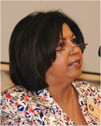
Engineer: finality of contract
Seeking a toehold outside London, she opened an agency in Kent in 2004, outsourcing various functions to India, South Africa, etc. Providing personnel is a £ 24 billion industry in the UK with over 3,000 agencies vying for a slice of the pie, Engineer noted. Bidding for the business of a very large legal department, Engineer said she was asked at the interview to state her unique selling point. "I said, ‘The ability to say no.’ Ninety percent of the time we would have the right staff, but occasionally we would have to tell them that we didn’t have what they required,” she explained, adding, "I knew then that I had got the business.”
Emphasizing "our deeply ethical faith,” Engineer postulated the "finality of contract” in the business world where there is "rarely a clear-cut path – it’s all shades of grey…I keep my word as a businesswoman and also enforce it…
"Never take short cuts; never compromise on ethics. The only good business is repeat business. And be cheerful. Everyone wants to do business with a happy company!” Engineer told her audience.
Gastronomic roller coaster
Owner of two award winning restaurants in central London – Café Spice Namasté and The Parsee – Todiwala’s racy speech encapsulated a turbulent career starting at the bottom of the ladder in the Taj Group of Hotels. He recalled how he was ragged in the early days in the Taj kitchen. But he was determined to be a chef and by the end of 15 years when he left the Group he was executive chef of all the Taj properties in Goa. His first gambit was to found Touché: The Place in Poona. "It became the number one restaurant in Poona within a month but I couldn’t face upto Indian corruption. My partner Shahrukh (Irani) is still paying for my folly.”
In the Taj and later, the privilege of cooking for famous people worked like an elixir for Todiwala and, charmed with the creativity and succulence he presented, the restaurants’ patrons responded in kind. For example, a letter from the Australian Prime Minister got him immigration to that country in 15 days; some years later the patronage of Lord Roy Jenkins prevented deportation from UK; later a letter to the UK home office from the Canadian Ambassador got his impounded passport released.
But six to eight months with the Bombay Brasserie in Australia and Todiwala said he "blew up everything” there and arrived in the UK in 1991, wife Pervin and two young children in tow. His job with Namasté was hugely successful but socially incompatible. Until he took over the restaurant in 1993 he said they lived a miserable life. And even after he acquired it they spent the first nine years paying off debts while Pervin, a trained chef, worked in a front office job. While in a tussle with previous owners over the name of the eatery, which the court ruled in his favor (Café Spice Namasté was born in 1995) and he was adjudged the best Indian chef in the UK for five consecutive years, his passport was impounded. Gradually, the tide began turning in Todiwala’s favor: 1996 saw him winning culinary honor from the World Chefs Society — the first Indian chef to be so honored; 1997 saw him appointed to the National Advisory Council for Education and Training Targets which Todiwala said worked directly under the secretary of state for education and he received the National Training Award; in 1998 came the Investors in People Award. He also launched his first cookbook, selling over 60,000 copies from his restaurants.

Todiwala: problems and patronage
In 1999 came a call from the Canadian Ambassador to represent modern UK culture across Canada, which Todiwala said he could not honor as his passport was impounded. The Ambassador wrote to then home secretary David Blunkett and the passport was released in four days, the Canadian visa followed in two hours, deadpanned Todiwala. After a holiday in India in 2000 he returned to find that the Queen had bestowed an MBE (Member of the British Empire) on him.
Realizing that Indian restaurants were not involved in training others, Todiwala started funding the Learning for Life charity which funds education in India and Pakistan. He says he helped the British government put about 450 kids who had been troublemakers into full-time jobs. His effort was recognized as an outstanding contribution at the Tio Pepe-ITV London Restaurant Awards. His cookbook for those who want to become chefs was published in 2005 as an educational help for the industry. The restaurateur said he is helping reform the national vocational qualification for the Asian sector of the population on the belief that not everyone is suited for academic learning. Todiwala says he helps anyone in UK who needs education to make themselves employable. Voicing his belief Todiwala noted, "Everybody has the obligation to train younger people. If we had not invested in people, we would not have grown.”
His commitment requires him to frequently travel through the UK. Acknowledging Pervin’s support, he added, "She is my greatest critic, but one whose criticism I value most.”
Metallic powders
IITgraduate from Bombay and MS from the University of Wisconsin, Edul Daver said he was working for Alcan Powders when news got around that the company was selling off some of its down stream businesses. When he learnt that they were willing to sell the firm valued at 12 million dollars to management, he was given the first option and six months to come up with the finance. Daver found that the banks considered the balance sheet of the company too weak to lend the money they needed and the charges of brokers were too high.
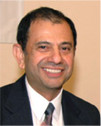
Daver: "success breeds success”
"Every ‘no’ made us learn something new.” It took two months of hard work to learn what an asset based deal was. Basically it was the same company with new management but "we had to change from a corporate culture to an entrepreneurial culture.” Daver said he offered partnership to some of the key employees, distributed 20 percent of pretax profits to others, and promised them job security – a lay-off would only be resorted to if survival was at stake. His overall goal was to have a few good employees.
To further his operational philosophy of safety of the plant and the environment, quality and service to the customer and productivity, Daver took a management course at Harvard University requiring three weeks’ attendance over three consecutive years and said he learned a lot from his fellow students. It taught him how to pursue opportunities beyond the resources available, how to make business a fun activity. The people he dealt with were sports oriented, with a special relationship to baseball. So baseball terminology became the lingo of AcuPowder: meetings became huddles, small successes were hits, major successes were home runs, failure was a strike out.
"The results were nothing short of magic. Our market share grew from 19 to 40 percent. A union exists, but only in name. The cooperation of the group was ensured with every employee taking home more than $10,000 in profits every year,” declared Daver happily, adding, "An equity stake did not appeal so much to the workers. They preferred to see cash every three months.” Moreover, all his 125 employees were put through business training. It increased their motivation because they understood the results. Daver’s policy of open business management and celebrating successes with employees and their spouses with dinner and a cruise round Manhattan seems to have ensured that "people are not afraid to fail… Nothing breeds success more than success.”
"Why are there such few entrepreneurs (in the community)?” questioned WZCC committee member Bomy Boyce and noted, "It is a question of environment, of the mind. The more knowledge and intellect you have, the less street-smart you are and the less street smart, the fewer risks you are prepared to take. The best and wisest thing was to get a job in a bank or the reputed Parsi firms... The WZCC has been created at the right time to bring awareness to people. Entrepreneurship is personal preparation to take risk…”
As Wania analyzed the problem, "Risk is what makes an entrepreneur. Are Zoroastrians high risk tolerant? We are brought up with fears of failure. Fear lowers risk tolerance, makes one think always of security. The amount of times parents and grandparents say ‘You will fall,’ kids grow up hearing they are going to fall! We are raised to believe we are not in control of our environment. Unless you believe you are in control, you can’t be an entrepreneur. In summary, don’t tell (kids) they will fall.”
◆ ◆ ◆
From the archive