
In Memoriam
The last post
The last post
Died: Field Marshal Sam Hormusji Framji Jamshedji Manekshaw MC (Military Cross), 94, soldier extraordinaire, of bronchopneumonia in Wellington, Tamil Nadu on June 27, 2008.
He was a hero of James Bond proportions — except that he was real. Handsome, witty and unflappable, he prompted adulation and anger in equal measure – it depended on the perspective, whether that of the soldiers he led or the politicians-bureaucrats he bested with professional self-assurance and good-natured contempt.
The humorless babus couldn’t fathom the man who refused to be cowed into inappropriate action but cracked inappropriate jokes with reckless abandon. The tongue-in-cheek humor of the man who gave India her only resounding victory in battle against Pakistan in 1971 and changed the political map of South Asia with the creation of an independent Bangladesh included a blithe retort to a journalist who asked what would have happened if he had joined the Pakistan army instead of India’s: "Then Pakistan would have won the war.” It had the Indian Parliament tied up in knots and there were those who wondered if the Field Marshal’s baton should be bestowed on such a man!
And the recurring theme played itself out at his funeral. The establishment kept its distance; the common people thronged to pay homage, delaying the cortege from the army hospital in Wellington to the Parsi cemetery in Ootacumund (Ooty) by almost three hours, though the road had been cleared of normal traffic.
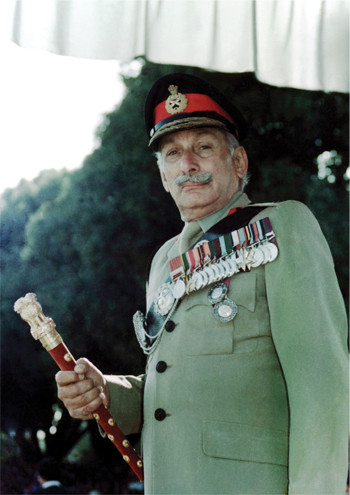
FM Sam Manekshaw, then 90, at the Indian Military Academy
Pratibha Patil, President of India and commander-in-chief (C-in-C) of India’s defence forces, sent a condolence message to Manekshaw’s family describing him as a "legendary soldier (who) always led by example and therefore was able to inspire his men,” but did not care to attend his funeral. Neither did Prime Minister Dr Manmohan Singh though his message notes, "He served the Indian Army with great distinction for over four decades, beginning with the very first military engagement free India was dragged into in the mountains of Jammu and Kashmir…Military historians will forever record the strategic brilliance and inspirational leadership of Sam Bahadur.” Similar tepid messages were received by the family from the defence minister, service chiefs and other dignitaries, reiterating what the world had known for a long time. It rankled that they were unable to spare the time to give the final salute in person to the man to whom India owed so much. (The Army is to name a modern facility for higher military learning in Delhi after Manekshaw according to Indian Express, July 1, 2008)
"Though this great and iconic military personality was given the final salute and laid to rest with full military honors at the funeral, yet the cold apathy and indifference of India’s ruling United Progressive Alliance (UPA) establishment was patently evident on the occasion. It is a matter of great national shame that the entire defence establishment, except the Minister of State for Defence, skipped the State Funeral of India’s most decorated soldier… It is indeed a grim tragedy that the Chief of Air Staff and the Chief of Naval Staff also decided to emulate the ‘political’ example of their boss and did not think it prudent to attend the funeral of the great Field Marshal who has played such an important role in the evolution and development of the defence structure of India today. The Pioneer of Delhi has rightly summed up this disgusting story by saying ‘Government buries civility at Sam Bahadur’s funeral,’” wrote V. Sundaram, IAS ‘Emeritus’ in the Madras evening paper Newsindia TodayNet.
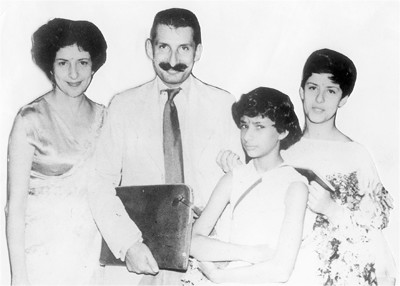
File photo with Silloo and daughters Maja (left) and Sherry
"Manekshaw was not an ordinary soldier. A singular degree of integrity and harmony pervaded (his) glorious and long life,” noted Sundaram. "His personal charm and deft address made its persistent appeal to all with whom he came in contact. His fidelity to his country, whatever its government or form of government and to his faith, no matter what obstacle it imposed upon his military career, constituted for him an abiding element of strength. Right through his career, he displayed an undaunted and ever-flowing combative energy, with infinite capacity for grasping and understanding the ever-changing flux of harrying detail…
"He loved youth and accepted, nay, encouraged its demands. In mind he was always young, and yet he inspired the feeling that he possessed the wisdom of the ages. Truly refined, cool and undaunted, he was ever ready to meet all emergencies and to accept death or obscurity should either come his way.”
Sam Bahadur (an honorific for courageous), as he was known to the jawans of the Indian Army, fought the enemy on all fronts, including the Indian administration which sought to whittle down the strength of the fighting force and strip it of some of its traditions. "He stood up for the Army and did not let the bureaucracy ride over us. He maintained throughout the izzat (honor) of the Indian Army…He raised its prestige…The Army needed someone and Sam was there. Sam became an icon,” wrote Lt Gen (retd) J. F. R. Jacob in the Indian Express (June 28, 2008).
Tributes poured in from all parts of the globe. Glowing obituaries were featured in the international Press. According to an e-mail from Cdr Tehmasp Mogul of Bangalore to Parsiana there were 75 pages of Internet tributes to Manekshaw on the India Times web site as of June 27. "There are tributes from Hindus, Muslims, Anglo Indians, and I even spotted a couple of Jewish sounding names. At a fair estimate there were about 800/900 tributes listed, of which we contributed 10! Where are all those who cram your columns with how proud they are to be Parsis? They need to zip their lip.”
Manekshaw was best known for masterminding India’s victory against Pakistan in 1971. The Times of London recalls the scenario: "The conflict arose from the results of the East Pakistan general election of 1970, decisively won by the Awami League led by Sheikh Mujibur Rahman. When the Pakistani President, Zulfikar Ali Bhutto, refused to yield the East Pakistan premiership to Mujibur, there were strikes and acts of non-cooperation in the capital, Dhaka. This led to the banning of the Awami League and the retaliatory formation of a civilian guerrilla group, the Mukti Bahini.
"Then, on March 27, 1971, Mujibur’s spokesmen declared the national independence of Bangladesh (as East Pakistan was thenceforth to be known) and the predominantly West Pakistan Army intervened, resulting in an estimated 10 million refugees seeking safety in India.
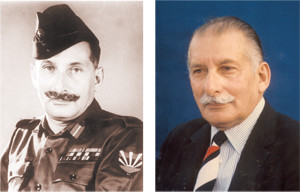
As Chief of Army Staff and in his corporate avatar
"Manekshaw had become Chief of Staff of the Indian Army in 1969 and found himself embroiled in the East Pakistan crisis as soon as it broke out. After returning from an inspection tour of the affected border region in March, the Prime Minister Indira Gandhi asked him what the Indian Army could do to help. In typically frank fashion he replied: "Nothing,” going on to explain that the Army was unprepared but that, given time, he could prepare it.
"At a Cabinet meeting a few days later he said that his troops would be ready in June, yet counselled against intervening at that point. He argued that the monsoon would seriously hinder the movement of troops and supplies and that the passes through the Himalayas would have to be protected against possible Chinese involvement, with the risk of India having to fight on two fronts. It would be better, he advised, to wait for the monsoon to end and for snow to seal the mountain passes. Those who demanded an immediate invasion pointed out that India could not handle more refugees. Thousands of East Pakistan dissidents — including many intellectuals — were being killed by Pakistani troops and police in an attempt to crush the rebellion, sending waves of refugees into India every day.
"Despite stiff resistance from Cabinet members, Manekshaw stood his ground, warning of a debacle if troops, artillery and vehicles floundered in the monsoon mud. He offered to resign but Indira Gandhi wisely let him have his way.
"His obduracy, which had often led him into conflict with politicians and senior bureaucrats, doubtless saved India from something approaching the humiliating war with China in 1962. Yet Manekshaw’s insistence on thorough planning for the invasion induced a whispering campaign that he lacked the stomach to fight. Some Cabinet ministers wanted to sack him and order immediate war — just as the monsoon was about to break.”
As The Guardian of the UK recapitulates, "The lightning speed of the operations in the east led to the fall of Dhaka and Lt Gen A. A. K. Niazi’s surrender on December 16, with 93,000 soldiers taken prisoner. Under intense US and UN pressure, India agreed to a ceasefire in the West the following day…
"Gandhi asked Manekshaw to go to Dhaka, the capital of the new nation, to accept the surrender of the Pakistani forces, but he declined the honor, which he said belonged to the eastern army commander, Lt Gen Jagjit Singh Aurora. It was the sort of gesture that marked him out as a great leader, respected by all who served under or came into contact with him,” wrote Vinod Saighal.
Once that conflict was over, the jaunty military march Sam Bahadur was composed in his honor and his popularity was such that the premier reportedly confronted him with rumors that he was planning a coup against her. He is said to have replied: "Don’t you think I would be a worthy replacement for you, Madam Prime Minister? You have a long nose. So have I. But I don’t poke my nose into other people’s affairs,” continued Saighal.
Adds The Guardian’s war correspondent Harold Jackson, "I have cherished the memory of Manekshaw as my favorite military leader ever since reporting on the Indo-Pakistan war of 1971. The military hazards in Kashmir and East Pakistan turned out to be child’s play compared with my grim battles against Indian bureaucrats in New Delhi and their Bengali brothers in Dhaka: by the time I flew back to Delhi, they had almost reduced me to a gibbering wreck.
"I arrived just in time to hear rumors that the Pakistan army had surrendered — unfortunately accompanied by one of Delhi’s power cuts. The defence ministry phones were all engaged. In desperation, I rang the chief of staff’s direct line.
"‘Manekshaw here.’
"‘Harold Jackson of The Guardian. Nobody here seems sure if you’ve won the war or not.’
"‘Oh yes, we’ve won all right. General Niazi signed the surrender at 4.31 this afternoon. Is that all? Anything else I can help you with? No. Well I’m afraid I’m rather busy just now. All the best.’ He was one of a kind.”
"After the Partition of India in 1947 Manekshaw became one of the first Indian officers to command Gurkha soldiers who had chosen to serve in the new Indian Army and developed a deep affection for them. He was a fluent Nepalese speaker, and a Gurkha family looked after him in his retirement bungalow in Coonoor, where he was frequently visited by officers of his former regiment,” wrote Haresh Pandya of the New York Times, quoting Manekshaw’s frequent refrain: "If a man says he is not afraid of death, he is either lying or he is a Gurkha.”
An e-mail from Brig Hamid Rao of Pakistan is a testament to what the professional soldiers thought of him: "It is with immense respect and admiration I write about Manekshaw. He was an icon of all the virtues valued by the followers of the profession of arms. Besides being a great leader of men and an outstanding strategist he was a person who respected human rights and men’s dignity. He believed in leading an effective, happy and harmonious team. Sam Bahadur led from the front and always brought laurels to his country. Those under his command believed and trusted him. They found him fair and Spartan. He was a commander who not only protected his troops on a battlefield but always looked after their dignity and interests in the halls of power.
"I consider myself exceptionally fortunate having met him over a cup of tea in Delhi some years ago. He was suave, handsome and immensely friendly… I wonder if in our part of the world there have been any other military leaders made in the mold of Sam Bahadur. Nay, he was unusual and different.”
In the course of a very complimentary tribute in the Dawn Ardeshir Cowasji notes, "Sam Bahadur became India’s chief of army staff in 1969 and, as we in Pakistan must accept with heavy hearts, the highlight of his outstanding career was his resounding victory over the armed forces of Pakistan in 1971, when we lost East Pakistan to Bangladesh.”
"His most famous remark was not, strictly speaking, true. On the eve of the war with Pakistan in December 1971 that led to the creation of Bangladesh, India’s Prime Minister, Indira Gandhi, asked her army chief, Sam Hormusji Framji Jamshedji Manekshaw, if he was ready for the fight. He replied with the gallantry, flirtatiousness and sheer cheek for which he was famous: ‘I am always ready, sweetie.’ (He said he could not bring himself to call Gandhi ‘Madame,’ because it reminded him of a bawdy-house),” records The Economist.
"His men loved him for his willingness to take on their civilian bosses and stand up for the army’s interests. He had shown this in the Indian army’s darkest hour, the abject defeat in 1962 by China. Already a general, he had the previous year quarrelled with India’s defence minister, V. K. Krishna Menon, about national security. He was vindicated when the Chinese army swatted aside Indian resistance and briefly occupied what is now the state of Arunachal Pradesh. Menon resigned. Gen Manekshaw was rushed to the front to rally the demoralised troops. His first order was: ‘There will be no withdrawal without written orders and these orders shall never be issued,’” continues The Economist.
"General Manekshaw was able to demand courage from his soldiers because his own was not in doubt,” notes the magazine, recounting the Burma story. "There was something of British military tradition in his stiff upper lip, the lavish handlebar moustache in which he cloaked it, the dapper little embellishments to his uniform and his partiality for Scotch whisky. Yet he was born into a very particular and tight-knit community: India’s small and dwindling Parsi minority, which has produced a disproportionate number of leading Indians, such as the members of the Tata and Godrej business dynasties. Sam Manekshaw was another Parsi overachiever. He was the first of only two field marshals ever created in the (Indian) army.
"Yet his retirement since 1973 was not one long bask in glory. Former deputies felt he had monopolized the credit for various victories. Then last year his name was linked to bizarre allegations, by the son of a former Pakistani president, against an unnamed brigadier who had once sold Indian war plans to Pakistan. All nonsense, said those who knew him. Already in hospital, Manekshaw was in part shielded from controversy.
"After his death, anger at the slur, and at the lack of proper honor for one of India’s true heroes, rumbled on... Bangladesh, however, paid grateful tribute to his part in the nation’s foundation.
"He too might well have been disappointed that his obsequies were not grander. His last words were ‘I’m OK,’ though he had rehearsed a better line nearly 37 years earlier. For death at least, the brave soldier had indeed shown himself ‘always ready.’”
After retiring from active service in 1973, the government passed him over, making no use of his innate abilities. It was the corporate sector that lapped up Manekshaw’s consummate man management skills. It has been said even his pension remained in arrears. President of India Dr Abdul Kalam was the only high ranking civilian dignitary to visit Manekshaw as he lay ailing in the Wellington Army Hospital.
The fifth of Hormusji and Hilla’s six children, Amritsar born Manekshaw had schooled in Nainital and was part of the first batch to graduate from the Indian Military Academy in Dehradun where Sir Philip Chetwode had instilled in them the army creed: "The safety, honor and welfare of your country come first, always and every time. The honor, welfare and comfort of the men you command come next. Your own ease, comfort and safety come last, always and every time.” His father, a doctor, had been born in Valsad where grandfather Framji was a teacher. One of Framji’s students was Janata government Prime Minister Morarji Desai.
Sam had wanted to be a doctor too and his father had promised to send him to England to study after his Senior Cambridge exam, Manekshaw had recounted to the audience in Bombay when he had been felicitated by the Bombay Parsi Punchayet (BPP) in 2002. When he passed the exam with distinction in all eight papers, Hormusji said, "You are only 15. When you are 18 I’ll send you.” In a pique the offended son applied when the Army advertised 150 vacancies and was the sixth to be selected. After graduating from the Academy he served for a year with the Royal Scots. Thereafter he was transferred to the Frontier Force (now part of the Pakistan army) and spent seven years on the Indian frontier fighting the Pakhtoons. But his staunchest connection was as colonel of the Eighth Gurkha Regiment.
Manekshaw was a colonel in the Directorate of Military Operations when he was sent by then C-in-C of the Indian Army General Sir Roy Boucher to accompany V. P. Menon on his mission to Srinagar to get the Maharaja’s signature on the accession document in 1948. "I knew what the situation in Kashmir was. I knew that the tribesmen had come in — initially only the tribesmen — supported by the Pakistanis,” Manekshaw is quoted in Kashmir 1947, Rival Versions of History by Prem Shankar Jha. "The army knew that if we had to send soldiers, we would have to fly them in. Therefore, a few days before, we had made arrangements for aircraft and for soldiers to be ready. But we couldn’t fly them in until the state of Kashmir had acceded to India…
"Eventually the Maharaja signed the accession papers and we flew back in the Dakota late at night. There were no night facilities, and the people who were helping us to fly back, to light the airfield, were Sheikh Abdullah, Kasimsahib, Sadiqsahib, Bakshi Ghulam Mohammed, D. P. Dhar with pine torches, and we flew back to Delhi… It must have been 3 o’clock or 4 o’clock in the morning.”
"At the cabinet meeting presided by Mountbatten at 9 a.m. there were Jawaharlal Nehru, Sardar Patel, Sardar Baldev Singh... I knew Sardar Patel, because Patel would insist that Menon take me with him to the various states…
"At the morning meeting I gave him the military situation... As usual Nehru talked about the United Nations, Russia, Africa, God almighty, everybody, until Sardar Patel lost his temper. He said, ‘Jawaharlal, do you want Kashmir, or do you want to give it away?’ (Nehru) said, ‘Of course, I want Kashmir’ (emphasis in original). Then (Patel) said ‘Please give your orders.’ And before he could say anything Sardar Patel turned to me and said, ‘You have got your orders.’
"I walked out, and we started flying in troops at about 11 o’clock or 12 o’clock. Then all the fighting took place. I became a brigadier, and became director of military operations …the first signal to be signed ordering the cease-fire on January 1, (1949) had been signed by Col Manekshaw on behalf of C-in-C India, General Sir Roy Boucher. That must be lying in the Military Operations Directorate.”
Invited to address the students of his old school, Sherwood in Nainital, on the occasion of its centenary in 1969, Manekshaw, then Chief of Army Staff, had begun, as the Old Sherwoodians website notes, "It is customary on these occasions for the guest speaker to give a learned discourse or advice to young gentlemen. It is not my fault that, although I received my early education in Sherwood, I am not learned. Sir, I am fit neither to give you a learned discourse nor advice. I really want to tell you what Sherwood has done for me:
"Sherwood has taken me to my present position. First and foremost, I learned to live alone and independently. I learned to fight — from the time I got up in the morning till the time I went to bed (starting with skirmishes over soap and towel at the morning wash)…It stood me in good stead during the war in Burma when we came up against the Japanese.
"What else did I learn from Sherwood? During the war in Burma I went without food for many days. I was hungry. I withstood this and said to myself, ‘After all I went through eight years of hunger in Sherwood!…’”
The short, humorous speech which had the boys tickled, had not a word about how he was mortally wounded in Burma and unexpected to survive, prompting his commanding general to pin the ribbon of his own Military Cross (MC) — the highest British award for exceptional gallantry in battle — on the wounded captain because a dead man cannot be awarded the MC. Another story has it that a surgeon was going to give up on his bullet-riddled body, until he asked him what had happened and got the reply, "I was kicked by a donkey.” "A joker at such a time, the surgeon reckoned, had a chance,” notes The Economist.
Manekshaw’s own deadpan recall of the event went thus: "When I was evacuated from Burma because of my injuries, my father wrote to me, ‘If you smoke, you’ll be a dead man. If you drink, you’ll be a dead man.’ I listened to my father and nearly died!”
When he came as chief guest to the BPP’s Holiday Programme for Youth in 1993 Manekshaw was not averse to advising the audience, albeit in his own masterful, humorous style. Professional knowledge and professional competence he classed as the "first and cardinal attribute of leadership. It requires hard work, continuous study. In this fast moving technological world you cannot lead unless you keep up with that knowledge.” From that professional competence flowed the ability to take decisions: "The law of averages says if you take 10 decisions, five should be right…And if you have professional knowledge and professional competence, nine should be right.” He advised absolute impartiality and moral courage which he defined as distinguishing "right from wrong and having done so, to have the courage to say so, irrespective of what your superiors might think, your colleagues may like or whether your subordinates may dislike. A yes-man is a dangerous man. Shun a yes-man.” Loyalty, humor, the ability to talk people out of their problems, out of their despondency were other attributes he spoke about before concluding, "By and large men and women like their leader to have all the manly qualities. The man who says he doesn’t smoke, he doesn’t drink, he doesn’t do — I won’t tell you what — that man doesn’t make a leader. He may make a mahatma, a prophet, a saint, a priest, but he really doesn’t make a leader.” Alluding to Julius Caesar, Napoleon and the Duke of Wellington and their pecadillos, and striking a theatrical pose to project his long nose, he noted with mock seriousness, "All these great leaders had one special characteristic in common: they all had long noses.”
He had told his young audience, "For generations the Parsi youth has been told by their fathers that the Parsi youth is deteriorating. My father said the same thing of my generation. People are saying the same thing about you. Don’t believe it. You have inherited in your blood the genes of your ancestors. I have no doubt in my mind that in the future some of you — I hope most of you — will do as well for the community as past Parsis have done.”
"To Raul, Brandy and me, he was always Sam, our most amazing, wonderful, and loving grandfather. He was the man whose thick finger you held on to as you were taken around the garden and made to memorize the names of flowers. The man who showed you how to wash behind your ears and tolerate extremely hot and extremely cold water baths without complaining. The man who would tell you incredible stories — not just the public ones of the army that many have narrated before — but of growing up in Amritsar, in a large Parsi family and a set of characters that sounded like they came out of an Amritsari version of Malgudi Days.
"This was the Sam I knew, loved, and remember.
"Sam always wanted us to do things properly. His morning routine for example: waking up, putting on the BBC and setting his watch to exactly 5½ hours ahead of GMT, to the chime of Big Ben, checking the mail in a particular order, going through the newspaper and folding it back for Silloo, showering and dressing in a particular order, until finally arriving at the breakfast table at 9 sharp would be a long detailed drill,” wrote Manekshaw’s grandson Jehan Daruwala in Thaindian News.
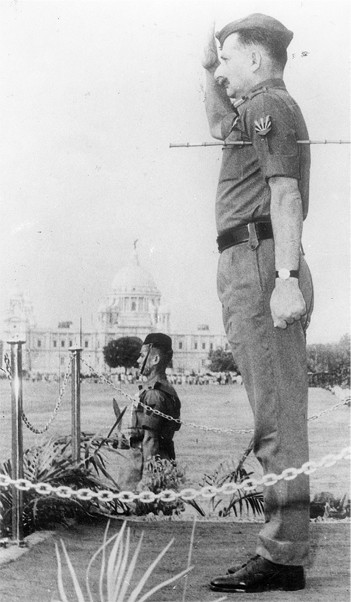
Taking the salute at a regimental march past
The Manekshaw Museum in Shillong already holds much of Sam Bahadur’s memorabilia. "All my things, the sword, the baton (the very heavy Field Marshal’s baton is made of ivory and covered with velvet and gold) will also go there,” he had told this reporter who had visited him in Stavka, his well-appointed Coonoor bungalow, in 1993. On several acres of rolling hillside which he said his wife had bought for a song when he had been transferred from his posting as commandant of the Staff College in Wellington to fight the Chinese in NEFA (North East Frontier Agency), he was growing tea and rearing milch cattle. He enthusiastically displayed his production charts to a young veterinary student who was part of the visiting group. To our surprise we found a set of Barbie dolls. Happily rearranging them the Field Marshal shrugged, "When I was small, my father didn’t let me play with dolls. When I got married my wife didn’t let me play with dolls…”
We wondered if he ever prayed. "From early childhood my mother used to make me say my prayers — Ashem Vohu, Yatha, to ask for dooa (blessing) and go to sleep. My wife is the religious one. She never goes to bed without saying her prayers. She used to have a divo. Now there’s an electric lamp. I am not an atash behram/agiary goer. When work took me to Valsad, I went to Udvada and I was horrified at the poverty and ugliness of our priests. Unlike other places we don’t mind if other communities sit in the room while prayers are being said.” He had noted that his father and mother were both liberal minded. "Mother always said prayers from a book; father was probably more religious but didn’t believe in sitting down and praying.”
Noting that at one time the Parsis were the only educated community in India, he said, "You can’t expect from the community now what you got 50 years ago. But we still have someone or the other at the top, though not as many as before.” As for the community’s declining numbers, "It’s because of our narrow-mindedness. We’re very stupid. If a girl gets married to a Muslim she wouldn’t be accepted!”
At that time his wife Silloo (née Bode), used to doing welfare work in various places they had been stationed in, had started a clinic in Coonoor. She said she had started it in a very small way because there were no funds but they had built it up so that at the time of the meeting she said it treated about 12,000 patients a year. She said she had written to people like the Tatas and the Birlas and their donations had been put in government securities, the interest being passed on for the use of the poor. Two to three retired doctors attended to the patients on certain days of the week. A former student of the J. J. School of Art, Silloo’s paintings hung on the walls of the house. The couple, married in 1939, had two daughters. After Silloo’s demise in 2001, the old soldier slowly began to fade…
Manekshaw is survived by his daughters Sherry Batliwalla and Maja Daruwala.
◆ ◆ ◆
From the archive