
Business
A bawaji buffet
The Parsi-da-Dhaba en route to Udvada from Bombay offers delectable Parsi fare
"Marghi na farcha, dhansak, kheema sali — all the Parsi items are doing well,” says Urvaksh Hoyvoy, owner of the newly launched Parsi-da-Dhaba restaurant on National Highway 8. Opened on May 3, 2009 the eatery, adjacent to the roadway connecting Bombay to Ahmedabad, is spread over an acre of land in Varwada Village in the Maharashtrian taluka of Talasari.
The Dhaba is turning into a "a classy restaurant” and becoming a meeting point for businessmen from the Vapi, Surat, Bombay belt, says Hoyvoy. "People conduct meetings at our place,” as it is conveniently situated about 25 km from the Vapi industrial township. "It’s like a suburb of Vapi,” he adds.
Guests don’t come by the bus load as the Dhaba is not a fast food joint, notes the restaurateur. Catering to the discerning consumer he clarifies, "We also have fast food but for Parsi food give us time to prepare.” The location is also becoming a picnic spot and as the temperature "is comfortable” in the winter months sitting in the garden and eating is a pleasant experience, he observes.
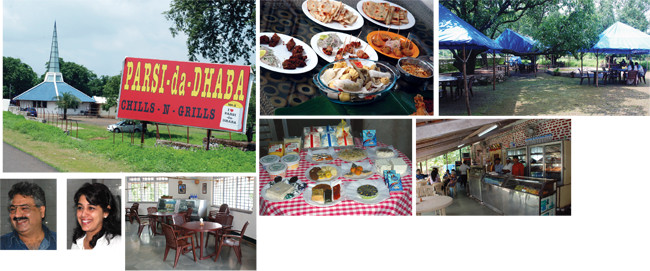
Clockwise from top left: Dhaba overview; sample of nonveg fare; outdoor seating; veg-etarian dairy counter at the Dairyland Parlour; mithais and confectioneries; Dhaba dining hall. Left: Urvaksh and Amy Hoyvoy
Sundays attract the largest crowd and the Dhaba is starting a "Bawaji buffet” which for Rs 299 will offer a lavish spread. "All food will be prepared and ready. No more waiting,” promises Hoyvoy. A mini buffet, termed a Parsi platter, on the style of a Gujarati thali will also be offered. A liquor license is on the anvil by early 2010.
The nonvegetarian Dhaba is nearly 100 meters from Dairyland Parlour, the original vegetarian restaurant started by his father, Naval, a member of the Parsi Dairy Farm family. The Nariman family that runs Parsi Dairy Farm acquired around 350 acres of grassland around 1968 when the Dairy Owners League Cooperative Society decided to shift the tabelas (sheds housing the cattle) out of Bombay. Whilst not all dairy owners honored this decision, Parsi Dairy Farm shifted their buffaloes there.
Visiting and developing the farm on his weekly off, Naval and his wife Taz found many friends from Bombay en route to Udvada (an hour’s drive away from the Dhaba) and other parts of Gujarat stopping for a visit and a cup of tea. Naval saw an opportunity to turn an intrusion into a business proposition and the Dairyland Parlour serving vegetarian fare and dairy products became a landmark on the way.
But Urvaksh noted that there was "no good nonvegetarian” eatery with "hygienic, clean toilets” on that sector of the highway. A spire-shaped free dispensary for adivasis built in 1980 by the Nariman family was lying unused. "No doctor was willing to come” to the place, he recalls. His entrepreneurial instincts led him to start the Parsi-da-Dhabha in that round structure.
Milk and more
According to family lore Urvaksh’s grandfather Nariman Ardeshir started the dairy business around 1916 selling 40 litres of milk near the present Parsi Dairy premises on Princess Street. As he had to be on the pavement at 3 a.m. to supply the milk to his vendors, he begged the landlord of a nearby building to let him sleep in a small room on the ground floor which was reserved for corpses. A Jesuit priest observing the young boy offered him a scholarship to study at St Xavier’s School as he could not afford the fees. In return Ardeshir offered to sell five litres of milk in the school giving the institution a share in the profits. After schooling he worked for Badshah Cold Drinks and noticed that the café had a good clientele. Customers frequented the place because "Yeh Parsi log ka hai (it belongs to a Parsi)” he heard people say. Ardeshir realized "people trust Parsis.” If he were to start an establishment selling milk, clients would come, he was confident.
By 1980 Parsi Dairy sold around 50,000 litres of milk a day. But the family should have taken the next step, gone public, rues Urvaksh. Instead they said, "keep it a small family owned business. But you can’t keep it small. All over the city small dairies have shut down. One dairy owner converted his premises into a hotel. Parsi Dairy Farm should have capitalized on its name.” At that time "people were looking for an honest company to invest in.” To be viable as a dairy one needs to sell around one lakh litres a day. Without economies of scale costs shoot up "and nobody wants to pay (more),” remarks the dairyman.
But Hoyvoy is not keen to pursue the milk route. "I don’t want to be an Amul or a Nestle. I’m older now so I do the things I enjoy doing,” he replies.
Although Urvaksh’s first love was music, he was obliged to join the family business. He remembers well the time when he and his college band mates won Rs 50,000 in a Limca jingles contest. Excitedly intimating his father of this achievement, the elder responded, "galla par bes (sit on the cash counter)!” His dad, in fact, appreciated fine arts and had sketched Mahatma Gandhi and Jawaharlal Nehru. When he had approached the Mahatma to sign his painting of the great man, Gandhi had reportedly asked him for a token fee of one rupee which went to his ashram.
"My long-term plan is to shift from mithai (sweetmeats) to confectionery,” says Urvaksh as he takes Parsiana on a tour of his toffee and assorted dairy products factory on his Talasari premises. The test of good toffee "is how long it lasts in the mouth… Chocolate is a very versatile food,” he observes. Depending on how you prepare it, it can be either sweet or bitter. "It’s going to be the next big thing in India” he adds. A Colaba confectionery, Theobroma, run by Kainaz Messman "made chocolate affordable and accessible to South Bombay.” Rumi Merchant of Quality Cakes "gave up a career in a top advertising company” to take up confectionery, preparing chocolate cakes for birthday parties, Urvaksh notes.
The public’s warm response to the Talasari dhaba has inspired Urvaksh to consider starting an outlet at his Dadar shop in Bombay. Renovations are under way and the entrepreneur hopes to expand by mid-2010. "We’ll have a home delivery counter where people can phone and order Parsi cuisine and collect it. We’ll have a few items on the counter such as cutlets, chicken farcha, old-fashioned Parsi style mutton and chicken mayonnaise sandwiches, typical bawaji fare.” If they find a good location, Urvaksh would consider opening a full-fledged restaurant. "Urvaksh is very much into food,” says his wife, Amy. "Even over a quiche he takes so much trouble.”
Diversifying from his culinary activities Urvaksh is keen to develop 1,400 villas on a part of the land. The project which will be completed in stages over a three-and-a-half-year period will comprise around eight plots to an acre. Potential buyers would be people from Vapi, Surat, North Bombay and Gujaratis who live abroad. As Vapi is within commuting distance, he believes people would prefer to reside in Talasari rather than live in Vapi which is one of the most polluted industrial townships in the area.
On the anvil is also a motel with 10 to 15 rooms.
How does he plan to run so many enterprises? "A solid, good wife,” pat comes the answer. Aside from raising their two sons, Armaan,15, and Azamaan,12, and managing the house, Amy assists with accounts and managing the staff.
Recently Parsi-da-Dhaba took a stall at the Upper Crust food festival organized by Farzana Behram Contractor on December 4, 5 and 6, 2009. "Friday was a good day and the kheema ghotala was a great success. No one was catering for breakfast as most of the stalls were preparing for lunch,” Hoyvoy explains the attraction for their stall. One customer noting the rich content of Parsi fare inquired, "How the heck do you Parsis live so long,” allowing for the food you eat? Replied Urvaksh, "You need to rethink nutrition.”
Contact details: Dhaba 02521 299471, Bombay 022 65732367
◆ ◆ ◆
From the archive