
Food
“Eat little, eat daily”
With no compromise on taste or quality, Poona’s Royal Bakery has satisfied customers with their delicious delicacies
"The bread that lasts for 100 hours and keeps you fit for 100 years” reads the packaging on the 200 g milk bread or Milko Vita produced by Royal Bakery that is sold at Rs 10. In fact the regulars are so used to Royal’s bread that when they go outside Poona they mention how much they missed it and how habit forming the delicious loaf is. Members of the Jain community in particular have taken a fancy to this bread, states Royal Bakery partner Rusi Irani who joined his father Salamat Ardeshir Irani in business 50 years ago, his elder brother Adi having joined five years before that.
The Iranis claim that they were not only the first in Poona but also the first in India to make milk bread way back in 1947. The entire process of making their bread takes about seven hours. What sets their bread apart is once it has been made into a dough it is placed in a wooden vat for an hour to allow it to ferment. This releases enzymes and gives a unique flavor to the bread. Most commercial establishments and large-scale manufacturers of bread don’t use such vats which are not even available nowadays. "Only one gentleman in Bombay makes them,” mentions Rusi.
Their other specialities include sada pav (plain bread), cheese papri, batasa, Shrewsbury and ginger biscuits. Their cakes are also freshly prepared. The popularity of Royal Bakery can be judged from the fact that fresh batasa biscuits are placed at the counter at 4 p.m. sharp and if you go at 5 p.m. you can be sure that you will have to leave empty-handed. On some days their items are sold out by 4.30 p.m. itself. Royal Bakery has a simple policy — thodu khau, roj khau (eat little, eat daily). In fact Rusi states that at Royal if you specifically request them to set aside products to be picked up the next day, you are asked to pay double the amount.
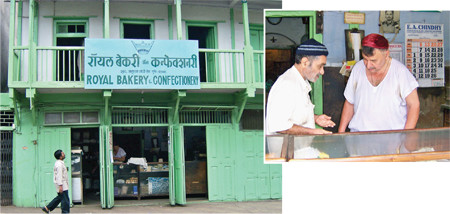
Adi (left) and Rusi Irani at the popular Royal Bakery and Confectionery
Not ones to compromise on taste or quality their preparations and their suppliers have remained the same over the years. Amul butter continues to be used in most of their products ever since Polson stopped manufacturing.
Around two decades back there was an American gentleman named Swami Veda from the Osho Ashram who would daily visit the Bakery for nut biscuits. "He found out what time our biscuits would be ready and amidst the fresh aroma would take his order for the Ashram. He would also eat a couple himself,” laughs Rusi.
The bhatti or furnace is fired using wood and that too imparts a special aroma to their products. As gourmet writer Karen Anand wrote in Pune Times on May 11, 2007, "Rusi at Royal Bakery still produces the best bun pav in the world.” Old-timers remember that way back in the 60s Abdul, an employee of Royal Bakery, would come daily on a bicycle with a steel box on the carrier to deliver fresh bread and broon for almost 40 years.
Finding labor is particularly difficult when running a bakery. "It’s troublesome to find labor as everyone wants a white-collar job. No one wants to work in the heat near the bhatti. Also getting change is a problem. For Rs 100-worth of small change we have to shell out Rs 115,” says Rusi.
When the Iranis settled in India there were only two job options that lured the immigrants. One was becoming a hotelier and the other was becoming a baker. Salamat Irani came to India on a donkey and started out as a waiter in Kohinoor Restaurant, Poona. In Iran he was a rich man but he had to start afresh in India. After a couple of years of slogging and saving up he became a partner at the same eatery. No one knows why he discontinued being a restaurateur and chose to become a baker in 1914, starting Royal Bakery. From 3:30 a.m. to almost 10 at night Irani slogged at his Bakery, sometimes sleeping in there overnight when there was too much work. Royal Bakery is thus the success story of a man who didn’t have a pie to his name when he came but turned his enterprise into one success story.
Many of his customers were European and British officers. Family lore includes one incident concerning a British major who visited Royal Bakery and wanted broon. Irani never wrapped his broon in paper; he would simply hand it over. Seeing the officer the other customers prompted Irani to present the major with a paper-wrapped product to which Irani remarked: "For me he is not above any of my other customers. He can either take the broon like the rest of them or he can leave it.” Amidst aghast expressions the officer took his order and left.
The Bakery has flourished thanks to its cosmopolitan crowd of faithfuls who flock there regularly. "We have never advertised. It’s all been word-of-mouth publicity,” declares Rusi, adding, "We believe that the customer is after all the best judge of our products. If he likes them you have a long-term association and if not he simply will never visit your Bakery again.”
◆ ◆ ◆
From the archive