
Science
Stalwarts of science
A fellow researcher reminisces about three great, generous and humble agricultural scientists of the last century
Think about the great Parsi scientists of the past like Prof Rustomji Hormusji Dastur when you wear a cotton raiment, Prof Rustamji D. Asana when you consume a wheat product and Prof Faridoon R. Bharucha when you gaze upon the ecological beauty of a desert. Parsi Zarathushti agricultural scientists have been unsung and largely unrecognized by the community even though they have made very significant contributions.
This is the birth centenary year of Prof Asana who was born in August 1908 in rural Gujarat. His earlier years were uneventful till he went to Ahmedabad to study at the Gujarat College for a Bachelor’s degree in science. Subsequently he did his post graduation from the Royal Institute of Science (RIS) at Bombay under the guidance of Prof Dastur (1896-1961) who was head of the Department of Botany from 1929 to 1935. Later he proceeded to London where he did research for a doctorate at the Imperial College of Science and Technology. After obtaining his PhD, Asana was offered a post-doctoral appointment at the Botanical Laboratory at Utrecht in the Netherlands. There he worked on the "Avena Test” for the estimation of auxins in plants, a frontline topic at the time concerning the growth and development of crop plants. However, Asana’s heart was not in working abroad and he longed to return to his home country.
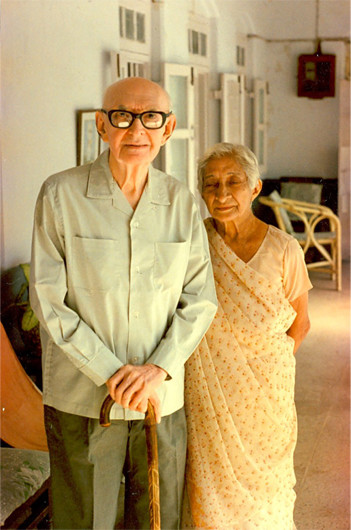
Prof Rustamji Asana with wife at home in Valsad, circa 1992
In India he first worked at the Biochemistry Department of the Indian Institute of Science at Bangalore. In the meantime, Dastur was posted at the Punjab Agricultural College at Lyallpur (now in Pakistan) where he worked on cotton physiology and became a full-fledged physiologist. The Dastur and Asana team worked on the "tirak” disease of cotton, which is basically pre-mature opening of the cotton bolls resulting in poorly developed lint. The disease, that had started in 1919, reduced the yield and brought about heavy losses to cotton farmers in the Punjab (land of the five rivers) in undivided India. By 1935 the cotton crop in Punjab had failed completely. The work carried out by their team from 1935 to 1943 at Lyallpur, showed that tirak disease was caused by low amount of nitrogen in the soil. Also, that high alkalinity was not helpful to the crop. New methods of cotton planting, culture and fertilization resulted in much improvement of the crop. For example, late sowing of cotton seeds (mid June instead of mid May) and closer spacing resulted in reduced plant size and less demand for moisture from the soil. This innovation worked, and the bolls opened normally with mature seeds (used in commerce for oil extraction) and good lint (for spinning into cotton cloth). This discovery, published in the prestigious British scientific journal Nature, is considered even today in agronomy as one of the classical contributions of applied aspects of crop plant physiology thanks to the efforts of the Dastur-Asana team. Dastur received the OBE (Order of the British Empire) in 1946 for his work that saved the cotton crop in the entire Punjab and Sind.
Asana was next posted at the Sugarcane Research Station, Pusa, 50 miles north of Patna in Bengal (but now in Bihar). Pusa was a sleepy and dusty town with a small railway station where very few trains stopped. It was an isolated post. Thankfully he was not there for a long time. Due to a devastating earthquake, the Pusa Institute had to be transferred to the outskirts of Delhi.
Under the scheme of liberalization in Government spending after the end of World War II, separate sections on Genetics, Plant Physiology, etc, were created within the Botany Department of the Imperial Agricultural Research Institute (IARI). In 1946 Asana was appointed as the head of the Physiology Section. In the meantime the IARI, after independence in 1947, had changed its name to Indian Agricultural Research Institute (IARI) but was also otherwise known in the local circles as "Pusa Institute.” On November 14, 1966, the Botany Department was split up into two full-fledged departments, viz, Genetics and Plant Physiology with Asana continuing as the head of the Department of Plant Physiology.
Till his retirement in 1970, Asana worked on the physiology problems of several crop plants, but his main work was focused on wheat. As I was also working on wheat at the International Center for Agricultural Research in the Dry Areas (ICARDA) at Aleppo, Syria, I sought out Asana to discuss some problems that I was facing in wheat pre-breeding research.
I wrote to him at Valsad (Bulsar) where the good professor had retired with his wife (they did not have any children). He wrote back to me and invited me to visit him. So on my next home leave to India I took a train early in the morning and visited him at his ancestral home, Jamasp Lodge on Tithal Road at Valsad. He came out, walking with the help of a stick, to welcome me. Immediately we began a long chat about agricultural research and he answered some questions that I had about my research at ICARDA on salt tolerance in wheat. Then I presented him with a copy of my latest book, Biodiversity And Wheat Improvement. I could see that he was very pleased, as he slowly turned the pages, but he said he may take a long time to read it as his eyes were not as good as they used to be. Afterwards, he said he would send the book to the Navsari Agricultural University where he had donated all his own books. "One day they came in a jeep and took all my books to their library.” I was happy to hear that since Navsari is where my family comes from and we still have our ancestral home there. At that juncture his wife interrupted us and announced "Lunch is ready.”
There is nothing like Parsi food cooked over a wood/coal fire in a rural setting. The food was delicious. After lunch we sat on the verandah and talked about the Parsi community’s dwindling numbers and other problems. "Nowadays there are hardly any Parsis in the agricultural research field,” he observed, "but I am glad at least you are there!” I was told that Asana was a very private person during his tenure at the IARI, but he and his wife readily agreed to pose for pictures for me. He pressed me to stay on overnight, offering his own car and driver the next day to take me to places of Parsi interest around Valsad. I told him that I had very little vacation time left and I had to return to Syria the week after. So, regrettably, I had to decline his generous offer. I could see that he was a bit saddened by this since he liked visitors to stay on in his sprawling bungalow. Nevertheless, he had his driver drop me to the station from where I took a train back to Bombay.
Thus ended my first and last meeting with Asana. He continued to correspond with me even when I joined the University of California at Davis in 1994. In his last letter to me dated December 17, 1994, he mentioned that his wife and he were not keeping good health. I was sad to learn later that he had passed away in 1999 at the ripe old age of 91.
His students at IARI insist that Asana was a great teacher. He guided a large number of students for their PhDs over a span of almost 25 years. Later, several of his students occupied important positions in various universities throughout India. They also served at agricultural research institutes in the country as well as abroad. The Indian Society for Plant Physiology (ISPP), of which he was one of the founder-members, has instituted a gold medal in his honor which is given each year to a young physiologist. The ISPP also published the Indian Journal of Plant Physiology of which Asana was editor-in-chief from 1958 to 1966. Those who knew him well at IARI told me that he used to work quietly without much fanfare and was deeply devoted to his research.
He never applied for or sought any award. However, the Indian Council of Agricultural Research (ICAR) recognized his contributions to crop physiology in India and awarded him the Rafi Ahmed Kidwai Memorial Prize for the biennium 1966-67, a few years before retirement. He was also invited by the Government of Australia to work on a research project at the Centre for Education and Research in Environmental Strategies (CERES) in Canberra (Ceres is also the name of the Roman Goddess of agriculture and farming). The greatest tribute to his genius is the worldwide recognition he received for his ground-breaking work in crop plant physiology. Asana, writing in Nature (December 23, 1961) on the death of Dastur, described the latter as a man who was "reserved, but (with) a gentle and kindly disposition and shunned publicity; he virtually lived for his work and had little interest in social activities and scientific conferences (abroad) which would take him away from it.” It seemed to me that Asana had modeled his own life on Dastur, his teacher. Today, Asana is remembered in India and abroad as a humane person and a scientist with the highest integrity.
After reading about professors Dastur and Asana, I was at once struck by how their meeting each other was similar to my meeting the late Professor Faridoon R. Bharucha in 1970 at the Royal Institute of Science (RIS), Bombay, and studying plant ecology and geography under him. Bharucha was the head of the Department of Botany from 1936 to 1953, and the first director of the Institute of Science (the word "Royal” was dropped when India became a republic) from 1953 till his retirement in 1959.
Bharucha was born in Bombay on May 4, 1904 and graduated from Wilson College, a short walk from his home at the foot of the Cumballa Hill. I am grateful to have known Bharucha and to have had tea with him several times in the RIS canteen or at Café Royal, the Irani restaurant opposite the Regal cinema. One day in March 1971 just before my exams, as we got up after having tea and biscuits at Café Royal, I offered to pay our bill as we went towards the cashier. Then with a twinkle in his eye he said from behind "Adi, thanks for the tea but I hope you are not under the impression that I am one of the examiners, because I am not!” and we both laughed as we walked back to the Department. I missed getting a first class for my Master of Science degree in botany by only a couple of marks, but proceeded for higher studies to England in 1974 and worked on numerous international assignments.
Here I would like to relate another interesting incident. While I was at the Institute of Science, Bharucha had received a grant to study the ecology of the plant species of the Thar desert in Rajasthan. He had taken on an assistant from the state of Uttar Pradesh to help him with the project. The assistant also got himself registered for a PhD, Bharucha being eminently qualified to act as his research guide. Both Professor and student (like a guru and chela) would be seen in the corridors of the RIS, with the student always walking respectfully a few feet behind, invariably carrying a heavy leather satchel of Professor’s personal items, books, papers and other paraphernalia. They traveled to Rajasthan several times and gathered lots of data on the vegetation of an area near a place called Pokhran. Totally unknown to them, the Indian team of nuclear scientists led by Raja Ramanna, had also chosen the same area to test India’s first nuclear device. On the morning of May 18, 1974 operation "Smiling Buddha” culminated with India’s first successful detonation of an atomic bomb! The whole nation was jubilant. Bharucha and his student, on hearing the news, rushed immediately to the area and studied extremely important data on the effect of the nuclear blast on the ecology of the vegetation at and around Pokhran (as the nuclear test was underground there was very little or no radiation on the surface) and compared it to data taken before the nuclear blast. The student got his PhD without much problem the very next year based on that unique data.
Prof Bharucha passed away peacefully in Bombay at his family home at Alexandra Road, Gamdevi, on March 30, 1981 while I was in Italy, doing my wheat and barley improvement research.
Later, on one of my visits to Bombay, I was told that Bharucha’s memory had begun to fail before he could complete his last book. It was to the credit of his former student(s) at the RIS that the book was completed and finally published two years after his passing: A Textbook of the Plant Geography of India, Oxford University Press, 1983. Bharucha’s portrait hangs among other greats in the gallery of "Eminent Botanists of the World” at the Hunt Botanical Library of the Carnegie-Mellon University, Pittsburg, Pennsylvania, USA. He was also to influence another Parsi student, Dr Vispi M. Meher-Homji (retired) of the French Institute, Pondicherry who was honored by the Government of France for his work (see "French honor,” Events and Personalities, Parsiana, October 2002). They were truly some of the great, generous and humble agricultural scientists of the last century.
Associate research geneticist at the University of California, Dr Ardeshir B. Damania’s area of interest includes biodiversity conservation issues, early agriculture, crop domestication and plants of economic and medicinal values. His early career was with the Food and Agriculture Organization of the United Nations and he subsequently worked with the International Center for Agricultural Research in the Dry Areas.
◆ ◆ ◆
From the archive