
Politics and Policy
Consequences of change
Lack of experience will be a great handicap if an entirely new board of trustees is elected to manage the complex working of trust affairs
Enlightened as the community is, and in order that honor may lie, it is expected to play its part well, at all places and on all occasions. In spite of the earlier system of election being well thought out resulting in appointment by and large of trustees of calibre and integrity at the helm of the trust affairs, for the first time in the history of the Bombay Parsi Punchayet (BPP) we witness the system of election of trustees through adult franchise. This is due to various acts of omission and commission, including on the part of existing BPP trustees bowing down to internal and external pressures. It is also the first time in its history that all the seven existing trustees of the BPP will quit the scene at one go, to be replaced by an entirely new team, unless some of the existing incumbents decide to throw their hats in the ring. Woe betide the community, as the new team will be completely ignorant of the complex working of the trust affairs of such a vast magnitude. In any institution experience is the best teacher, and the lack of experience for the new team will be a great handicap.
Of late too much stress is being placed on housing, which is only a minuscule activity of the trust. In spite of so many having been accommodated, numbers in the community have not shown any improvement. They are on the contrary declining in Bombay. There are larger and more important areas on which the trust activities should be concentrated for the benefit of the community.
The ensuing election is an open field, and according to the grapevine there will be not less than 30 candidates contesting election for the seven trusteeship seats. Are they all good, capable, competent and do they all want to serve the community with only one objective, viz, good of the trust and good of the community? No community, nation or state can have the record of holding a completely fair election. The Parsi community cannot claim to be an exception to this almost universal rule, particularly now when the electorate will be much larger than in the past, and the elections will be spread out at more centers than one, and for more days than one.
When elections were held at one place, it was easier to control and supervise the same with no chance of any malpractice. But when they are held at various places on different days, it will require additional personnel who may find the task much more difficult, particularly with a larger electorate, to ensure fair play. The hawk eye of the BPP executives may not extend to all such places, and there is a possibility of the ensuing elections being a mini replica of the state elections where some or the other manipulation cannot be ruled out beyond doubt. In view of such a possibility what are the safeguards that can be taken, what are the steps which can be enforced to prevent such a scenario? There is no election commissioner conducting and supervising the election, as in the case of state or the Lok Sabha elections. Who can substitute the election commissioner in place of the BPP trustees?
Under the previous scheme, apart from the presiding officer, the trustees had a preponderant say in the matter. The present trustees having almost lost the confidence of the community because of more than visible internal differences and pulls in different directions, the community would not be confident of receiving proper justice from them.
In case of misdeeds on the part of government officials people may approach an ombudsman for settling their grievances. In England, there is a Legal Services Ombudsman appointed by the Lord Chancellor under the Legal Services Ombudsman Jurisdiction Order, 1990, who is responsible for hearing complaints against solicitors, barristers and licensed conveyancers. Why not therefore have a committee of two or three distinguished members of the community, such as retired Supreme Court and High Court judges or top ex-government officials playing the role of ombudsmen to oversee and dispense justice in case of a complaint from any quarter involving an allegation of malpractice? Such eminent members of the community, although rightly reluctant to rub shoulders with so many candidates contesting the BPP election, would surely make their services available for a minor role akin to that of an ombudsman. There could be no objection to such a proposal sailing through in spite of the fact that it may not have been provided for under the new scheme governing the ensuing elections.
Now let me dwell on the functions and duties of a trustee of the BPP so that prospective candidates may know what they have to face on their being elected as trustee. For a BPP trustee there is not a moment without some duty. It rises with him in the morning and goes to rest with him at night. He is also a different kettle of fish, unlike trustees of other trusts. On assuming the trust office, a BPP trustee should act like an animal of special pedigree, at times smiling, at times snarling, but at all times faithful to the master. He should be faithful only to the trust, even sacrificing his own personal interest to that of the community. His role and responsibilities are also vast and manifold as compared to trustees of other trusts. As observed by the Bombay High Court in Suit No 1111 of 1983 (B. K. Mistry vs the Trustees of the BPP), unlike the trustees of other trusts, trustees of the BPP are not only the custodians of the funds and the properties under their control, but are the leaders (the akabars) of the community extending their hand of assistance embracing a wider arena covering manifold activities of human endeavor, including religion. A BPP trustee is the leading light, the guiding star and becomes a respected elder of the community. In olden times, the BPP used to be approached by other Parsi institutions or bodies, not only in India but also outside India, for guidance and advice on problems facing the community. Alas, today this is no longer the situation. Its prerogatives under the new system of election, manned as it will be by a new inexperienced team, will remain a distant dream.
Only the other day, a good friend asked me whether the trustees of a trust could decide on issues concerning religious matters. I answered that a BPP trustee certainly can play a role in such matters too as has done in the past. The new team should emulate what their predecessors did. Not expected to be themselves enlightened in matters of religion, they can always act upon the advice of high priests and scholars, which they have done in quite a few cases, including in the case of Neville Wadia’s navjote and the case of Joseph Peterson’s navjote outside India.
Rumor rings the bell with a sound louder than that of the church bell that some of the prospective candidates have an eye on the trust’s properties, particularly Doongerwadi lands, by changing the present method of disposal of the dead to other methods. This possibility cannot be ruled out, and though not now, but later on, candidates may be put up to achieve this objective through the might of wealth and/or muscle power. Even if they find a seat on the board, I personally feel that the trustees on their own would not be able to achieve this nefarious objective, even if they so resolve. Any member of the community can go to the court and prevent them by recourse to an application for construction of the relevant trust deeds. Although trustees’ support may have some value with courts, as it did in the case of system of election through adult franchise, the court would have to construe the relevant provisions of the concerned trust deeds relating to the Doongerwadi property. Here the community seems to be on a better wicket, unlike in the case of proceedings relating to the introduction of the new scheme of elections. I hope that the day for the court to decide otherwise will never come.
There are also some rumblings regarding the present system of paying obeisance to the body of a deceased inside the bunglis and non-Parsi mourners sitting apart in the pavilion. Some say that this system should be dispensed with as most Parsis feel miserable while following the same. They also say the same thing about non-Parsis not being able to remain present at the place where the body is exposed for the last time, where even non-Parsi workmen of the BPP have access. The existing practice has been in vogue ever since the dakhmas were installed at the Doongerwadi properties side by side with the erection of bunglis. Did we hear any murmur to this effect in the past, or even now, from any member of other communities complaining about the system? They are more sensible and more understanding than some grumbling members of our own community, as they do respect the practices and traditions of our community. They also know that in certain temples of theirs, only those belonging to their community can enter. What is wrong therefore if our community follows such customs and traditions?
Some say that under the present system of disposal of the dead there is a stench which is pretty strong near the dakhma gate. First of all, the pall bearers alone are in the vicinity of the gate while those attending a paidust ceremony wait some meters away. I have attended hundreds of such ceremonies but not once have I experienced an unbearable stench. Anyway, is it proper to do away with the present system which has stood the test of time for more than a century, when it does no harm to anyone? The horrendous campaigning in the Press has not only divided the community, but also divided the families. Whereas some members of a family resort to the above, Marezban Wadia, a true server of community’s interests, has brought out discs to reflect the opposite viewpoint which I admire, and which every young member of the community should enjoy listening to it. Indeed the winds of change are blowing everywhere, but change should not be for the sake of change. Only good and justifiable reasons, should compel change.
Although the elections are far away, active campaigning has commenced in the Press and in various Parsi circles. Mudslinging seems to be rampant as never before. Although the hidden agenda for some of the aspiring trustees would be difficult to fathom, the reformists through the Press seem to hold the sway. The other day, I attended the annual function organized by WAPIZ (World Alliance of Parsi Irani Zarthoshtis). The gathering present displayed sizeable strength. The presence of its representatives on the BPP board of trustees should augur well for the community in these trying times as a check against radical reforms and for the preservation of our valuable properties within the community in accordance with the intentions of our illustrious ancestors who made the trusts to be handled by persons of stature, status and dignity. May their intentions be honored. May the best men win.
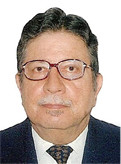
Former president of the Bombay Parsi Punchayet and a senior partner of Mulla and Mulla and Cragie, Blunt and Caroe, Eruch B. Desai is a director of around 15 companies and trustee of the General Electoral Trust formed by the House of Birlas and some other trusts. He has also made representations before the authorities for the amendments to the Bombay Rent Act.
◆ ◆ ◆
From the archive