
Welfare
Haven for the hapless
The abandoned and orphaned children at The Byramjee Jeejeebhoy Home are assured good amenities, sound care and a secure life
Some eager children were awaiting their turn while others were struggling to gain their balance on the bicycles. Lending a steadying hand to their younger peers were three-four responsible preteens who were cheerfully making the rounds in the compound of The Byramjee Jeejeebhoy (B. J.) Home for Children at Matunga. The nearly 100 children who share a common roof here may have no bonds of blood. But most of them trace their linkage to the Juvenile Court under whose directives they remain here. The children brought to the Juvenile Court by the police are assigned one of the shelter homes in Bombay depending on the vacancy available. The B. J. Home additionally accommodates some individual cases sponsored by private agencies or social workers.
While some of these children are "completely abandoned, others are orphans or with single parents or those whose mother may be a sex worker,” explains Maneck Davar, chairman of the Home, who with his fellow executive committee members has induced greater commitment among staff members and a happier environment for the wards. Knowing that this is "a stop-gap arrangement where the children only remain until they are 12 years old,” they try to "give them as much comforts as possible,” washing machines and water filters included.
The children here neither have to clean their plates nor wash their clothes. Even their beds are done for them. Among the child welfare homes "we probably have the highest ratio of staff to children,” mentions Davar. Earlier there used to be three staff members for 250 children as against the 23 currently in employment. The present committee ensured that the staff members, some of whom have been working over a long period of time, were given their dues including better salary with privileges like leave, bonus, travel allowance, yearly increments. As per their income and expenditure account for the year ended March 31, 2007, the Home incurred Rs 8,86,976 on salaries and wages.
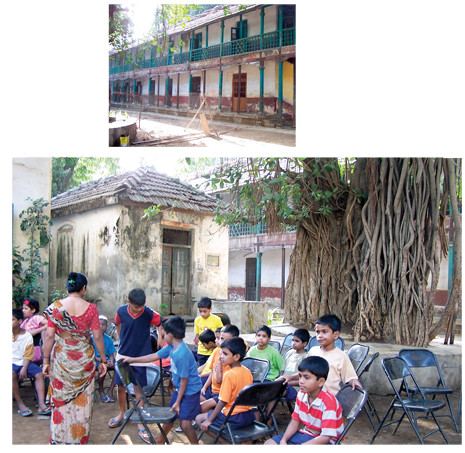
The Byramjee Jeejeebhoy Home: Old buildings shelter the young wards
Presently just the strength of the cooks has been increased to three with the children enjoying a variety of meals starting with oats at six in the morning and ending with dinner at seven in the evening comprising two vegetables, chapattis, rice-dal. Parsiana too got to taste the dinner served to the children. As per their practice, an office bearer making an unannounced visit at meal time is expected to partake of some food to ensure that a consistency in standard is maintained throughout the year.
On an average the children get to enjoy 10 special meals a month sponsored by philanthropic individuals who give a treat at a cost of Rs 3,000. The chairman himself makes it a point to celebrate his birthday with the children at The Byramjee Jeejeebhoy Home. Festivals of different faiths accord more reasons for feasting. As notes their annual report for the year ended March 31, 2007, "The inmates are encouraged to observe their own religion. Morning and evening prayers and observance of all important Hindu, Muslim and Christian festivals have helped in fostering a spirit of brotherhood, love and tolerance amongst children of different communities.”
Sudhir Tamankar who has been working at the Home for the last 31 years brings us the visitors’ book which is laden with praises about the quality of the food served and the smiling faces of the children. "Every Saturday a doctor comes to check the health of the children,” states Roshni Damania, joint honorary secretary of the B. J. Home, citing the instance of a "child without one lung who was given personal care.” Periodic eye camps ensure that the children do not neglect their all-important organ.
Vocational courses, art, craft, tailoring, computers, physical education, indoor and outdoor games, music and dance are some of the regular activities conducted on the premises. The dance that the B. J. Home children had performed on the occasion of the 26th Children’s Meet (which brought together over 2,000 children from nearly 35 child welfare institutions) on May 1, 2008 was enthusiastically presented with panache and flair for Parsiana too when we went visiting the next day.
Classified as a "Kanishta Balgruha (junior children’s home)” by the Social Welfare Department of the Maharashtra State, the children under the care of this institution are aged between six and 12. On each child the Home maintains meticulous records. Once they cross the threshold of junior and become "varisht (senior)” they are shifted to another home. The imminent departure of one of the boys saw Damania giving him the necessary encouragement and confidence to face the new challenge. Rather than see them uprooted at such a stage and particularly wary of "orphan siblings being separated” with brothers and sisters sent to different homes, the committee is considering expansion of facilities at the B. J. Home such that they can accommodate up to 130 children once the trustees receive permission to retain the children until they are 18. Davar refers to the proposals the trustees have received whereby the children would continue to be housed here while a portion of the land is commercially developed, with perhaps a new school on the premises to serve the educational needs of their own and neighboring children. As of now, children from the Home study in local municipal primary and secondary schools in grades appropriate to their age.
The Home which was recognized by the State Government as a certified school under the Bombay Children Act 1948 (and now Juvenile Justice Administrative Act) comes within the purview of The Society for the Protection of Children in Western India. In 1916 Sir Rustom Masani and Sir John Wardlaw-Milne had the vision to work for the protection and care of orphan and destitute children. They started from a small shelter at Grant Road and thereafter formed the Society. Among the esteemed patrons of the Society were Lord Willingdon, Lord Lloyd, Sir George Carmichael, Sir Leslie Wilson, Sir Ferdric Sykes, Lord Brabourne, the Earl of Scarborough, Lord John Colville…as lists the 91st annual report.
The B. J. Home shifted to the Matunga premises [Shraddhanand Road, Opp Shankar Mattham, Matunga (E), Bombay 400019, tel: 24011197] in 1921 where over the years they have earned "a lot of goodwill from the neighbors,” declares Davar. "We have a tremendous pedigree,” states the present chairman referring to the illustrious list of the past presidents of the Society who besides Masani and his wife Lady Masani had included British nationals, different governors of Maharashtra, and committed Parsis like Sir Tehmulji Nariman, Sir Homi Mehta and J. D. Bamji.
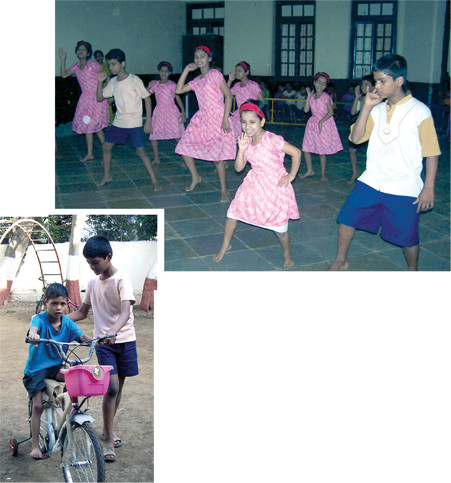
Above: Bonding through dance Left: Supporting the novice cyclist at The Byramjee Jeejeebhoy Home
Assisting the current president Manorama Saraiya are the office bearers of the B. J. Home comprising vice presidents Byram N. Jeejeebhoy and Sadanand S, chairman Davar, joint honorary treasurers Rustomjee J. R. B. Jeejeebhoy and Rustom N. Jeejeebhoy, joint honorary secretaries Pradeep Nagori, Ratanshi Thakker, Damania and Rustom Tirandaz. The present team also gratefully record the dedication of Roshan Parikh who had served on the committee for 15 years, the last three as joint secretary, visiting the Home daily till her demise in 2007. In fact it was she who persuaded Damania and Davar to spare time for this institution.
Until four years ago the accounts were showing a shortfall but in the last three years they have shown a "consistent surplus” with the resources the committee members are able to generate.
Towards the maintenance of each child here, the State pays Rs 950 per month. The other costs have therefore to be raised from donations in cash and kind like foodstuff, cloth, school stationery and other necessities. The four buildings in their complex being old, the committee expended Rs 76,692 on repairs in the year 2006-07. Acknowledging donations of Rs 15,29, 131 in the financial year 2006-07, with the largest donation of Rs 5,00,000 coming from Seth Cowasji Dhunjishaw Baug Charity Trust (through Byram Jeejeebhoy), the annual report "earnestly appeals to our patrons and the public in general to continue helping the Society with liberal contributions…to enable us to carry on our missionary work more efficiently.” Recognized as a charitable institution, donations to the Society entitles a donor to claim income tax relief.
Over the years more than 5,500 children have passed out from the portals of the B. J. Home where they were brought up, educated and suitably rehabilitated. Some of them did return — to reciprocate the largesse they had received.
◆ ◆ ◆
From the archive