
Business
Risk and return
Overcome obstacles to trade between India and Pakistan says the Pakistan minister for trade and the Karachi Chamber of Commerce president
"Pakistan spearheaded the opening up of the economy. India followed,” observed Tariq Ikram, minister of state, Federal government in charge of the Trade Development Authority addressing the World Zarathushti Chamber of Commerce delegation to Karachi on September 12, 2007. The Nawaz Sharif government had "freed foreign exchange.
"But by October 1999 when Gen (Pervez) Musharraf took over (matters) were in a sad state. Our reserves were (sufficient for) less than four or five days,” he noted. Faced with a grim reality Musharraf turned to the private sector for recruiting top executives.
At that time the GDP growth was one percent or zero. "Agricultural (output was) dwindling.” We had "strained relations” with our neighboring countries. Trade had dropped. There was a lot of corruption. (Pakistan was like) a rudderless ship. (People) used to be scared. (They didn’t know) in a week’s time what will happen. Since 1947 the maximum (exports) we could touch was nine billion dollars.”
With such a baleful scenario people were reluctant to leave the security of the private sector. "No way. (People) didn’t want to touch the government,” said the former chief executive officer of Reckitt and Coleman in Pakistan, the first Pakistani to hold that post. He oversaw the functioning of 30 countries from Pakistan to North Africa.
But Musharraf has "enormous mobilization skills… (so we decided) we will burn our boats and come over.” About 10 such people joined Musharraf’s inner circle of advisors but "now only two guys are left: (Prime Minister) Shaukat Aziz and myself.”
Under Ikram’s tutelage, exports crossed the 10 billion dollar mark in the year 2000-2001. "We (have) excellent resources, hard-working people (who are) very committed. It was the commitment and resilience of our business (people) who made it happen.”
But there were disadvantages as well. Intenal strife, natural calamities and "then 9/11 hit.” Terrorists attacked the Twin Towers in New York on September 11, 2001. "We went through absolute hell — misery. Nobody was granted visas (by other countries) to go out. Nobody wanted to come to Pakistan.”
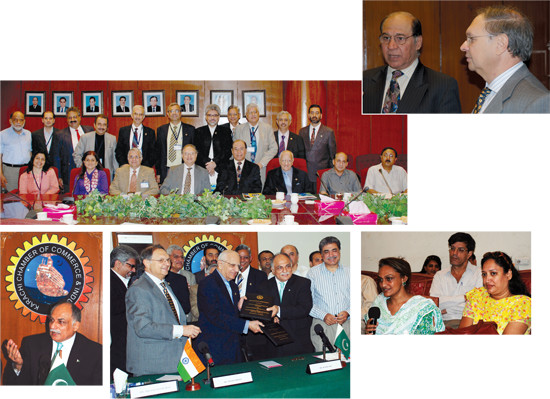
Top: Tariq Ikram and officials with WZCC delegation; Above Ikram (left) with Byram Avari; Bottom row from left: Majyd Aziz; Avari, Minoo Shroff and Aziz exchanging documents;
The US aid after 9/11 contributed negligibly to Pakistan’s economy. People thought Pakistan was "a great beneficiary” but "in terms of trade we got nothing except some extra quotas and duty-free concessions from the European Union....The perception that September 11 (caused) a turnaround (in the Pakistan economy) is rubbish.”
The upswing came about because the "government’s policy changed… (import) duty was reduced from 40 percent to 17 percent… the trade deficit improved. Data transmission costs have come down.” Mobile phones have increased in number from six lakh to over 60 million. Exports touched 17 billion dollars in January 2006, up 118 percent since 1998-99. Textile exports grew by 78 percent. There is now talk of revenues touching about one trillion (one followed by 12 zeroes) rupees, Ikram stated. "Something must have been done right.”
On the debate over democracy versus authoritarian forms of government, the minister felt the issue was debatable. "Look where China is (today) and where India is.” Musharraf, anyway, is "more tolerant than he needs to be.”
Referring to Karachi Parsi Anjuman Trust Fund chairman and prominent Pakistani businessman Byram Avari’s opening remarks regarding improving Pakistan-India trade ties, the minister commented there was "enormous potential” for furthering economic relations between the two one-time warring nations.
Noting that the trade between the two was less than one billion dollars Ikram said he had studied the industries in both countries to try and estimate how much growth was possible. But he had not arrived at a figure. "I don’t have a crystal ball,” he replied to a query on the estimate of trade achievable.
Though on paper the trade conditions between Pakistan and India may look favorable, non-tariff barriers ( goods that are banned entry) prove a stumbling block. Computer hardware, information technology, fashion garments, fruit and vegetable produce, onyx, marbonite, gems and jewelry, select chemicals, pharmaceutical products, engineering goods, meat (kosher meat) and poultry, furniture, cement products were some of the items the two countries could export to each other, he observed. Amongst the service industries, Ikram referred to accounting and tourism.
Noting the "supply chain is globalized,” he pointed out global trade was in the region of 10 trillion dollars. War torn regions involved high risk but also offered high returns. Ikram felt both Pakistan and Afghanistan offered "potential” and "opportunity.” One has to "trade off between risk and return,” he commented. "Billionaires are born out of reconstruction of countries,” he noted wryly. "Not too many such opportunities” occur.
He admitted though that the deteriorating law and order situation was a fact of life. Relocation of populations was taking place and there was "a real fear” of the growth of the Taliban and fundamentalism in the North West Frontier spreading south.
"Bring pressure on our respective governments to come to terms… be practical. (Some things) are beyond our control… (there are) opportunities even today… whatever can be exported, push ahead. Pakistan desperately needs exports. Encourage exports of Pakistan into India,” he exhorted the delegates. The Pakistan economy "was opening up,” and regardless of the government in power, the trend would continue.
Terming the kulfis supplied by Urvaksh Hoyvoy of the Parsi Dairy Farm family at the behest of hotelier Avari, "an absolute delight,” Ikram said "(It) calls for a good joint venture here.”
Powerful chamber
"I’ve never seen any chamber (of commerce) in India taking up law and order,” observed WZCC (India) and Bombay Parsi Punchayet president Minoo Shroff addressing a gathering of business leaders at the Karachi Chamber of Commerce and Industry (KCCI) in Karachi on September 12, 2007.
His comments came in the wake of Karachi Chamber president Majyd Aziz’s remarks that the KCCI had funded six wireless mobile vans to monitor all the market areas for lawbreakers. Plans for 100 motorcycle policemen were also being considered. This was part of the KCCI’s corporate social responsibility program. With many of the Chamber’s top leaders away to attend the funeral of a member’s daughter who was shot dead by armed gunmen in a robbery attempt at her home, one could understand the KCCI’s concern with the deteriorating law and order situation in the city and the country generally.
But as Aziz noted, despite the political uncertainty and the breakdown in law especially on May 12, 2007 when members of the Muttahida Qaumi Movement took over the streets of Karachi with government connivance to ban the entry of the suspended Supreme Court Chief Justice of Pakistan Iftikar Mohammed Chaudhry, the "My Karachi” exhibition was held nonetheless. This showcase of business enterprises accompanied by music, singing and dance performances "was one of the biggest achievements of the year. People come out” to see the exhibition, he added.
The 45,000 or so member KCCI (which covers 350 markets) would soon be "one hundred percent IT (information technology) enabled,” said Aziz. The Chamber also has a women entrepreneurs subcommittee "to empower women and to give them their place in society,” said the president. Small entrepreneurs were "the backbone” of the Chamber.
Calling for more trade between the SAARC (South Asian Association for Regional Cooperation) Aziz called the existing quantum of five percent trade "pathetic… (we must) remove the cobwebs… strongly (oppose) any roadblocks to business.”
Referring to the Memorandum of Understanding and Cooperation signed between the KCCI and the WZCC represented by Shroff and Avari that afternoon, Aziz said "two organizations of India and Pakistan are joining hands.
"We are interested in trade with India. (There is) undocumented trade we want to discourage… certain core issues (however) are hampering the true measure of trade… Pakistan is a developing state. The onus (on improving trade) lies on the business community.”
Alluding to the "pure and genuine” desire to work together, Aziz said the relationship could be "a win-win situation… let trust come. We can rule the world. In education, textiles, commodities we can work together.” He termed the ties between the two countries, which once were one, as an "emotional (one). It comes from the heart.”
Noting he and Aziz had been friends for over 40 years ("though we are both only 30 years old”) Avari stated "the KCCI is the most powerful chamber of commerce” in the country. The "hustle and bustle (all) comes from Karachi. It is a driving force to make things better.” When the elections for the Chamber are held, commerce in Karachi "comes to a standstill,” said the hotelier.
Shroff noted that at one time "there was a lot of mistrust between France and the UK. They were countries that fought each other. Today the European Union is the largest (economic trade) group (in the world), larger than North America.” He was optimistic the "clouds will clear” between Pakistan and India, and that "business should be in the vanguard” of such efforts.
There is a "lot of talent here...why pay European wages when we can (purchase the same products by paying) SAARC wages? Why (route the business) through Dubai” instead of dealing directly? queried Aziz.
"It’s an evolutionary process,” he added. "The world has changed. If we don’t (change) we will remain in the dark ages.”
◆ ◆ ◆
From the archive