
Business
“The mindset has changed”
The governor of Sindh and Pakistani businesspeople favor improved trade ties with India
The governor of Sindh was late for the meeting by 40 minutes. He apologized for the delay. "We’ve been busy handling different flights,” said Dr Ishrat-ul-Ebad Khan in jest. It was the day (September 10, 2007) the former Prime Minister of Pakistan Nawaz Sharif was to land at Islamabad airport. A few hours later the deposed leader was put on a flight to Saudi Arabia.
Karachi Parsi Anjuman Trust Fund chairman Byram Avari was quick to point to the visiting 15-member World Zarathushti Chamber of Commerce (WZCC) delegation that the Governor had rescheduled several of his other appointments to accommodate them. During the meeting the governor again had to absent himself for a few minutes after an aide came and whispered a message in his ear. When he returned he informed the gathering that Pakistan President Pervez Musharraf sent his "good wishes” to the delegation!
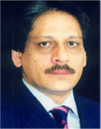
Governor Dr Ishrat-ul-Ebad Khan: "we have progressed”
Talking of the "common destiny” between the two countries, WZCC (India) and Bombay Parsi Punchayet chairman Minoo Shroff mentioned the "hesitation and trepidation” with which many in India viewed the WZCC trip to Karachi. But the occasion was also "a rare opportunity” to visit Pakistan. "We have seen how stable it is here. We are not concerned with what happens in the air.”
Avari noted, "Parsis are non-political… (they) don’t interfere… Hindus don’t trust Muslims. Muslims don’t trust Hindus. The Parsis are in the middle” hence would be good go-betweens.
Avari mentioned that the Parsis in Pakistan had prospered. "There is not a Parsi who does not have a roof over his head. None go without three meals a day…Parsi schools were the first to open their doors to non-Parsis at the request of (Pakistan’s founder Mohammed Ali) Jinnah.” The Mama Parsi Girls’ High School, he noted, started an afternoon shift to cope with the demand from the cosmopolitan community.
But the governor was asked when Parsis were faring so well in Karachi, why were so many desirous of emigrating to other lands? The governor prefaced his answer with a remark that his answer applied not only to the Parsis but the "general” public. He said the despondency was "unfortunate” and "because of various reasons…the economy could not grow.”
The political uncertainty had been detrimental to economic development. But since Musharraf came to power "we have now progressed. We’ve given people confidence. People used to go abroad. Now even they are coming back. A lot is being done here.” [A Herald monthly magazine (August 2007) poll showed 87 percent of Pakistanis would prefer to stay in the country rather than go abroad.]
He cited the boom in the hotel industry to reinforce his statement. "Byram Avari is running two hotels (in Karachi). The occupancy was around 25 to 30 percent. Now it’s much higher.”
"Last night it was 100 percent,” chipped in Avari.
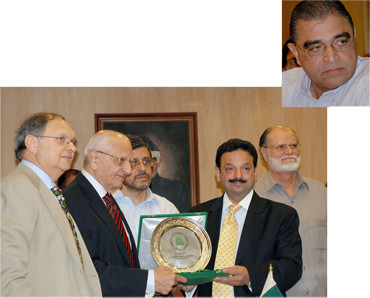
From left Byram Avari, Minoo Shroff receiving plaque from Tanvir Ahmed Sheikh. Inset: Arshad Alam
"This reflects the new interest (in Pakistan),” said Khan. The leaders of India and Pakistan had visited each other’s country. "People don’t want any war. They want friendship, peace.” Increased trade between the two nations would result in improved relations. "The mindset has changed,” he observed. Despite a political solution to the Kashmir issue (both countries claim sovereignty over the divided state), Khan noted, "we have to live together. We have a lot of things in common.” For instance both countries had an increasing population which is now viewed as a "potential” for economic growth.
"We would certainly like to welcome entrepreneurs (to Pakistan). Karachi is the major city of Pakistan. It contributes 60 to 70 percent to the national exchequer. It has a wide base of industry. It’s a vibrant city.” Karachi is the capital of Sindh province, the second largest of Pakistan’s four provinces.
Citing the economic and political progress made by this Islamic state, Khan noted the proliferation of mobile phones with around 62 million subscribers. "Half of those are consumed in Karachi,” he noted. "Whatever products we have are invariably (largely) consumed in Karachi.”
Khan observed the "Parsis have fond memories of past heritage and history in Pakistan. (Jinnah was married to a Parsi, Ruttie, the daughter of Sir Dinshaw Petit. Jinnah’s sober looking portrait loomed behind the governor in the chandeliered, carpeted hall where the meeting took place.)
Noting the Press and other institutions were free in the country, Khan remarked the government had "strengthened democracy and democratic process in Pakistan.”
Even though the government lost the case regarding the dismissal of the Supreme Court Chief Justice Iftikar Mohammed Chaudhry, "in reality we won because we allowed (the judiciary to function as it should and permitted) people to express their point of view. Pakistan has developed a lot of maturity.” A new second tier form of government was introduced to empower the people and to "overcome feudalism,” he added. The government was also "focused on development of the rural areas.”
Noting the common issues both countries faced, the governor said, "we can learn from each other. (We can) share expertise.” He regretted that Pakistan’s film industry was not prospering. Cinema theaters had been converted into shopping malls. Joint ventures for films were a possibility. Like India, Pakistan was also developing its information technology and looking at Indian partners.
The youthful, mustachioed governor, a former member of the pro-Musharraf Muttahida Qaumi Movement who fled Pakistan in 1992 when the Sharif government pressed murder and kidnapping charges against him, believes "the role of government is to facilitate” industry so that "the private sector can get opportunities for growth, government has no business to be in business,” he said. "In this (new) climate investment is coming in of unimaginable magnitude… agriculture and every sector is showing sustainable growth. "
The government was raising expenditure in education from one percent of gross domestic production to two percent. The international standard is four percent, he observed. Poverty and health were other sectors of concern to the government, noted the governor who had trained at the Sindh Medical College.
The governor thanked Avari for facilitating the WZCC delegation visit to Karachi and coming to meet him. "The community here (in Karachi) has credibility” thanks to people like Avari. "You have strong roots in both countries. (You’re) bringing together our two nations.” Avari had also arranged individual meetings at the request of some delegates with top Pakistani officials and businessmen. The hotelier credited WZCC Bombay chapter president Edil Katrak for coordinating the tour.
WZCC delegate Urvaksh Hoyvoy of Parsi Dairy Farm had brought, at the behest of Avari, 300 pieces of kulfi to Karachi for distribution to officials, business associates and others. Dressed in khaki trousers, striped shirt and jacket Khan thanked the delegation for the gift noting the sweets would "add to my weight.”
Mementoes were exchanged but due to protocol/security reasons cameras were not permitted in the governor’s home, once the British viceregal residency.
Federation visit
The call for closer relations was echoed at the meeting the WZCC delegation had with the president and other officials of the Federation of Pakistan Chamber of Commerce and Industry (FPCCI) on September 11, 2007. The monolith FPCCI building incidentally faced the mammoth Jehangir Kothari parade grounds donated by the Zoroastrian benefactor to the people of Pakistan. The grounds were gifted on March 21, 1921 and the renovated grounds were inaugurated by Pakistan President Pervez Musharraf on February 27, 2007.
Welcoming the delegation in a large boardroom which also featured a portrait of Jinnah in his younger days, FPCCI president Tanvir Ahmed Sheikh noted that "your community has been in business” in both countries for ages. It was the "political problems” that "were not letting (trade between the two countries) happen...in spite of an earnest desire” favoring commercial ties.
Being in the textile industry, Sheikh noted that Pakistan consumed "16.5 million bales of cotton of which 12.5 million were locally procured. India has surplus cotton. We are not buying as much as we can from India. We go to third countries.” The goods from India are imported by sea which works out expensive. "We are not able to import through the land route...which would be cheaper,” he observed.
Noting that FPCCI represents business interests to the government, Sheikh stated, "the business community in India is very strong. They can influence (the Indian) government.”
Despite both countries achieving independence 60 years ago, the trade between the two countries was a dismal $ 1.5 billion (the minister of trade, Tariq Ikram in his meeting on September 12, 2007 with delegates put the figure at $ 1 billion).
"India’s share (of the trade) is more....India has more to offer.” He urged the delegates to "explore each other’s markets.”
Shroff said it was "a real joy to visit Karachi. We travel abroad...but never to Pakistan” noting the two countries were "natural allies.” Shroff said the "Political logjam has to be broken.”
Shroff recalled that former Pakistan Prime Minister Zulfikar Ali Bhutto "grew up in India” and that Jinnah’s wife (and his doctor) were Parsis.
"There is no reason why $ 1.5 billion should not go up to $ 10 billion,” said Shroff. He spoke of the "economic scope in technical cooperation...our technology is more suited to Pakistan...it’s more compatible. The transfer of people is easier. We are closer to Pakistan than China with whom India has $ 25 billion of trade… Build new highways across... strengthen bridges...we have to do it ourselves...no third country can do it. The younger generation looks to Pakistan as a friend. At the grass root level we will do our best (to cement ties). We come with great hope.”
Avari called on corporate India to pressure their government to improve ties. "Corporate India can do it more formally and officially. In Pakistan we do it informally. Referring to the Kashmir issue, Avari said, "It is for us to make things work.” The politicians would also benefit from improved relations. "If there is economic growth they will get votes and get reelected,” he remarked.
Sheikh observed that when the Chinese government brutally cracked down on the dissenters at Tiananmen Square in 1989 slaughtering hundreds if not thousands of Chinese citizens, the American corporations convinced their government not to break ties with the brutal regime.
Arshad Alam, a former FPCCI vice president and chairman of the Standing Committee on Press and Media, while lauding the Parsi contribution to "the social sectors and development of Pakistan” said "the country was the best place to invest (in). Parsis should consider the best overseas venue to be Pakistan...culturally (both countries) are so near.”
He noted that 65 percent of the "trade of Europe is within the European Union. So why not (between) Pakistan and India? Pakistan is not only a place to which you can sell and not buy. Don’t make (Pakistan) a dumping ground. Buy” our goods, he urged.
India has granted Pakistan the Most Favoured Nation (MFN) status but Pakistan had not, Alam said. But despite the MFN, "we are still not able to export to India (due to to non-tariff barriers). The banks (also) don’t pay for two or three months.
"Pakistan is growing very fast. The problem is with image, (especially) after 9/11,” he concluded. At least for the delegation, the visit helped change that negative portrayal.
◆ ◆ ◆
From the archive