
Comment
“Welcomer” to all
With her navjote performed at the age of 44, Amy Jafarey kept ties with members of all faiths
Some 500 persons, from San Francisco to San Diego, came to Rustam Guiv Dar-e-Mehr, Westminster, Orange County, to participate in the celebration of the 82nd birthday of Amy Ali Jafarey, on Sunday, September 30, 2007. The occasion was jointly sponsored by the California Zoroastrian Center (CZC), the Zarathushtrian Assembly and the Jafarey family. It was a unique function. Instead of holding a memorial service in honor of a dear one who had departed to the life beyond on September 2, there was a celebration on her birth anniversary, just four weeks later.
The stage was decorated with a large photograph of her amidst abundant flowers. Susan Bakhtari, who knew Amy well, started with a sweet Persian poem. Mobed Bahram Shahzadi, head priest of the Center, recited a prayer in Avesta and Persian and praised Amy for her part in religious and social activities. Granddaughter Sara Razavi followed next with a broad smile to give Amy’s biography but burst into tears when describing her wonderful grandma. Unable to continue, she left the stage with tears flowing. Granddaughter Pouneh Pourkharabi, budding poetess, described in verse the love she had observed in her.
Next, a young hirbod (student) of the Good Religion of Zarathushtra from Tehran, Noushin Jehangiri, chanted from the Gathas while another, Arash Kasravi read the translation in Persian. It spoke of life’s progress towards entirety and eternity (Haurvatât and Ameretât). Our goddaughter Fariba Goshtasbi (Pirghaibi), a teacher of the Gatha Class at the Center, made the audience laugh by recalling the incident of Amy waiting a little too long for her tea to get cold prompting the server to take it away thinking that she did not want it. Then she described the two years she spent with Amy as a family member. Mitra Behmardian (Dinyari), another teacher of the religious classes, was the next to speak about Amy with a bright smile.
A slide show displaying 48 photos of Amy from 1941, when she was only 16 years old, to 2007 when she was approaching her 82nd birthday, gave glimpses of her private, parental, religious, cultural and social life with background music of her favorite Persian and Indian melodies. Heda Sarvi, a health expert who has been close to the family for almost 50 years, played Amy’s favorite tunes on the santoor, an Iranian musical instrument she lovingly encouraged him to learn.
Dr Zartosht Azadi came on the stage to recite a poem by Sa’di Shirazi, an outstanding poet of Iran (d. 1293 CE), that spoke of the sublime qualities of a good person. Dr Jose Louis Abreu, Professor of Ethical Management (based on the Good Religion), Monterrey University, Mexico and a founder of the Zoroastrian Movement in South America, spoke of Amy’s companionship. Dariush Irani, founder president of the Zarathushtrian Assembly, went further to describe the bonds between the two families from 1975 to 2007. And Mehrdad Parsa, a prominent member of ParsTV, had his praises for the motherly Amy. Center president Ardeshir Baghkhanian appreciated Amy’s services to the community.
The Zarathushtrian Ensemble, consisting of Dr Parviz Koupai (a founder of the Assembly), Ali Karimian (former assistant manager of the Commerce Bank, Iran), Parviz Fazel (engineer, residential and road architecture), Nozhat Ardekani (beauty saloon owner), Mahmoud Mosavi (electronics engineer) and Iraj Karimian (computer expert) came on stage to give a live concert of Iranian music so enjoyed by Amy at the Assembly gatherings. That gave guests the time to appreciate the music and the Indo-Iranian appetizers, soft drinks and fruits that decorated the tables in the adjacent hall.
The wonderful event in honor of Amy owes its success to Baghkhanian, Yasaman Farin, Goshtasbi, Behmardian, Shahbahram Pouladzandi, Sohrab Khoobyari and Rostam Kasravi, members of the Center, who prepared and managed the entire program, especially Kasravi who was the unseen spirit behind the entire function.
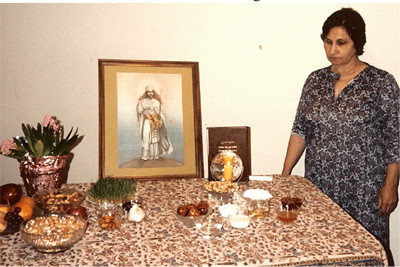
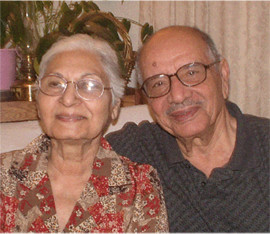
Top: Amy and Ali Jafarey at their 62nd wedding anniversary in 2006; (above) Navroz table laid by Amy in 1986
Lost Amy, my love
Amineh Naderi, was born on September 30, 1925 in Abadan, Iran, in a Shirazi family. Her parents sent her to her aunt in Karachi, then in India, in 1937. Her cousin, Nasser Mostowfi, was my classmate and a very close friend. It took Amy and me five years to draw closer until I asked her if she would marry me knowing that I was not a Muslim. She smiled and said that she too was not a Muslim and would love the union. We disclosed this first to her aunt and cousin, and then to our parents. Although a union of two lovers was unheard among the small Iranian community, so used to arranged marriages, the aunt, the cousin and our parents agreed. We were married on February 9, 1944.
My mother was the fifth generation of a Zoroastrian family of Kerman which was forced about 150 years ago to convert to Islam. She and her family never forgot that and I too was informed of it in my boyhood. My later studies have shown that my father’s ancestors of southern Kerman were defeated some 900 years ago and forced to convert to Islam. At the age of 14, I read books on modern science. It made me lose my faith in Islam and akin religions. Then, through a Parsi friend, Eruch Bulsara, I became a disciple of Dr Maneck B. Pithawalla, principal of the B. V. S. Parsi High School and later of Dastur (Dr) Maneckji N. Dhalla. That gave me my religion of "choice.” The divine doctrine of Zarathushtra Spitama is thought-provoking, rational, progressive, ever-fresh and ever-modern with a scientific basis. I had my navjote done almost 40 years ago in Tehran.
Our marriage meant a new life, a life of love for all: relatives, friends and the unfriendly. A novel way of partnership. I called her Amy, literally "beloved” right in the beginning of our love, a name adopted by all, even by the children, grandchildren and great-granddaughter Naazanin. This became her official name when we became US citizens. My father was called "Baba” by the small Iranian community of Karachi because he was the oldest of them all. He lived for 108 years. Amy transferred the name to me and the joint name, Amybaba, has been the way our children and close friends have been calling us two.
As a family member, Amy was there at the deathbed of her parents and my sister, who had fostered me as her own child since I lost my mother. Amy was ever at hand to serve my father. She mothered her two younger brothers Abbas and Nazir, lovingly cared about her younger sister Hannou until her marriage, and was a loving relative to every kin.
Amy proved, from the very beginning of our partnership, a "loving counselor” of low profile. She proposed I should get a better job. It raised our income three times over. Yet again, another better job. Later, resumption of my college and university studies; going to Saudi Arabia for an even better job; leaving Saudi Arabia because of the lack of provisions for girl education; returning to Iran; preferring Tehran over her birthplace Abadan; establishing a translation bureau; joining the Ministry of Culture and Arts to serve Iran; founding the joint Iran-Pakistan Institute of Persian Studies in Islamabad; helping me in running the enterprise of the first and still unique way of Persian studies in the Indo-Iranian realm; and finally coming to the USA to dedicate herself to the Good Conscience, the way of life she chose of her own considerate will.
In Tehran, she prompted me to get in close contact with the Zoroastrian community as soon as we were well established. She had her quiet navjote ceremony done in the garden of our close friend the late Shah Jamshid Soroushian, in Kerman, in 1969. She was very active and yet kept a low profile in my "Gatha” and "Message of Zarathushtra” classes held in the Zoroastrian Association, the Zoroastrian Women’s Organization, the Zoroastrian Youth Organization and the Ancient Iranian Cultural Society in Tehran. In Los Angeles, her part in our activities at the California Zoroastrian Center and the Zarathushtrian Assembly was quite evident.
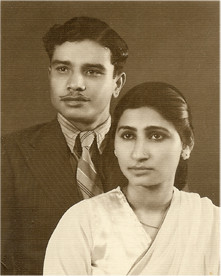
Ali and Amy Jafarey on their first wedding anniversary in Karachi in 1945
Watching a few small group initiations (navjotes) of young Zoroastrian adults arranged by me, ZICA (Zoroastrian International Cultural Association), run by the Parsi residents of Tehran, came forward so that the group navjotes of Iranian youth in Yazd, Kerman and Zahedan could be performed for the first time with the Association bearing the expenses. I was asked to be the intermediary between the Parsis and the Iranis. Amy was instrumental in preparing the mobeds and laity in Yazd. Group navjotes of adult "born-Zoroastrians” have now become routine in Iran and abroad. The same holds true for those who choose the Good Religion as their way of life.
Amy was instrumental in building closer relations with other religious minorities in Tehran so much so that our three children Nahid, Nasrin and Nozar were the first to join Dabirestân-e-Ettefâgh, the Jewish High School in Tehran. Later, Nahid and Nozar joined the Indian High School, established by the Sikh residents of Tehran. Much later, our youngest daughter Naghmeh went to a Christian school. It brought us closer to Jews, Sikhs, Hindus and Christians. Very soon we became the godparents of a young man, commonly known as Moti (pearl) Sabarwal, only to have him and his wife Kundan (fine gold) become the pearl and gold of our family as our godchildren, grandchildren, great-grandchildren and their next of kin as our nearest relatives, from Tehran to Los Angeles. Amy was a very good friend and a popular counselor, even a successful psychological adviser to remove differences, hatred and animosity.
Amy was an ever-smiling "welcomer” to all: to Iranians as an Iranian, to Parsis as a compatriot and to others as a close friend. As far as Zartoshtis who knew her are concerned, it will take pages to fill their last names and that is why I would put it "from Abadian to Zomorrodi” for Iranis and "Amaria to Zarolia” for Parsis. There are many Iranian ladies who have been very close to her, but again it would take a full page or more to name them. I would only single out Farangis Shahrokh Yeganegi who, as an elder sister, has been with us for the last 47 years. We owe her much.
Except at Iranian functions, Amy dressed herself in kurta and salwar, a typical pre-Islamic Iranian dress preserved until the Western styles took over, and she was thought by many in pre-partition Karachi as Hindu, particularly when she had the red bindi (dot) on her forehead. But when she wore a sari, she was taken to be a typical Parsi. Generally, whenever some Parsis who met us for the first time asked me if I was a Parsi, I would say "I am Iroon junglee” and point to her that she was Parsi, because as a Shirazi she came from the province of Pars and the Iranians know the people there as "Parsi” or "ahl-e Pars/Fars — people of Pars/Fars.” She was a true "Parsi” and loved the Parsis.
She was a wonderful cook of Indo-Iranian foods, especially the Persian Gulf dishes. She started writing a book on the Moghal recipes by studying various manuscripts at the Iran-Pakistan Institute of Persian Studies, but our unexpected return to Tehran deprived her of her literary resources making her forsake her mission.
She spoke, read and wrote in Persian, Urdu and English, spoke and read Arabic, and understood Baluchi, Gujarati and Sindhi. She retained her sweet Shirazi accent all along in spite of the Tehrani accent of her smiling children and friends. Educationally, her brother, Nazir, and children — Nahid, Nasrin, Nozer and Naghmeh — stand high in business, decoration, education, engineering and public relations. Her earnest desire that one of the children become a physician was surprisingly fulfilled one day by Ellie Farshidi, our family physician, who announced herself as her eldest daughter and embraced her in her clinic. She and her spouse Dr Bahram Farshidi were with her through her suffering, ensuring her comfort and giving us solace.
Amy, the "beloved” of all, had a fall that fractured her hip and struggling hard to recover she developed a cancerous growth that weakened her further. She fell into a peaceful sleep, leaving behind her four children, eight grandchildren, one great-grandchild Naazanin, and her hamsar (match), and departed to life beyond on the morning of Sunday, September 2, 2007 and was quietly buried at a cemetery close to her house, on September 8.
Physically the loving counselor has gone silent but mentally she is very, very alive.
A founder director of the Zarathushtrian Assembly and a founder trustee of the Cyrus Society, Dr Ali Jafarey’s fields of specialization include Indo-Iranian history, geography, culture, religion, linguistics and literature. Author of 16 books in Persian and English on the Zarathushtrian religion and Iranian culture, Jafarey has taught at various universities and institutions in Iran and Pakistan.
◆ ◆ ◆
From the archive