
Literature
Love of the lyrical language
Orthodontist Dr Navroze Kotwal has been writing Urdu poetry since his college days
"Shaayari, shaayar ki mukhtalif kaifiyaton kaa nuzool hai/Gar baat dil se ho kar zabaan tak na aaye to woh fuzool hai. (Poetry is the result of the various thoughts in a poet’s mind. If what is said does not come straight from the heart, it is worthless.)”
This couplet from among the many ghazals and nazms that have been penned by orthodontist Dr Navroze Kotwal conveys his sentiments in Urdu, "a beautiful language” through which he has chosen to express himself. "Urdu, especially Urdu poetry, is like music to the ears,” he enthuses.
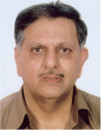
To members of the Zoroastrian community and others who look askance at his fascination for Urdu, Kotwal feels obliged to "clear this misconception from the minds of people that Urdu is the language only of the Muslims just because it is the language used in the capital, in Muslim dominated places such as Uttar Pradesh, Hyderabad and some parts of Pakistan. In fact in the Sindh area of Pakistan they speak Sindhi, in Baluchistan, Baluchi, and in Peshawar, Pashto.” If Urdu was the language of the Muslims, then people in Indonesia, Malaysia and several African countries, all predominantly Muslim, would have been speaking this language, he conveys.
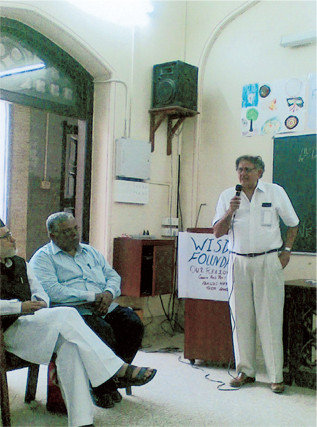
Dr Navroze Kotwal (top and above) at St Xavier’s College at a meeting conducted under the aegis of the Wisdom Foundation to condemn the terrorist attacks of 26/11. Various religious heads attended including (seated from left) Maulana Zaheer Abbas and Rabbi Ezra Moses
Even in India, Muslims living in various states speak the regional language of their state, he points out. And in fact the "Deccan Urdu spoken in Hyderabad sounds somewhat different from Urdu spoken in Lucknow or Delhi.” Urdu originated and was developed in northern India, most probably in Delhi, he believes.
"Urdu is a lyrical language of metaphor and symbolism, a language of poets and scholars. Unfortunately because of the conflict between Hindus and Muslims it has been politicized…Urdu is not a religion, it is a language of culture shared by both Hindus and Muslims,” he is emphatic. Dwelling at length on this subject Kotwal was inspired to compose the ghazal on Urdu Zabaan (see pg 37).
There was a time in the 1920s-30s when Parsi theater was synonymous with Urdu theater, with the stage productions on different themes being enacted exclusively in Urdu, a language in which the Parsi cast was well conversant. The Hindi films too in the early part of the 20th century had renowned Parsi actors like Sohrab Modi who was known for his delivery of Urdu dialogs. The film Alam Ara made by Ardeshir Irani had music composed by Pirojsha Jamaji Mistry. In the course of treating Mistry’s great grand daughters, Kotwal learnt that even Pirojsha’s son Kersi, a musician himself, unfortunately did not have the music of the earlier epoch. "So much of our old heritage is lost,” regrets Kotwal.
He has grown up on a genre of good Hindi historical films like Mughal-e-Azam, Taj Mahal, Anarkali, Jahanara and Muslim socials like Barsaat Ki Raat, Chaudhvi Ka Chand. The content of such films "gave great scope for beautiful Urdu poetry. In those days every lyricist was a good poet. Even the film music had great poetry,” says Kotwal proud of his collection of old Hindi songs. His father Shavak being one of the partners of Evergreen Pictures, Kotwal recalls his continuous exposure to shootings of Hindi films and recordings of songs since the age of eight years. Lyricists today are handicapped, he observes, because "the tapori (riffraff) type characters in the present day films are not expected to speak good, chaste Urdu.”
It was Sahir Ludhianvi who wrote lyrics for films like Pyasa who inspired Kotwal to try his hand at Urdu compositions. Although no one in his family spoke Urdu, under the influence of contemporary Urdu poets like Iftiquar Imam, Shamim Abbas and especially Shafiq Abbas, "the most important influence in inspiring me to write Urdu poetry,” Kotwal tried to express his thoughts in Urdu. "Sometimes I am blank for months and sometimes I may get a sudden flash when driving,” says Kotwal who neither believes in "writing fast or vast” and has many unfinished works although several of his compositions have appeared in print in Urdu magazines like Shayar, Kitabnuma, Hamaari Zabaan and on the literary page of Sunday Inquilab.
Among the city’s leading Urdu poets, Kotwal had participated in a mushaira organized by the Sahyog Cultural Society to condemn the terrorist attacks on the city on November 26, 2008. One of his couplets on the subject: "Yun noch noch khana darinda sifat hai kaam/Insaan ne kyon mita diya insaaniyat ka naam (The habit of eating bit by bit is a beastly act. Why have humans eroded the name of humanity)?” (see Ghazal on terrorism, pg 42) was part of a ghazal written soon after the terrorists struck seven different trains in Bombay in July 2006 to "express my pain, anguish and condemnation.”
Over the years Kotwal has written more ghazals than nazms. Among the two best known forms of Urdu poetry, a ghazal is composed of a series of couplets. A ghazal can be continuous (musalsal) on one particular subject or non-continuous where every couplet tells its own story. The first misra or line of a couplet is in the form of a question and the second misra, which the reader/audience awaits with keen expectation, is in the form of an answer. The first couplet of a ghazal is called the matla, and the last where the poet usually brings in his name is called the maqta.
In a nazm the poet expresses himself in a verse format. It can be a free verse (aazaad nazm) or rhyming verse (paaband nazm). The paaband nazm may adopt the radeef style of the ghazal where the same word is repeated at the end of each couplet or the qafiya format where rhyming words are used at the end of the line. A ghazal must have a qafiya but it can be without a radeef, Kotwal explains the finer nuances. One of his nazms (see pg 37) was inspired by his mother Meher during the last days of her life in hospital when "she was too weak even to speak to me. She wanted to say certain things to me but had to convey by facial expressions and signs made by her hands.”
The other forms of Urdu poetry are hamd (in praise of God), naat (in praise of prophets), qaseeda (in praise of royals), manqabat (in praise of holy people), marcia (elegy or lamentation) and masnavi (epic).
Before Kotwal developed a fascination for Urdu, he had mastered the Hindi language. He remembers his student days at St Mary’s School when he took others by surprise — "a Parsi boy winning a prize in Hindi.” Later during his college days at St Xavier’s, the Institute of Science and Government Dental College, Bombay he became friendly with those who spoke good Urdu "which furthered my interest in the language.” Even after he completed his masters in orthodontics from Indiana University, USA, Kotwal continued to pursue his study of Urdu.
The Urdu alphabet has 36 letters, we learn. Originally there were 22 letters taken from the Sami or Sumerian language. Then six more letters were added from Arabic, another four from Persian and yet another four from Hindi. Although the Urdu and Persian scripts are known to be similar Kotwal’s only regret is that "I have no knowledge of Persian.” Many in India speak Hindustani which is a mix of Hindi and Urdu, for the grammar of the two languages is the same although the vocabulary differs (Urdu incorporating many Persian words, and Hindi many Sanskrit words).
Making time for sports too, being the Bombay State Junior Badminton champion in 1959, Kotwal refers to his trip to Beijing for the Olympics last year when two Muslim boys from Iran — Meherdad and Meherzad — mistaking him for an Iranian, came up to him and hugged him and started talking to him in Persian. When Kotwal revealed his Zoroastrian ancestry, "they were ecstatic and declared ‘nek pindaar, nek guftaar, nek kirdaar (good thoughts, good words, good deeds).’”
Being an ordained navar and having participated in jashans, Kotwal professes "great faith” in his religion "though I may not go to the fire temple every day.” Whilst appreciating that the "sanctity of fire temples has to be respected,” Kotwal maintains, "I consider all religions equal; no one is superior.” His son-in-law Tommy Cornett he considers "a wonderful person” although he is not a Parsi. Daughter Nairika has completed her degree in dance from Brenau University in Georgia and is now settled in USA with her husband and children Kamyaab (meaning successful) and Shayaan (meaning worthy), both names suggested by Navroze when she sought his recommendations from the ‘k’ and ‘sh’ raashi. Navroze also has a son Kaizaad who is professor of theater at the Ohio State University.
On the day of the interview with Parsiana, the Mumbai Mirror had carried the front page report of seven-year-old Farzin Batliwalla having died of starvation after her Parsi father deserted his non-Parsi wife and three children. Convinced that "something could have been done to avert this tragedy,” Kotwal hopes that the community will look after the younger two children instead of carrying their fights to the media "and making a fool of themselves.”
Seeing the world divided on the basis of religious denominations, Kotwal has penned yet another couplet: "Insaan toh but chuka hai mazhabon ke maare/Khuda ke wastey ab Khuda ko bhi na baant dena (World is divided on the basis of religion. For God’s sake don’t divide God too.)”
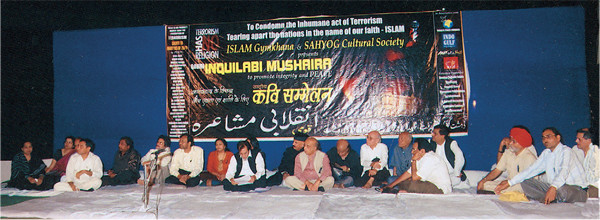
Kotwal (extreme right) at a mushaira at Islam Gymkhana in December 2008 to condemn the 26/11 terrorist attack
Kotwal’s rhymes
Kotwal’s verses and the corresponding translations that he has given with great reluctance for he firmly believes like Robert Frost: "poetry is that which is lost in translation.” When translating from any one language to another, the soul is lost, only the shell remains, he regrets.
Ghazal on Urdu Zabaan
Urdu na Mussalmaan, na Hindu ki hai zabaan
Ishq-o-wafa ke rang ki, khushbu ki hai zabaan
Mazhab ki tangiyon se isey waasta nahin
Insaaniyat ho jismey, usi khu ki hai zabaan
Magreeb ho ya ke sharq, shumaal-o-junoob ho
Iss kaenaat mein yeh har ek su ki hai zabaan
Makhsoos log iss ke, na haakim kabhi huey
Rastey pe chalti phirti man-o-tu ki hai zabaan
Hare ek ke saath isska masavi sulook hai
Aaqa ki aur ghulaam ki, babu ki hai zabaan
Hai tantana bhi ismey, mohabbat ki aag bhi
Jah-o-jalaal-e-Akbar ki, sheikhu ki hai zabaan
Kaise azeem logon ko taskheer har gayi
‘Iqbal’-o-‘meer’-o-‘Mirza’ ke jaadu ki hai zabaan
Zulmat kadeh mein jaise ke bijli chamak uthey
Kaali andheri raaton mein, jugnu ki hai zabaan
Maashooqiyat bhi ismey mujassim si ho gayi
Husn-e-lab-o-rukhsaar ki, gesu ki hai zaabaan
Had se hi zyaada pyaari na mujhko lagey yeh kyon
‘Navroze’ yeh meri, mere goolru ki hai zabaan
Translation
Urdu is neither the language of the Muslims, nor that of the Hindus
It is the language of sincerity and the fragrance of love
Urdu has no connection with any religion
It is the language of those who have faith in humanity
Be it West or East, be it North or South
In this Universe, Urdu belongs everywhere
Urdu has never been ruled by anyone in particular
It is the common man’s language, spoken by you and me
Urdu is the language of the ruler and of the ruled
It accords equal treatment to all concerned
Urdu boasts of pomp and splendor, as also the fire of love
It was emperor Akbar’s and his prince Salim’s language
Urdu has captivated such great minds, that
It was the language of the magic of ‘Iqbal,’ ‘Meer’ and ‘Ghalib’
Just as lightning would strike on a dark night
Urdu glows like a fire fly in a starless sky
The beloved’s beauty is epitomized in Urdu
It is the language of the beauty of the lips, cheeks and tresses
Why should I not hold Urdu really close to my heart, for
It is my language and that of my beloved
Nazm (on the threshold of death)
Zindagi phir bhi chalti rehti hai
Zindagi chahe ek kahani ho/Guftgu saari bezabaani ho
Har taraf marg-e-nagahani ho
Zindagi phir bhi chalti rehti hai
Har wafa mein jafa ka dhang miley
Noor mein zulmaton ka rang miley
Jism par har kaba hi tang miley
Zindagi phir bhi chalti rehti hai
Apne sab ho jahan mein begaane
Har haqeeqat sunaye afsaane
Hum ko koi yahan na pehchaane
Zindagi phir bhi chalti rehti hai
Door manzil se jab bhi ghaafil ho
Rehjani taakti muqaabil ho
Kashti dube jahan pe saahil ho
Zindagi phir bhi chalti rehti hai
Zakhm jitney hain daag hon sab
Dil mein goya chiraag hon sab
Ishq ka ek suraag hon sab
Zindagi phir bhi chalti reht hai
Aaj jaane kahan se mah nikla
Who bhi kya kuch na mujshe kah nikla
Ashq aankon se meri bah nikla
Zindagi phir bhi chalti rehti hai
Baad-o-Baaraan na gar zameen se miley
Phool koi na phir kahin pe khiley
Ek patta na apni jagah se hiley
Zindagi phir bhi chalti rehti hai
Log zinda hain yaan dafeene se
Koi rehta nahin kareene se
Hum toh baaz aaye aise jeene se
Zindagi phir bhi chalti rehti hai
Jal chukka ho kaleja peene mein
Mar gayein ho aarzooein seene mein
Ab mazaa kya raha ho jeene mein
Zindagi phir bhi chalti rehti hai
Waqt ka ek jhonka aaya toh kya
Marg dekar humein rulaya toh kya
Usne jashn-e-ajal manaya toh kya
Kuch bhi ho jaaye, maut marti hai
Zindagi phir bhi chalti rehti hai
Translation
But, life yet goes on
Life may be like fiction
Conversations may be by sign language
Everywhere there may be sudden deaths
But, life yet goes on
There are shades of deceit among the faithful
There are shades of darkness in every light
There aren’t enough clothes to cover everybody
But, life yet goes on
Those who are our own may behave like strangers
Every truth may sound just like a story
People may refuse to recognize us
But, life yet goes on
You may be oblivious of your destination
Your attackers may be right in front of you
Your ship may sink right near the shore
But, life yet goes on
Every wound may form a spot on your heart
Yet they may glow like lights from your heart
They may all be signs of unrequited love
But, life yet goes on
The moon suddenly appears without informing us
We are not aware what it means to us
Suddenly our eyes well up with tears
But, life yet goes on
Our earth may not be blessed with wind or water
Flowers may never bloom again
Not a leaf may be blown away
But, life yet goes on
People may live like some hidden treasure
Nobody may be leading a proper life
We may not approve of such living
But, life yet goes on
One’s spirit may have been consumed by drinking
All hopes may have been snuffed out of the heart
Life itself may not be worth living
But, life yet goes on
Time may deal a cruel blow to us
We may grieve for death itself
Others may celebrate the death of someone
Whatever happens, death remains
But, life yet goes on
Ghazal on terrorism
Nikley the kal jo subah ko, kartey huey salaam
Lautey na ghar ko, aa hi gayi, zindagi ki shaam
Jalti rahi dilon mein, jo yeh naar-e-intaqaam
Barbaadiyon ke kissey, na honge kabhi tamaam
Yun noch noch khaana, darinda sifat hai kaam
Insaan ne kyon mita diya, insaaniyat ka naam
Pahuncha ke zak kisiko, kiya bhi jo zer-e-daam
Mansab hua buland, yeh kaisa khayaal-e-khaam
Ghaaratgari, fassad, qahar, loot, qatl-e-aam
Kya ab yehi bacha hai yahan, laayak-e-anaam
Yun bebason ko maarna, hai buzdilon ka kaam
Nafreen hai khuda issey, mazhab bhi ho badnaam
Ab toh khuda ke wastey, jhagde karein tamaam
Hindu ke lab pe Allah ho, Muslim pukarey Ram
‘Navroze’ dast-e-dil mein, mohabbat ko aisey thaam
Insaaniyat ko duniya mein, har ja miley dawaam
Translation
Those who left home in the morning, saying ‘Salaam’
Did not return, for arrived suddenly the evening of their lives
If the fire of revenge keeps raging in people’s hearts
These acts of destruction will never come to an end
Devouring bit by bit is a beastly act
Why did human beings erode the good name of humanity
That, by capturing one after causing grievous harm
Raises your status, is a mean and low thought
Plunder, violence, fury, pillage, massacre
Is this all that is left for humans to do?
Killing of the helpless is the work of cowards
This incurs the Almighty’s wrath and brings disgrace to one’s religion
For God’s sake, let us put an end to fighting
May Allah be on Hindu’s lips, may Muslims chant the name of Ram
‘Navroze’ hold love so close to your heart, that,
The message of humanity spreads everywhere and forever
◆ ◆ ◆
From the archive