
Cover Story
The weapons of choice
The art and design of sword making and carrying during the reign of the Sassanian Zoroastrian rulers is expounded
The sword was a symbol of rank and authority in the Sassanian period. In contrast to Achaemenian and Parthian kings, Sassanian kings adhered strictly to the teachings of Zoroastrianism. Therefore, there are no graves of Sassanian kings left since the burial of the dead was strictly forbidden, as writes Ahmad Tajbakhsh in Tarikh-e Mokhtasar-e Tamadon va Farhang Iran Gabl Az Islam (The Concise History of Iranian Civilization and Culture Before Islam). Thus excavated Sassanian swords cannot be attributed to any king or even an important person with any degree of certainty.
In Sassanian art, the king is always portrayed with a sword while hunting on horseback or enthroned in majesty, as conveyed by Prudence Oliver Harper in The Royal Hunter: Art of the Sassanian Empire. This is confirmed by G. Gunter and Paul Jett who state in Ancient Iranian Metalwork in the Arthur M. Sackler Gallery and the Freer Gallery of Art that swords were an important royal emblem in Sassanian Iran and were prominently displayed along with other royal equipment, such as the crown. Based on these representations, most Sassanian swords were either carried via a scabbard slide attached to the center of the scabbard or were attached to the belt by straps passing through loops on two P-shaped scabbard attachments placed at a distance from each other on the scabbard.
Based on their shape, Sassanian swords can be classified in four different types, as mentioned in my book Arms and Armor from Iran: The Bronze Age to the End of the Qajar Period. There were swords with crossguards; swords with scabbards with P-shaped attachments; swords with silver-covered scabbards and handles that were decorated with a feather pattern without P-shaped attachments on the scabbard; and two-handed Sassanian swords.
Similar to their Parthian predecessors, early Sassanian swords had broad guards, long and straight blades, and were suspended by scabbard slides in front of the body, explains Kaveh Farrokh in Sassanian Elite Cavalry AD 224-642. He further opines that early Sassanian swords share many features with Sarmatian swords, namely sword suspension, globe-shaped pommels, and wide sword guards. He further adds that this Sarmatian influence may have been introduced by the Kushans into the Parthian empire. The Sassanians, then, adopted the Parthian sword into their own military system. Farrokh rightly observes that early Sassanian swords were suspended vertically from the belt via the scabbard slide, meaning that swords were suspended vertically from a metal slide mounted on the scabbard, and this allowed swords to be moved along the belt. One should note that swords with a scabbard slide were hung in front of the body in a vertical position.
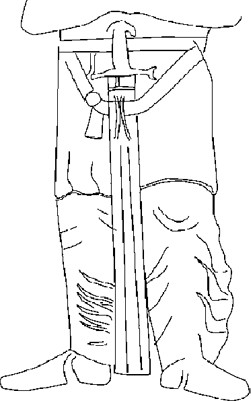
Late Sassanian swords had two attachments on their scabbards. By passing a belt through these two P-shaped attachments, the sword could be carried horizontally. By using P-shaped mounts, Sassanian warriors were able to carry the sword at an oblique angle. Harper is of the opinion that this type of sword with P-shaped scabbard mounts was not originally Sassanian in design and that the Sassanians adopted such weapons and mounts in the sixth century AD. Gunter and Jett are of the opinion that this type of sword suspension seems to have reached and influenced the Sassanians from the Central Asian Hephthalites, presumably during the late fourth or early fifth century AD. Harper states that the P-shaped suspension system that allowed the sword to be hung at an angle is especially interesting and convenient for mounted warriors.
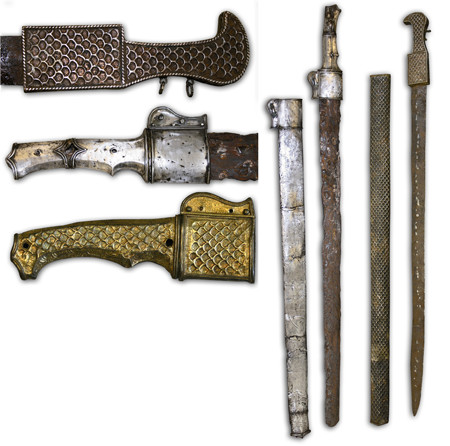
Sassanian swords (above, from top): Silver beak-shaped handle (courtesy, Cultural Institute of Bonyad); sword handle and P-shaped silver scabbard attachment; golden handle and P-shaped scabbard attachment with feather pattern. Alongside: Sword with two P-shaped silver scabbard attachments; (extreme right) sword with silver beak-shaped handle (courtesy, Cultural Institute of Bonyad). Below: Warrior carrying a sword via a scabbard slide system
However, unlike Harper, who sees the introduction of the P-shaped scabbard system as an improvement for the cavalry, Farrokh states that swords suspended vertically via the scabbard slide were also suitable for cavalry as the depiction of Shapur in the Naqsh-e Rostam site clearly shows. Shapur is depicted resting his left hand on the hilt, tilting the sword by 45 degrees to the right, allowing the scabbard to rest on the flank of the horse behind his leg. Farrokh considers the introduction of the two-point (double-locket) system or P-shaped scabbard system a clear improvement in sword suspension for infantry soldiers as the infantry could not efficiently use the scabbard slide on the march due to the fact that the sword would drag on the ground unless constant pressure was applied to the hilt.
As notes K. Masia in her article, "The Evolution of Swords and Daggers in the Sassanian Empire,” published in Iranica Antiqua, Vol XXXV, the archeological examples of Sassanian swords have narrow blades and curved hilts. Further, these swords have very small guards or none at all. Masia further states that almost all of these swords are decorated with a feather pattern, and the same pattern can be seen on other Sassanian decorative art as well. Harper quotes Roman Ghirshman [Notes Iraniennes XIII: Trois Épées Sassanianes published in Artibus Asiae (Ascona), Vol XXXVI] who interprets the feather pattern as a symbol of the Varagn bird, one of the shapes of Verethragna, the Zoroastrian deity of victory. Soudavar explains in The Aura of Kings: Legitimacy and Divine Sanction in Iranian Kingship that among the Zoroastrian deities, Verethragna is often associated with khvarnah (the divine glory) and, in the Avesta, boasts that he possesses the most khvarnah. However, Soudavar stresses that Verethragna is only in possession of the khvarnah, whereas Mithra not only gives khvarnah and power as offering but can also take it away. Since Verethragna only receives khvarnah, Verethragna has a position subordinate to that of Mithra. It is for this reason that in Meher Yasht, Verethragna runs in front of Mithra, opening a path and striking at opponents. Sassanian warriors used the feather pattern on their swords and armor to protect themselves against their enemies. Farrokh shares this view and states that the front of the scabbard was decorated in the Verethragna feather pattern.
There are Sassanian swords that have a feather pattern on the scabbard but lack P-shaped scabbard attachments. Additionally, they have a beak-shaped handle, and on the side of the handle straps on the back, there are two rings attached; most probably, a handle strap was passed through these rings so as to offer improved control of the sword, specifically retrieval by the swordsman in case the sword slipped from the hand.
Two-handed Sassanian swords have a long handle and two protective discs that are placed at a distance from each other on the handle. One excavated example of this type of sword is kept in the National Museum of Iran. This sword is the first known archeological example of a two-handed Iranian sword. This sword has a total length of 116.5 cm (the total length of the blade is 85 cm, and the total length of the blade with its reinforcement on the forte is 86 cm). The total length of the handle is 31 cm, and there are two discs placed at a distance on the handle. The distance between these two protective discs on the handle is 21.5 cm. The long blade has a reinforcement at its forte as well as a central rib that runs throughout the whole blade until the tip. The blade is heavily corroded.
Persian sources on arms of the Sassanian period offer scant information, according to Ghirshman. This dearth of academic information is filled to an extent by the work of Tiratsian who offers chapters written by contemporary Armenian historians of the Sassanian period in the first half of the fifth century AD. These historians distinguish between three forms of Sassanian arms carried simultaneously by the nobles: a short sword that was attached to a belt on the right side; a long sword that was also attached to the sword belt on the left side with the help of a scabbard slide and is considered typically characteristic of Sassanian armament; and a dagger.
The elite cavalry formed the military backbone of the Persian empire during the Sassanian period. The Sassanian mounted warriors followed the principles of honorable warriors and helped the empire to defend its national borders against foreign invaders. At the same time, the expansionist policies of the Sassanian empire highly emphasized both offensive and defensive warfare, and the technology of warfare played a crucial role during the empire’s history. This resulted in contact being made with various kingdoms in the East (Afghanistan, Central Asia and China) and in the West (Rome, Asia Minor, Armenia, Syria and Egypt), observes Masia. The warriors were equipped with different offensive and defensive weapons. The swords and daggers used in the Sassanian empire are witness to the development of military technology as a result of confrontations with other nations and also reveal traces of the Parthian tradition in warfare.

Manouchehr Moshtagh Khorasani is the author of Arms and Armor from Iran: The Bronze Age to the End of the Qajar Period (for more information see http://www.arms-and-armor-from-iran.de) that features a detailed analysis of Iranian arms and armor from the pre-historical times to the end of the Qajar rule (1925) in Iran. Presently he is preparing his second book Lexicon of Arms and Armor from Iran: A Study of Symbols and Terminology that will feature the inventory of arms and armor of The Cultural Institution of the Museums of Bonyad. He has majored in English linguistics and Business Administration and minored in Spanish from the University of Giessen (Germany), the University of Wisconsin (USA) and Universidad de Salamanca (Spain). Keenly interested in martial arts he has extensive experience in international competitions.
◆ ◆ ◆
From the archive